In Bhutan, the pursuit of happiness extends to the food system

In Bhutan, the pursuit of happiness extends to the food system

Bhutan is a Himalayan kingdom sandwiched between China and India. Forty percent of its 800,000 citizens work in the agriculture sector. The mountainous country is famous for its breathtaking landscapes and its unique policy of "Gross National Happiness," instituted in 1972 by Jigme Singye Wangchuck, the fourth king of Bhutan.

My guests on the Newscast this week say this philosophy is the backbone of the nation's food system, and its plan for full food self-sufficiency by 2029.

"Our food system isn't just about producing food. It's about sustaining our landscapes, our communities, and our culture," says renowned chef and restaurateur Bleu Tshering Dorji. She owns two restaurants in the nation's capital, Thimpu. She explains the unique challenges farmers she works with face due to climate change and steep mountain terrain.

"We are a mountainous landlocked country, and only a small percentage of our land is, I think, actually suitable for agriculture. We don't have the luxury of just expanding farmland. We have to make better use of the land that we sort of already have," she says.

"Labor is becoming extremely scarce as young people sort of move away from agriculture, and farmers still have to deal with issues like wildlife conflict, unpredictable weather, and also getting their produce to the market," Bleu says.

Sonam Wangchuk is an executive specialist at the Ministry of Agriculture and Livestock for the government of Bhutan. He also joins the conversation to explain how the government plans to address these challenges through the 13th five-year plan, "Transforming the Agrifood Sector for Economic Growth and Sustainable Development." The plan calls for spending the equivalent of about $180 million through 2029. Much of these funds appear to be directly supporting smallholder farmers, the majority of whom in Bhutan are women.

"We have been working to strengthen the capacity of the smallholder farmers, especially through training on climate-smart agriculture, improve production technologies, farm mechanization, post-harvest management, value addition and agribusiness and business development for women and youth," Wangchuk says.

"The skills are imparted to improve access to finance, technology and markets and creating an environment of entrepreneurship and to support the farmer groups and cooperatives."

Some government measures have received criticism, such as the implementation of a 3,400-kilometer (2,100-mile) fence to deter human-wildlife conflict.

A previous study from 2023 on agricultural practices in the nation suggested that, "Bhutan should emphasise women-centred initiatives by enhancing access to assets, raising awareness of climate change mitigation strategies, and developing training programs to promote CSA," or climate-smart agriculture.

This appears to be what the plan aims to do. However, not all challenges are easily solved with funding. Previous Mongabay fellow Choki Wangmo highlighted some of these challenges through the story of Pen Zam, a medicinal mushroom gatherer who struggles with a shrinking habitat at extremely high altitudes to attain a fraction of what her family used to gather decades ago, before the current climate impacts of today.

Later this month, the inaugural Global Conscious Food Systems Summit will take place in Bhutan.

Please take a minute to let us know what you think of our podcast here.

Mike DiGirolamo is the host & producer for the Mongabay Newscast based in Sydney. Find him on LinkedIn and Bluesky.

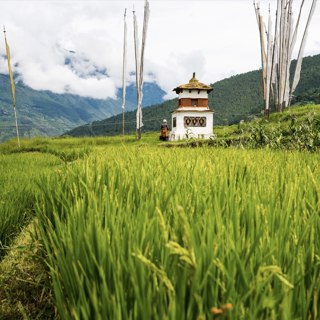
Cover Image: A chorten, or Buddhist stupa, at a rice field in Bhutan. Image by thaths via Flickr (CC BY-NC 2.0).

—-

Time codes

(00:00) Bhutan is transforming its food system

(06:45) A challenge ahead

(12:53) How 'Gross National Happiness' guides the way

(19:04) Supporting farmers amidst climate change

(29:36) Moving the global conversation forward

Det här avsnittet är hämtat från ett öppet RSS-flöde och publiceras inte av Podme. Det kan innehålla reklam.

Avsnitt(371)

'Remembering Wildlife' before it goes extinct

'Remembering Wildlife' before it goes extinct

British wildlife photographer Margot Raggett says she created the book Remembering Elephants after she heard David Attenborough say, "The question is, are we happy to suppose that our grandchildren ma...

18 Aug 46min

Historic fire seasons are the 'new normal' without 'serious action' on climate change

Historic fire seasons are the 'new normal' without 'serious action' on climate change

Elizabeth Goldman is a co-director of Global Nature Watch, previously known as Global Forest Watch, a database measuring forest loss that's frequently cited in Mongabay reporting. She joins this week'...

11 Aug 28min

The 'quiet revolution' inspired by Delhi's urban wildlife

The 'quiet revolution' inspired by Delhi's urban wildlife

In her upcoming book, My Wild City: Finding Nature, Meaning, and Hope in India's Capital, conservation biologist Neha Sinha takes readers to the hidden and not-so-hidden ecosystems of India's largest...

4 Aug 54min

Why are forests in Liberia disappearing?

Why are forests in Liberia disappearing?

On this week's episode of the Mongabay Newscast, we speak with features writer Ashoka Mukpo, who traveled to southeastern Liberia to investigate what satellite images indicated was a spike in deforest...

28 Juli 38min

Oil has brought destruction to the Niger Delta; women and human rights may save it

Oil has brought destruction to the Niger Delta; women and human rights may save it

On this week's episode of the Mongabay Newscast, I speak with travel writer Noo Saro-Wiwa. She has documented the violence and natural destruction that the presence of oil companies have brought to th...

21 Juli 42min

The Mediterranean Sea's beauty hides an ecosystem under pressure

The Mediterranean Sea's beauty hides an ecosystem under pressure

The Mediterranean Sea accounts for less than 1% of the world's ocean surface water, but it contains roughly 18% of global marine biodiversity. It is home to 150 million people along its coastline (rou...

14 Juli 33min

Wildlife crossings are having a moment

Wildlife crossings are having a moment

Nearly three years ago, Newscast guest, author and journalist Ben Goldfarb discussed his book Crossings, which is about wildlife crossings and road ecology. Wildlife crossings help reconnect habitats...

7 Juli 37min

Populärt inom Vetenskap

dumma-manniskor
p3-dystopia
allt-du-velat-veta
kapitalet-en-podd-om-ekonomi
ufo-sverige
medicinvetarna
svd-nyhetsartiklar
det-morka-psyket
rss-vetenskapsradion
sexet
bildningspodden
halsorevolutionen
rss-odla
naturmorgon
rss-spraket
rss-vetenskapsradion-2
paranormalt-med-caroline-giertz
ideer-som-forandrar-varlden
ufo-sverige-2
barnpsykologerna