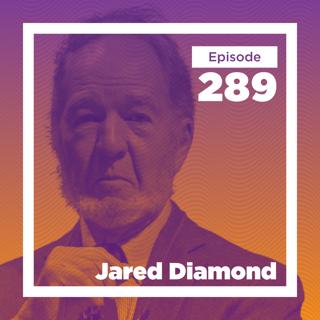

Jared Diamond on Leaders, Luck, and Irreplaceability

Jared Diamond on Leaders, Luck, and Irreplaceability

Is leadership overrated? That's one simple reading of what Jared Diamond argues in his new book. Asked by Tyler to name the least replaceable leader in human history, Jared declines to name one — not Christ, the Roman Empire having had prophets to spare — and observes that even Genghis Khan happened to be born at an auspicious moment for a conqueror of the steppes. Conditions ripen; somebody turns up. So which leaders do make a difference?

Tyler and Jared debate that question, including conditions what a religious founder needs to succeed, whether destructive leaders matter more than constructive ones, why individual leaders have mattered so little in Papua New Guinea, whether we undervalue preventers, how much Rachel Carson and the Resnicks really mattered, whether Botswana's success will endure, Jared's own place in intellectual history, and what he'd tell an ambitious 25-year-old about how to become consequential. They go on to cover whether New Guineans are smarter, his reasons for why the Industrial Revolution started in England, what he learned from Jim Robinson about natural experiments, why he's more optimistic about the environment than when he wrote Collapse, what he'd do about nuclear risk, the 189 bird species on his street in Los Angeles, why the MacArthur "genius grant" left him depressed for a week, why he's listening to one Bach cantata a week, what he hopes to work on as he enters his nineties, and more.

Read a transcript enhanced with helpful links, or watch the full video on YouTube.

Recorded August 21st, 2026.

Other ways to connect

Timestamps:

00:00:00 - Intro

00:01:11 - On whether any leader is irreplaceable

00:21:35 - On his own replaceability

00:24:55 - On the decline of face-to-face skills

00:29:02 - On intelligence and genetics

00:32:57 - On why the Industrial Revolution began in England

00:36:38 - On environmental optimism

00:41:11 - On nuclear risk and the Dvorak keyboard

00:42:55 - On birdwatching

00:44:07 - On writing and productivity

00:47:06 - On what his parents gave him

00:49:51 - On what comes next

00:51:36 - Outro

Det här avsnittet är hämtat från ett öppet RSS-flöde och publiceras inte av Podme. Det kan innehålla reklam.

Avsnitt(300)

Michael Moritz on Origin Stories, Exile, and Obsessive Curiosity

Michael Moritz on Origin Stories, Exile, and Obsessive Curiosity

Michael Moritz has written books through every phase of his life: the first history of Apple and an account of Chrysler's near-death while he was a journalist at Time, a study of Alex Ferguson's Manch...

2 Sep 41min

Luke Burgis on Mimetic Desire, Catholicism, and the Age of Social Contagion

Luke Burgis on Mimetic Desire, Catholicism, and the Age of Social Contagion

Luke Burgis left Wall Street after two years, founded a few successful companies in his twenties, then walked away to spend three years in a Roman seminary on the path to the priesthood. He now runs t...

19 Aug 52min

Daron Acemoglu on Liberalism, Automation, and the Educated Elite

Daron Acemoglu on Liberalism, Automation, and the Educated Elite

Daron Acemoglu returns for his second appearance with a new book, What Happened to Liberal Democracy?, which Tyler reads as an attempt to redefine and revitalize liberalism for our times. Where Daron'...

12 Aug 55min

Julia Ioffe on Russian Women, Missing Men, and the Roots of Autocracy

Julia Ioffe on Russian Women, Missing Men, and the Roots of Autocracy

Julia Ioffe left the USSR as a child and came back as an adult journalist to find that the confident, credentialed women she remembered from her Soviet childhood had largely been supplanted by those c...

5 Aug 55min

Andrew Graham-Dixon on Vermeer, a Forgotten Sect, and Underrated Artists

Andrew Graham-Dixon on Vermeer, a Forgotten Sect, and Underrated Artists

Andrew Graham-Dixon's new book, Vermeer: A Life Lost and Found, rests on the conviction that you cannot understand what's in a painting without knowing what its maker was thinking about. In Vermeer's ...

22 Juli 56min

Chase Koch on Principles, Music, and Overcoming Entropy

Chase Koch on Principles, Music, and Overcoming Entropy

Chase Koch grew up receiving Sunday philosophy lessons from his father Charles and, by his own account, spent most of them half asleep while his sister supplied the answers. The principles didn't land...

15 Juli 54min

Joel Mokyr on Clans, Corporations, and a Culture of Growth

Joel Mokyr on Clans, Corporations, and a Culture of Growth

Joel Mokyr co-won the 2025 economics Nobel for exploring the question that traces back to the beginning of economics: how did sustained economic growth suddenly become normal? For nearly all of human ...

8 Juli 46min
Populärt inom Utbildning

historiepodden-se
rss-bara-en-till-om-beroende-medberoende
det-skaver
nu-blir-det-historia
harrisons-dramatiska-historia
not-fanny-anymore
allt-du-velat-veta
johannes-hansen-podcast
rss-viktmedicinpodden
sa-in-i-sjalen
i-vantan-pa-katastrofen
rss-max-tant-med-max-villman
rikatillsammans-om-privatekonomi-rikedom-i-livet
rss-basta-livet
rss-ar-det-rimligt
rss-autismandan
rss-foraldramotet-bring-lagercrantz
roda-vita-rosen
sektledare
rss-traningsklubben