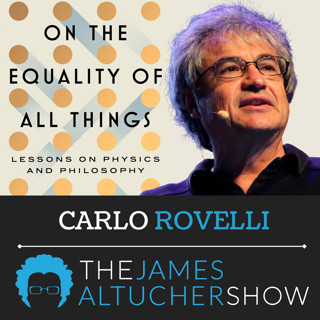

Carlo Rovelli: Nothing Exists Alone

Carlo Rovelli: Nothing Exists Alone

A Note from James:

Carlo Rovelli is one of the smartest people I know. He is a theoretical physicist and the author of a lot of great books, including Seven Brief Lessons on Physics, The Order of Time, Helgoland, White Holes, and now On the Equality of All Things: Lessons on Physics and Philosophy.

He has been on the show before, and at the end of this conversation I told him I felt like he was just tolerating my questions. He was nice about it.

But the first question I asked was: Do I actually exist?

Because in Carlo’s new book, nothing really exists on its own. Not a person, not a particle, not you, not me. Everything exists in relation to something else.

So I spent an hour trying to understand what that means.

Does absolute truth exist? Is free will fake? Are we just machines? Is consciousness quantum? Is everything doomed to decay? Is time real? Was there a before the Big Bang? And what does any of this actually do for us in ordinary life?

Carlo’s answer, again and again, is not that nothing is real. It is that we make a mistake when we try to imagine the world from the outside, as if we were standing somewhere beyond the universe looking in. We are not outside the universe. We are inside it. We are part of it. We know the world through relationships, perspectives, interactions, and limits.

And oddly, that is calming.

Because Carlo says the thing that brought him serenity was not finally knowing everything. It was giving up the need to know everything with absolute certainty.

That is where this conversation goes: physics, quantum mechanics, philosophy, Buddhism, Taoism, Wittgenstein, consciousness, black holes, time, the Big Bang, free will, and the strange comfort of not needing the final answer.


Episode Description:

Carlo Rovelli returns to the show for a conversation about reality, uncertainty, quantum mechanics, time, consciousness, free will, and his new book On the Equality of All Things: Lessons on Physics and Philosophy.

James begins with the central idea of the book: everything in the universe can only be understood in relation to something else. Carlo agrees that this is a good short version of the argument, but immediately pushes back against the need for “absolute” truth. Of course James exists. Of course Carlo exists. The question is why we need to add something heavier and more final than that.

From there, the conversation becomes an exploration of relational reality. Carlo explains that motion is not an illusion just because it depends on perspective. When James says he is sitting still, that is true with respect to Earth. When someone says Earth is moving, that is true with respect to the sun or the galaxy. The mistake is asking which motion is the “real” one outside all relations.

The same frame applies to quantum mechanics. Carlo argues that particles are not little objects with fixed properties sitting there independently of the rest of the world. A particle is what it manifests in interaction. It is a set of relations. This is why quantum mechanics has forced such a profound change in the way physicists think about reality.

James keeps pressing the practical question: What do we gain from knowing this?

Carlo’s answer is partly scientific and partly philosophical. We gain better questions. We stop asking impossible questions like “Who is really not moving?” or “What is the final foundation of everything?” We become more aware of our own perspective. And we may become more capable of understanding people whose moral, political, or philosophical perspectives differ from ours.

The conversation moves through the Big Bang and the possibility of a Big Bounce, with Carlo stressing that science is powerful precisely because it knows its own ignorance. Science is not the final story. It is an ongoing process of learning, correcting, testing, and replacing older models with better ones.

James and Carlo then talk about time. Carlo explains that Earth is so small, compared with the universe, that we experience conversation as almost instantaneous. That gives us the illusion that time is the same for everyone. But physics has shown that time is not universal. Every star and galaxy has its own time, and the idea of “now” across the whole universe does not really work.

The second half of the conversation turns toward philosophy and human life. Carlo connects his thinking to Eastern philosophy, Zhuangzi, Buddhism, Taoism, and Wittgenstein. For him, accepting the partial, perspectival, incomplete nature of knowledge is not depressing. It is serene.

James also asks about consciousness, free will, and whether quantum mechanics can explain the mind. Carlo respects Roger Penrose but says he does not think consciousness is specifically quantum. The brain is physical. Choices are physical. But that does not make choice unreal. The mistake, Carlo says, is imagining a separate ghost or soul outside the physical brain that is supposed to make the decision.

The episode closes with James trying to find one absolute: everything decays. Carlo says no. The universe also creates order. Galaxies form. Stars light up. Life emerges. Water and oil separate into structure. Civilization produces books. Nature is not simple decay. It is more complicated, more beautiful, and still not fully understood.


What You’ll Learn:

  • Why Carlo Rovelli thinks there is no useful “view from outside” the universe.
  • Why existence does not need to be “absolute” to be real.
  • How motion only makes sense relative to something else.
  • Why relative does not mean arbitrary.
  • How quantum mechanics challenges the idea that the world is made of independent objects.
  • Why Carlo sees particles as manifestations of interactions.
  • Why science is powerful partly because it knows what it does not know.
  • What the Big Bounce idea suggests about the Big Bang.
  • Why time is not the same everywhere in the universe.
  • Why there may be no single universal “now.”
  • Why physics does not explain everything, even if nothing escapes physics.
  • How Eastern philosophy, Taoism, Buddhism, and Wittgenstein shaped Carlo’s thinking.
  • Why giving up certainty can create serenity.
  • Why Carlo does not think consciousness is specifically quantum.
  • How Carlo thinks about free will without invoking a separate soul or ghost.
  • Why quantum mechanics should not be turned into vague New Age thinking.
  • Why nature is not only decay, but also structure, order, evolution, and growth.


Timestamped Chapters:

[05:04] Does Anything Exist Absolutely?

James asks whether he, Carlo, or the chair exists, and Carlo explains why ordinary existence is enough without adding the word “absolute.”

[06:47] We Exist Through Relations

Carlo explains that identity, friendship, love, social position, and knowledge all happen through relationships.

[08:41] Motion Is Relative, Not Fake

James uses the example of sitting still while Earth moves, and Carlo explains why “really moving” is the wrong question.

[09:31] Morality Without Absolutes

Carlo argues that morality can be meaningful and powerful without being independent of human beings.

[10:44] Relative Does Not Mean Arbitrary

Carlo clarifies that relational truth is not the same as saying anything goes.

[12:05] Quantum Mechanics and the Relational World

Carlo explains how quantum mechanics led him toward the idea that things do not have fixed properties independent of interaction.

[14:35] What Happens When We Are Not Looking?

James asks why quantum mechanics feels strange, and Carlo explains that the confusion begins when we try to describe what happens without interaction.

[16:29] Everything Is a Process

Carlo connects quantum reality to everyday reality: apples rot, stones become sand, and nothing is perfectly fixed forever.

[17:21] Before the Big Bang?

James asks what the first particle could have interacted with, and Carlo explains why the Big Bang may not have been an absolute beginning.

[20:22] The Big Bounce

Carlo discusses the possibility that the universe went through a phase of maximum compression before expanding.

[21:40] Science Knows Its Ignorance

Carlo explains why science is not about having final answers, but about knowing what we know and what we still do not know.

[22:58] Science Is Not the Final Story

James asks about string theory and scientific certainty, and Carlo says science is an ongoing process of learning more.

[24:29] Physics Does Not Explain Everything

Carlo explains why fundamental physics underlies everything but does not replace chemistry, biology, mechanics, or other forms of knowledge.

[25:13] Time Is Not the Same for Everyone

James asks about time, distance, and the Big Bang, and Carlo explains why the idea of one universal “now” is an illusion.

[27:44] How Do We Know Anything?

Carlo defends the power of science, pointing to Maxwell, Einstein, black holes, gravitational waves, and GPS.

[30:11] Will Science Ever Be Complete?

James asks whether even an advanced alien civilization would still face unknowns, and Carlo says he doubts science will ever reach a final story.

[31:20] Gödel, Ignorance, and No Theory of Everything

Carlo treats Gödel’s theorem as an analogy for the impossibility of closing knowledge, while stressing how far we still are from complete understanding.

[32:49] Zhuangzi, Taoism, and Serenity

James connects Carlo’s thinking to Eastern philosophy, and Carlo explains why giving up the need for certainty made his life more serene.

[37:00] Consciousness and Quantum Mechanics

James asks about Roger Penrose and consciousness; Carlo says he does not think the brain is specifically quantum in the relevant sense.

[38:08] Consciousness as Perspective

Carlo explains consciousness as part of a relational world: a piece of nature with information about the rest of nature.

[41:06] Avoiding New Age Quantum Thinking

James asks about law-of-attraction-style interpretations, and Carlo distinguishes serious quantum theory from vague extrapolation.

[42:53] Objects Are Not as Solid as They Seem

Carlo says quantum mechanics challenges the idea that the world is made of fixed, independent objects with properties of their own.

[44:22] Arguing With the Metaphysicians

Carlo describes the Princeton philosophy conversations that helped become the basis of the book.

[46:29] Copernicus, Darwin, and Quantum Reality

Carlo compares quantum mechanics to earlier scientific revolutions that forced humans to rethink their place in the world.

[48:18] What Will Future Science Change?

James asks what discoveries might blow our minds 100 or 200 years from now, and Carlo points to quantum gravity, black holes, and the mind.

[51:10] Free Will Without the Ghost

James asks about determinism and choice; Carlo says freedom is not an illusion, but the idea of a separate nonphysical chooser is.

[54:11] Does Everything Decay?

James tries to find one absolute truth, and Carlo says nature also produces structure, complexity, life, and order.


Additional Resources:


See Privacy Policy at https://art19.com/privacy and California Privacy Notice at https://art19.com/privacy#do-not-sell-my-info.

Det här avsnittet är hämtat från ett öppet RSS-flöde och publiceras inte av Podme. Det kan innehålla reklam.

Avsnitt(1437)

The Friendliest Store in the Mall | Ron Johnson Built the Apple Store

The Friendliest Store in the Mall | Ron Johnson Built the Apple Store

Ron Johnson built the Apple Store as Apple's SVP of Retail, and is the author of Shop Different: How Retail Revealed Apple's Genius.A Note from James:I love the Apple Store.I can walk into one without...

16 Sep 48min

Jon Morrow: The Man Who Changed the Rules [From the Archive]

Jon Morrow: The Man Who Changed the Rules [From the Archive]

Episode Description:Jon Morrow’s story begins with a diagnosis that was supposed to be a death sentence.Born with spinal muscular atrophy, Jon was diagnosed at six months old. Doctors told his mother ...

13 Sep 1h 15min

Kareem Abdul-Jabbar: Becoming Kareem, the Skyhook, and the Search for a Self [From the Archive]

Kareem Abdul-Jabbar: Becoming Kareem, the Skyhook, and the Search for a Self [From the Archive]

Episode Description:Kareem Abdul-Jabbar joins James for a From the Archive conversation about basketball, identity, mentorship, faith, writing, civil rights, and his book Becoming Kareem: Growing Up O...

5 Sep 28min

How You Get Rich Isn't How You Stay Rich: 300 Years of Proof | Joseph Moore

How You Get Rich Isn't How You Stay Rich: 300 Years of Proof | Joseph Moore

A Note from James:In 1790, one of the easiest ways to get rich in America was the old-fashioned way: marry someone rich.George Washington did pretty well that way. Benjamin Franklin, meanwhile, was so...

27 Aug 1h 3min

Seth Godin: The Smallest Viable Audience and the Work That Might Not Work [From the Archive]

Seth Godin: The Smallest Viable Audience and the Work That Might Not Work [From the Archive]

Episode Description:This is a From the Archive episode with Seth Godin.Seth Godin returns to the show for a conversation about making work that matters in a world obsessed with hits, rankings, followe...

23 Aug 52min

Arianna Huffington: The Sleep Revolution, Microsteps, and the Joy of Being Awake [From the Archive]

Arianna Huffington: The Sleep Revolution, Microsteps, and the Joy of Being Awake [From the Archive]

Episode Description:This is a From the Archive episode with Arianna Huffington.Arianna Huffington returns to the show for a conversation about sleep, success, reinvention, and the cultural delusion th...

22 Aug 39min

Nancy Cartwright: Bart Simpson, Fellini, and Finding the Artist Inside [From the Archive]

Nancy Cartwright: Bart Simpson, Fellini, and Finding the Artist Inside [From the Archive]

Episode Description:Nancy Cartwright is best known as the voice of Bart Simpson. But in this archive conversation, James is interested in the artist behind the voice.Nancy joins the show to talk about...

16 Aug 1h 15min

Populärt inom Business & ekonomi

framgangspodden
varvet
rss-jossan-nina
rss-borsens-finest
24fragor
svd-tech-brief
avanzapodden
badfluence
uppgang-och-fall
lastbilspodden
fill-or-kill
rss-inga-dumma-fragor-om-pengar
rss-kort-lang-analyspodden-fran-di
tabberaset
rss-dagen-med-di
bathina-en-podcast
rikatillsammans-om-privatekonomi-rikedom-i-livet
kapitalet-en-podd-om-ekonomi
affarsvarlden
borsmorgon