When Sleep Isn't Rest: What 'Sleep Stress' Reveals About Recovery (Bonus Episode)

When Sleep Isn't Rest: What 'Sleep Stress' Reveals About Recovery (Bonus Episode)

In this episode Andrea Samadi explains the concept of sleep stress — a wearable-device measured how physiologically activated your body remains during sleep — and places it within a neuroscience-based movement and recovery framework.

She reviews the autonomic nervous system (sympathetic vs. parasympathetic), how WHOOP estimates sleep stress from heart rate and HRV, and why trends over weeks matter more than single nights. Using her six-month data, Andrea shares how recovery habits and removing alcohol coincided with an 89% drop in nightly high sleep stress.

The episode ends with practical steps and a seven-day experiment to help you observe and reduce nighttime physiological activation by changing daytime behaviors, sleep environment, and training timing so your body can better recover and adapt.

When Sleep Isn’t Rest—What “Sleep Stress” Reveals About Recovery:

The Story Behind My 89% Drop in Sleep Stress

Welcome back to the Neuroscience Meets Social and Emotional Learning Podcast, where we bridge neuroscience, social and emotional learning, and human performance so we can create measurable improvements in our well-being, achievement, leadership, productivity and results.

I’m Andrea Samadi, and if you’ve been following along through Season 16, you’ll know that we have been building what I call The Brain’s Operating System for Human Performance—a neuroscience-based framework designed to help us understand how the different systems of the brain and body work together to influence how we learn, adapt, connect, lead and ultimately perform.

We are currently in Phase 3: Movement, Learning and Cognition, where we have been following a central pathway:

Movement → Adaptation → Performance

Movement creates a stimulus.

But movement alone does not make the brain or body stronger. We must be able to recover from that stimulus before adaptation can occur, to give us our desired outcome of improved performance.

This is why our recent bonus episodes have moved beyond exercise itself and into the recovery signals that help us understand whether our bodies are successfully handling the demands we are placing upon them.

In Bonus Episode 3[i], we explored the hidden story behind my resting heart rate. My data showed that it was not merely a measure of fitness—it was also reflecting the total load my body was carrying. During the higher-stress months of January and February, my resting heart rate remained elevated at approximately 56–58 beats per minute. As I placed greater emphasis on sleep, hydration, Zone 2 movement, sauna, meditation and recovery, it gradually fell to 54 and then 53 beats per minute. The lesson was that a lower resting heart rate signals that the body is working less during rest, and recovering more efficiently. The idea is to learn what your baseline is, and see how you can improve this number for a more efficient RHR.

In Bonus Episode 4[ii], we explored restorative sleep and learned that sleep quality is not measured by duration alone. Deep sleep supports physical restoration and repair, while REM sleep plays an important role in memory, learning and emotional processing. Because longer REM periods tend to occur later in the night/morning time my regular 4:00 AM wake time may give me less opportunity for that REM-rich portion of sleep—which is the tradeoff I’m choosing--since waking early allows me to exercise. Two additional hours in bed would not guarantee two more hours of REM, but they could create a greater opportunity for more REM sleep. The lesson was not to choose sleep over movement or movement over sleep. It was to protect enough sleep while still making room for movement, so the brain and body have the opportunity to adapt.

Throughout these bonus episodes, I’m sharing patterns from my WHOOP wearable device[iii] data—not because everyone’s numbers should look like mine, but to demonstrate what can happen when we measure consistently, look for trends and test small changes. The goal is not comparison. It is to help each of us better understand our own baseline and use that information to improve our habits, recovery and results.

While examining my own sleep data for these recent bonus episodes, another question came to my mind. It was while looking this sleep stress score.

What if we are sleeping—but our physiology remains unusually activated throughout the night? How would we even know if this was happening? This is another measurement I can see with this wearable device.

What if our eyes are closed and we are technically asleep, but the body is still working harder than usual? What if our sleep isn’t giving us the rest and recovery that we need.

This brings us to today’s question:

What is Sleep Stress?

One of the most valuable metrics I have been tracking this year is not simply how long I sleep or how much deep and REM sleep I achieve. Those are all important to me, but something stood out with these sleep scores to me, this year.

It is the amount of time my body spends in a state of elevated physiological stress while I am asleep.

When I examined my most recent six-month trend, I noticed something that kind of stopped me in my tracks.

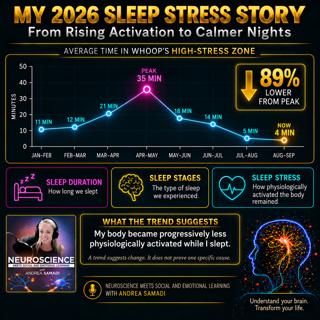
My average time in WHOOP’s high sleep-stress zone (monthly score from January 2026 till now) initially rose from 21 minutes to a peak of 35 minutes (around April/May) where I noticed my sleep scores were terrible with International travel, but I can’t blame everything on just the travel and times zones. I knew I was off track with rest and recovery. How much I was off, I’m not sure because Whoop confirmed my scores with the times zones might have been inaccurate, but either way, even if my sleep stress peaked at let’s say 25 minutes, it still showed me that I was doing something to keep my body stressed out while I was sleeping.

As I paid attention to rest and recovery, the scores began to improve in May, June, July, August…until now.

35 minutes of high sleep stress went…to 18…to 14…to 5…and finally to just 4 minutes of sleep stress each night.

That is an approximately 89% decrease from my six-month peak.

The data cannot tell me that one specific behavior caused this change. But it does suggest that my body has become progressively less physiologically activated while I was asleep.

And this helped me see recovery in a new way.

Sleep duration tells us how long we slept.

Sleep stages estimate the type of sleep we experienced throughout the night.

Sleep stress gives us another window into how physiologically activated the body remained during that sleep.

In today’s BONUS EP 5 we will explore:

    What Sleep Stress measures The sympathetic and parasympathetic branches of the nervous system Where Sleep Stress fits into the Movement Loop What I noticed in my six-month results What the results show—and what they cannot prove How you can monitor nighttime physiological stress And practical tips to help your body settle and recover

Let’s begin with the nervous system and what’s working behind the scenes while we are asleep.

The Autonomic Nervous System

To understand Sleep Stress, we first need to understand the autonomic nervous system and how ACTIVATION and RECOVERY work together. We covered this topic on a very early EP 59[iv] with Suzanne Gundersen on “Putting the Polyvagal Theory into Practice” and then again with educational neuroscientist Dr. Lori Desautels and Michael McKnight[v]. You can review those episodes if you want a deeper dive here.

The autonomic NS is the part of the nervous system that regulates many of the functions that happen automatically, without requiring conscious thought.

It helps manage:

    Heart rate Blood pressure Breathing Digestion Temperature regulation Energy use And our physiological responses to changing demands in our life experiences

Two of its primary branches are the sympathetic nervous system and the parasympathetic nervous system.

The sympathetic nervous system helps mobilize the brain and body when we need energy, alertness or action. It is often called the fight-or-flight system.

We need this sympathetic activation to wake up, exercise, concentrate, solve problems, respond to challenges and perform under pressure.

When sympathetic activity rises, heart rate may increase, breathing may become faster and energy becomes more readily available for action.

That is exactly what we want when climbing a mountain, completing an intense workout, delivering a presentation or responding to an immediate challenge.

The problem is not activation itself.

The problem may arise when the body has difficulty shifting out of that activated state after the challenge has passed.

The parasympathetic nervous system supports the restorative side of this process.

It is often described as the rest-and-digest system because it helps the body conserve energy, digest food and create conditions that support rest and recovery.

When our parasympathetic NS is activated, heart rate generally slows and the body becomes less physiologically activated.

But the sympathetic and parasympathetic systems are not simple on-and-off switches.

They continually interact throughout the day and night. Healthy regulation depends on our ability to move flexibly between activation and recovery as our life circumstances change. I’m sure you’ve heard people talking about how they “regulate” themselves, or take themselves from a high stress state, to lower stress state usually through intentional breathing, (I’ve just started to add this technique), physical movement (my go-to way to get back to myself when I have time) and some people use sensory grounding to get themselves out of anxious loops.

American neuroscientist Dr. Andrew Huberman suggests the physiological sigh as a breathing technique “to reduce stress and anxiety in real-time, while they are still engaging in life.”[vi] He does say that this pattern of breathing is something that we all engage in when we are in deep sleep (our dogs do it too), a double inhale, followed by an extended exhale. He says it works well to reduce stress because “it offloads a lot of carbon dioxide all at once.”

Until I started to look at this sleep stress number, I didn’t realize that even during healthy sleep, our autonomic activity fluctuates.

Deep sleep is generally associated with greater parasympathetic influence, while REM sleep can include more variable heart rate, breathing and sympathetic activity.

This means that brief periods of increased physiological stress during sleep are not automatically signs that something is wrong.

The more useful question is:

Can my body move flexibly between activation and recovery—or is it remaining unusually activated for extended periods?

What Does WHOOP Mean by Sleep Stress?

WHOOP estimates physiological stress using signals that include heart rate and heart-rate variability, or HRV, compared with your personal baseline.

Its Sleep Stress view shows the proportion of the night spent in low, medium and high physiological stress zones.

This is an important distinction:

A wearable does not directly measure your thoughts or emotions.

It cannot know whether you are worried, excited, digesting a late meal, fighting an infection or recovering from a difficult workout.

It also does not directly measure the sympathetic and parasympathetic branches of the nervous system.

Instead, it uses cardiovascular signals to estimate how physiologically activated your body appears relative to what is normal for you.

Elevated nighttime stress can potentially be influenced by:

    Mental or emotional strain Alcohol Illness or an emerging infection A late or heavy meal Intense exercise close to bedtime Accumulated training strain Dehydration Heat or an uncomfortable sleep environment Travel and disrupted routines Hormonal changes Certain medications Or sleep-disordered breathing

Sleep Stress should therefore be treated as a signal to investigate, not a diagnosis.

One elevated night may not mean very much.

The greatest value comes from observing your own patterns across several weeks and comparing those patterns with your behaviors, environment, training and health.

Where Sleep Stress Fits in the Movement Loop

Our original Phase 3 framework was:

Movement → Adaptation → Performance

But we can now expand this pathway:

Movement → Physiological Load → Recovery → Adaptation → Performance

Movement provides a challenge to the brain and body.

That challenge creates physiological load.

Recovery gives the body an opportunity to respond to the load, repair what was challenged and build additional capacity.

That process is adaptation.

And the capacity created through adaptation supports future performance.

Sleep Stress sits within the recovery stage of this loop.

It helps us investigate whether the body is successfully downshifting from the demands of the day or remaining more activated than usual during the recovery window.

This does not mean that every increase in nighttime stress prevents adaptation.

The body is dynamic. Exercise, digestion, illness, temperature and different stages of sleep can all affect nighttime physiology.

But if elevated Sleep Stress becomes a repeated pattern, it may indicate that the body is carrying more load than it is currently absorbing.

This is why Sleep Stress belongs in Phase 3:

Movement supplies the challenge.

Recovery determines how effectively we absorb it.

Adaptation builds capacity.

And capacity supports performance.

What My Six-Month Results Show

When I examined my 6-month Sleep Stress results from March 17 through September 12 when I was writing this episode, I first looked at six consecutive monthly windows:

    March 17–April 15: 21 minutes of average high Sleep Stress April 16–May 15: 35 minutes May 16–June 14: 18 minutes June 15–July 14: 14 minutes July 15–August 13: 5 minutes August 14–September 12: 4 minutes

The pattern was not a straight decline.

My average high Sleep Stress initially increased from 21 to 35 minutes. That April-to-May period (with International Travel) was the highest point in the six-month window—a 67% increase from the preceding month.

The nightly graphs also show more frequent and more substantial periods in WHOOP’s high-stress zone during that time.

The data cannot tell me exactly what caused the increase. It may have reflected accumulated emotional stress, training load, disrupted routines, sleep timing, travel, temperature, or several factors interacting at once.

But after that 35-minute peak, the direction changed:

35 → 18 → 14 → 5 → 4 minutes

That is an approximately 89% reduction from the peak.

This was not the result of one isolated night or a single unusually good week. It was a progressive decline across four consecutive monthly windows.

When I switched to WHOOP’s full six-month view, however, I initially noticed what appeared to be a contradiction.

My six-month average was 16 minutes in the high-stress zone—60% higher than my preceding six-month average of 10 minutes.

How could my current Sleep Stress be improving so dramatically while the six-month comparison still showed an increase?

The answer is that a six-month average is a lagging measure. You can see my 6 month data in the show notes.

This graph includes the elevated spring period, particularly the April-to-May peak of 35 minutes. Those earlier nights continue to pull the six-month average upward, even though my more recent results are much lower.

The percentage of each night spent in WHOOP’s different stress zones makes the recent change especially clear.

During the April-to-May peak:

    6% of my sleep was in the high-stress zone 27% was in the medium-stress zone 67% was in the low-stress zone

By August 14 through September 12:

    High-stress sleep had fallen to 1% Medium-stress sleep had fallen to 10% Low-stress sleep had risen to 89%

This may be the most meaningful finding in the entire six-month trend.

I did not simply spend less time in WHOOP’s high-stress zone. A much larger proportion of my night shifted into the low-stress zone.

From spring into early summer, my high Sleep Stress had already begun to decline as I was focused on my health routine it kept dropping—from 35 minutes to 18 and then 14 minutes.

I was living my life as usual.

Three observations help explain what I think this pattern means.

Observation One The Spring Peak Was Worth Investigating

The 35-minute average represented a 67% increase from the preceding monthly window. The nightly graphs also show more frequent and more substantial periods in WHOOP's high-stress zone during that time.

Something was placing a greater physiological demand on my system, but the screenshots cannot tell me precisely what it was. The increase could have reflected emotional stress, training load, disrupted routines, sleep timing, travel, illness, temperature or several factors interacting at once.

This is why wearable data becomes more useful when it is paired with context. The number shows us what changed. A behavior log helps us investigate why it may have changed.

Observation Two The Improvement Began Before August

My Sleep Stress did not suddenly improve in one week. After the April-to-May peak, it declined across four consecutive monthly windows: 35 minutes fell to 18, then 14, then 5 and finally 4 minutes.

That suggests an ongoing recovery shift rather than one isolated good night. By the latest monthly window, 89% of my sleep appeared in WHOOP's low-stress zone, compared with 67% during the spring peak.

My body appeared to be spending progressively more of the night in a lower state of physiological activation relative to my baseline.

Observation Three One Change May Have Strengthened the Trend

Then, on August 7, I changed one thing.

My movement, training, sauna, hydration and sleep practices remained relatively consistent. The clearest variable I intentionally changed was this:

I stopped drinking alcohol.

The timing matters. My July 15-August 13 average, which contained only the first week of the alcohol-free experiment, was already down to 5 minutes. Because most of that monthly window occurred before August 7, alcohol removal cannot explain the entire decline.

But after I removed alcohol, my Sleep Stress remained at its lowest level and fell again to 4 minutes. During the same period, my HRV increased, my resting heart rate decreased and my overall recovery improved.

These measures are related rather than completely independent-WHOOP's Stress Monitor itself uses patterns in heart rate and HRV. Still, when several parts of my recovery picture begin telling a consistent story after one clearly defined change, the pattern becomes more compelling.

The data does not prove that removing alcohol caused every improvement. The most responsible conclusion is that my recovery had already begun improving and alcohol removal may have helped reinforce and sustain that progress.

My Biggest Aha Moment

My biggest realization was this:

I was not improving my sleep only by changing what I did at night-such as cooling the room, using a sleep mask or limiting phone use before bed.

I was improving my nights by changing my days.

This is exactly what Dr. Kristen Holmes suggested we do on EP 4054.

Everything we do during the day contributes to the total load our bodies must process:

    The emotional stress we carry The timing and intensity of exercise The food we eat The time we eat it Alcohol Hydration Light exposure Travel Work demands And whether we create moments of recovery between those demands

The night can become a physiological reflection of everything that came before it.

For years, many of us have assumed that being exhausted guarantees a good night’s sleep.

But exhaustion and regulation are not the same thing.

We can be deeply tired and still physiologically activated.

The goal is not to exhaust the body until it shuts down.

The goal is to help the body transition from meeting the demands of the day into the conditions required for recovery.

How Can YOU Measure Nighttime Stress?

WHOOP provides a specific Sleep Stress view, but you do not need WHOOP to begin observing your recovery patterns.

Depending on the wearable or device you use, you may be able to track:

    Sleeping heart rate Resting heart rate Overnight HRV Respiratory rate Skin-temperature deviation Sleep disruptions Restlessness Blood-oxygen trends And recovery or readiness scores

The most important consideration is your personal baseline.

Your HRV, resting heart rate and respiratory rate should not be judged against someone else’s ideal number.

Begin by learning what is normal for you.

Then look for:

    Sudden deviations Repeated elevations Changes lasting several nights Connections with specific behaviors (I noticed that sleep stress was ALWAYS there after no more than 1-2 glasses of wine) And whether multiple measures change together (I noticed that after a long hike, if I chose to have a drink that night, even one glass of wine, sleep stress would be there the next day). There was no escaping what elevated it for me.

Even without a wearable, you can begin tracking subjective signs of recovery.

Each morning, ask:

    How many times did I awaken? Did I feel restored when I woke up? Was my mind calm or racing before bed? Did I wake with tension, a racing heart or unusual warmth? How was my energy, mood and focus the following day?

You can then compare those observations with factors such as:

    Alcohol Meal timing Exercise timing Emotional stress Illness Travel And changes in your sleep environment

The purpose is not to become anxious about every fluctuation.

The purpose is to find patterns that help you make better decisions. It did help me to have a wearable to notice just how consistent my sleep stress was with certain behaviors.

Can you measure Sleep Stress without a wearable?

Not in the same way. Without overnight heart-rate and HRV data, we cannot calculate WHOOP’s Sleep Stress score—and we may not consciously feel that our physiology remained activated.

That was true for me. I did not feel stressed while I was sleeping. I needed the data to show me that my body was experiencing something my conscious mind could not detect.

Without a wearable, we can still watch for indirect clues: repeated awakenings, morning fatigue, an elevated morning pulse, daytime sleepiness or a bed partner noticing snoring, gasping or restlessness. A sleep diary can help connect those clues with our daytime behaviors.

The wearable did not create the stress. It made an invisible physiological pattern visible.

How Can We Lower Sleep Stress?

There is no single method guaranteed to lower nighttime stress because the underlying cause may differ from one person to another.

The following ideas are best approached as individual experiments.

    Examine Alcohol

Alcohol can make us feel sleepy, but sedation is not the same as restorative sleep.

Try reducing or removing alcohol for several weeks and observe what happens to your Sleep Stress, HRV, resting heart rate, awakenings and morning energy.

Look for a trend rather than expecting every night to improve.

This isn’t the first time I’ve removed alcohol while creating certain conditions for my body to perform at its best over the past 7 years of this podcast, and prior. I remember first hearing Dr. Daniel Amen talking about how alcohol isn’t a health food, and that he suggests no amount to be healthy for the brain. When I first heard him say this, I did think, “Oh come on, Dr. Amen, say it’s not so” because I don’t eat junk food (we’ll cover this topic next) so I would almost look to find some research that would allow even just small amounts.

You can hear what Dr. Huberman[vii] suggests on his riveting episode on this topic, and I’m sharing that my reduction with sleep stress was significant enough for me to decide that cutting it out of my diet would be a permanent decision. This is a personal decision though and what might be significant for me with my results, might not be what you notice.

    Finish Eating Earlier

A large or heavy meal close to bedtime may keep the body active through digestion.

Experiment with finishing dinner earlier and leaving a consistent interval before sleep.

Then observe whether your nighttime heart rate, Sleep Stress or restlessness changes.

I’ve always had dinner around 5pm and don’t eat anything after 6:30pm (except the occasional hot chocolate).

    Create an Evening Wind Down

The brain and body need a transition between daytime demands and sleep.

Your off-ramp might include:

    Dimming the lights Reducing stimulating content Reading Meditation Slow breathing NSDR Gentle stretching A warm shower or bath Writing down tomorrow’s priorities Or following a consistent bedtime routine

The purpose is to give the nervous system repeated cues that the demands of the day are ending. I like an Epsom salt bath when I’m home to transition from a work day, to night time.

    Balance Training With Recovery

Exercise generally supports sleep and long-term health, but timing and intensity can affect individuals differently.

If you repeatedly notice elevated nighttime stress after late, intense workouts, experiment with completing those sessions earlier.

You might replace a late high-intensity session with walking, gentle mobility or recovery work and then compare the results.

I did notice that on days I go to the gym after work, I do have higher stress that next morning. It’s not always easy to fit everything in early mornings.

    Practice Regulation During the Day

Do not wait until bedtime to address accumulated activation.

Small recovery periods throughout the day can include:

    Brief movement breaks Time outdoors Slow breathing Space between meetings Short periods without digital stimulation Meditation

Recovery does not begin when your head hits the pillow.

It is built into the rhythm of the entire day.

    Optimize the Sleep Environment

Examine the physical conditions surrounding your sleep:

    Is the room comfortably cool? Is it dark? Is it quiet? Are notifications turned off? Are pets or other interruptions waking you? Does your bedding help regulate temperature? Has travel disrupted your routine?

Sometimes the source of elevated nighttime activation is due to your environment.

    Pay Attention to Possible Health Signals

A sudden increase in nighttime stress—especially when accompanied by changes in resting heart rate, respiratory rate or skin temperature—may occur when the body is fighting an illness.

Persistent changes deserve attention, particularly if they are accompanied by loud snoring, gasping during sleep, chest symptoms, unusual shortness of breath or significant daytime sleepiness.

A wearable cannot diagnose sleep apnea, an infection or another medical condition.

Its role is to help us notice when something has changed and decide whether further evaluation may be appropriate.

A Seven-Day Sleep Stress Experiment

This week, select only one or two variables to change.

Your experiment does not have to involve alcohol like mine did. I honestly just stopped enjoying it, so it was an easy variable for me to pick. Don’t ask me to give up coffee though. I won’t be participating in any caffeine reduction experiments.

Choose one variable that may be influencing your nighttime physiology, keep everything else as consistent as possible, and watch the trend—not one isolated score.

You might:

    Avoid alcohol Finish dinner earlier Move intense exercise away from bedtime Create a 20-minute evening wind down routine Practice five minutes of slow breathing Or make the bedroom cooler and darker

Each morning, record:

    Time in high Sleep Stress, if available HRV Resting heart rate Respiratory rate Number of awakenings And how restored you feel on a scale from 1 to 10

At the end of the week, ask:

What changed?

What remained consistent?

Which behaviors appeared to help my body settle?

Which behaviors were followed by greater nighttime activation?

Do not try to produce a perfect score.

The goal is to identify a pattern you can repeat.

Review and Conclusion

To close out this BONUS EP4, where we explored Sleep Stress—not as another score to chase, but as a window into what the body may be experiencing while we sleep.

We learned that Sleep Stress estimates how physiologically activated the body remains during the night. It is different from sleep duration, which tells us how long we slept, and sleep stages, which estimate the kinds of sleep we experienced.

To understand this metric, we looked at the two primary branches of the autonomic nervous system.

The sympathetic nervous system mobilizes energy so we can move, focus, respond and perform.

The parasympathetic nervous system supports conservation, digestion, restoration and recovery.

Neither branch is inherently good or bad. We need activation to meet life’s demands, and we need the ability to downshift when those demands have passed.

Healthy regulation is not the absence of stress. It is the flexibility to move between activation and recovery.

We also learned that WHOOP does not directly measure either branch of the autonomic nervous system. It uses patterns in heart rate and heart-rate variability, compared with our personal baseline, to estimate physiological stress.

That makes Sleep Stress a useful signal—but not a diagnosis and not proof of what caused a particular change.

This metric fits within the recovery stage of our expanded Movement Loop:

Movement → Physiological Load → Recovery → Adaptation → Performance

Movement creates the challenge.

But the challenge alone does not build greater capacity.

The body must be able to absorb the load, recover from it and adapt.

When I examined my own six-month results, I saw my average high Sleep Stress rise from 21 minutes to a spring peak of 35 minutes. It then declined across four consecutive monthly windows:

35 → 18 → 14 → 5 → 4 minutes

That represented approximately 89% reduction from the highest month

The proportion of my sleep in WHOOP’s low-stress zone also increased from 67% during the spring peak to 89% in my most recent monthly window.

My recovery had already begun improving before I had cut out alcohol on August 7, so alcohol removal cannot explain the entire decline.

But when I kept the rest of my routine relatively consistent and removed alcohol, my Sleep Stress remained at its lowest level. At the same time, my HRV increased, my resting heart rate decreased and my overall recovery improved.

This does not prove that one behavior caused every change. But it gives me good reason to believe that removing alcohol helped reinforce an already improving recovery pattern.

And that brings me to the most important lesson from this experiment:

I did not improve my recovery by asking my body to do more.

I improved it by creating better conditions for my body to recover from everything it was already doing.

So tonight, instead of asking only:

“How many hours will I sleep?”

Think about--

“What am I doing today that will help—or prevent—my body from settling tonight?”

Because the night does not begin when we close our eyes.

It carries the accumulated effects of how we moved, trained, ate, worked, regulated and recovered throughout the day.

Movement creates the stimulus.

Recovery allows us to absorb it.

Adaptation builds our capacity.

And greater capacity prepares the brain and body to perform tomorrow.

I’ll see you next time for Episode 407, where we will revisit Jason Wittrock’s work through a current and carefully defined lens.

We’ll examine his experience with nutrition and fasting as the perspective of an applied practitioner and personal case study, while comparing those ideas with current evidence surrounding nutrition, blood-sugar stability, metabolic flexibility, recovery and performance.

Because if recovery determines how well we adapt to a challenge, metabolism determines whether the brain and body have the energy required to power that adaptation.

And the brain and body cannot sustain performance without the energy required to power the system.

I’ll see you next time.

REFERENCES:

[i]Neuroscience Meets Social and Emotional Learning Podcast BONUS EP 3 https://andreasamadi.podbean.com/e/the-hidden-story-behind-your-resting-heart-rate/

[ii]Neuroscience Meets Social and Emotional Learning Podcast BONUS EP 4 https://andreasamadi.podbean.com/e/is-your-4-am-hike-costing-you-rem-the-movement-vs-sleep-trade%e2%80%91off/

[iii] whoop.com

[iv]Neuroscience Meets Social and Emotional Learning Podcast EP 59 https://andreasamadi.podbean.com/e/suzanne-gundersen-on-the-polyvagal-theory-in-practice/

[v]Neuroscience Meets Social and Emotional Learning Podcast “The Future of Educational Neuroscience” https://andreasamadi.podbean.com/e/lori-desautels-and-michael-mcknight-on-the-future-of-educational-neuroscience-in-our-schools-and-communities/

[vi] Dr. Andrew Huberman Breathing Techniques to Reduce Stress and Anxiety. The Physiological Sigh https://www.youtube.com/watch?v=kSZKIupBUuc

[vii] Dr. Andrew Huberman https://www.hubermanlab.com/subtopics/effects-of-alcohol-on-the-brain-and-body

Det här avsnittet är hämtat från ett öppet RSS-flöde och publiceras inte av Podme. Det kan innehålla reklam.

Avsnitt(415)

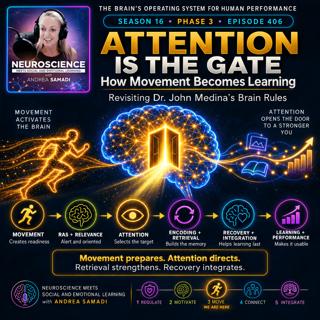
Attention Is the Gate—How Movement Becomes Lasting Learning with Dr. John Medina

Attention Is the Gate—How Movement Becomes Lasting Learning with Dr. John Medina

Episode 406 explains how movement prepares the brain but does not guarantee learning. It traces the full sequence—movement, RAS-driven readiness, salience and relevance, focused attention, encoding, r...

6 Sep 46min
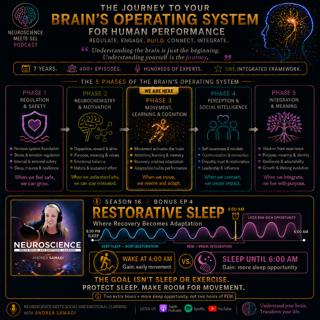
The 4:00 AM Tradeoff: Movement, REM and Recovery (Bonus Episode)

The 4:00 AM Tradeoff: Movement, REM and Recovery (Bonus Episode)

In this episode Andrea Samadi explores how movement and sleep work together in a "brain operating system" for human performance, focusing on restorative sleep (deep + REM), personal WHOOP data, and th...

30 Aug 29min
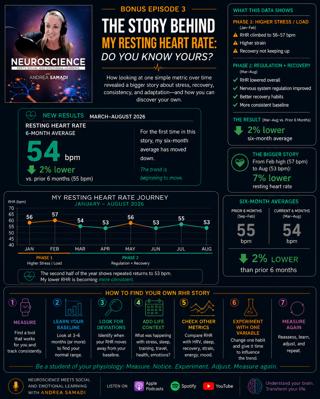
The Hidden Story Behind Your Resting Heart Rate: What Your RHR Can Reveal About Stress, Recovery & Adaptation (Bonus Episode)

The Hidden Story Behind Your Resting Heart Rate: What Your RHR Can Reveal About Stress, Recovery & Adaptation (Bonus Episode)

Andrea Samadi shares her personal resting heart rate data to show why measuring over time matters more than fixating on a single score. She explains how trends reveal stress, recovery, and adaptation,...

23 Aug 30min
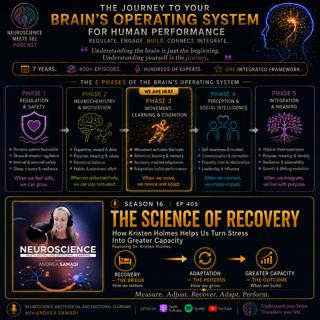
The Science of Recovery—How Dr. Kristen Holmes Helps Us Turn Stress Into Greater Capacity

The Science of Recovery—How Dr. Kristen Holmes Helps Us Turn Stress Into Greater Capacity

In this episode Andrea Samadi explores Phase 3 of the Brain's Operating System—movement, learning, and cognition—focusing on the recovery and adaptation side of the "movement loop." She revisits Dr. K...

16 Aug 45min
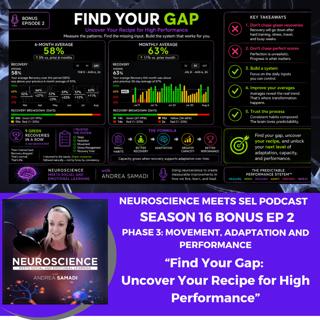
Find Your Gap: How Recovery Unlocks Predictable Performance (Bonus Episode)

Find Your Gap: How Recovery Unlocks Predictable Performance (Bonus Episode)

In this bonus episode Andrea Samadi introduces the Predictable Performance System, a practical roadmap from her Brain’s Operating System. She shows how measuring patterns—not chasing daily scores—plus...

9 Aug 30min
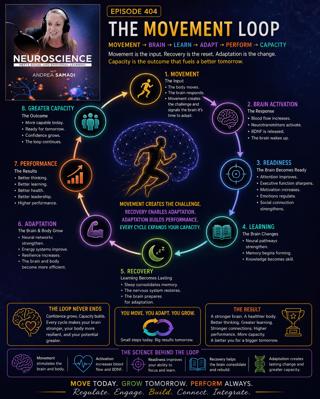
Dr. John Ratey and The Movement Loop: How Movement Becomes Human Performance

Dr. John Ratey and The Movement Loop: How Movement Becomes Human Performance

In this episode Andrea Samadi explores Phase Three of the Brain’s Operating System — how movement acts as the essential input that activates the brain, sharpens attention, boosts learning, and improve...

2 Aug 21min
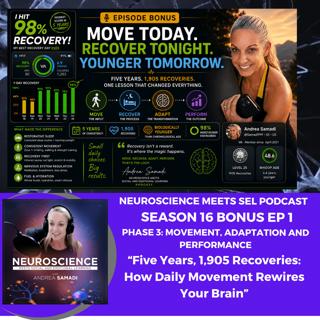
Five Years, 1,905 Recoveries: How Daily Movement Rewires Your Brain (Bonus Episode)

Five Years, 1,905 Recoveries: How Daily Movement Rewires Your Brain (Bonus Episode)

Andrea Samadi shares a five-year self-experiment using a WHOOP wearable to track sleep, recovery, movement, and biological age. She reveals how daily low-intensity movement and consistent recovery—not...

25 Juli 16min
Populärt inom Utbildning

historiepodden-se
rss-bara-en-till-om-beroende-medberoende
det-skaver
nu-blir-det-historia
harrisons-dramatiska-historia
not-fanny-anymore
rss-viktmedicinpodden
allt-du-velat-veta
johannes-hansen-podcast
roda-vita-rosen
rss-max-tant-med-max-villman
sa-in-i-sjalen
i-vantan-pa-katastrofen
rikatillsammans-om-privatekonomi-rikedom-i-livet
rss-ar-det-rimligt
rss-autismandan
rss-foraldramotet-bring-lagercrantz
rss-traningsklubben
rss-basta-livet
polisutbildningspodden