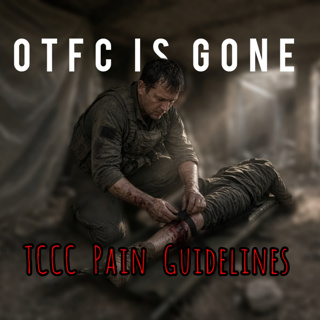
296 - Mission Capable Pain Control: The TCCC Analgesia Update Explained

296 - Mission Capable Pain Control: The TCCC Analgesia Update Explained

OTFC is gone. That was not a small supply hiccup. It punched a hole in the old TCCC pain plan.

George Barbee, a PA and co-author of TCCC Guideline Change 25-03, walks Dennis through why the committee rebuilt battlefield analgesia instead of patching the old triple-option chart.

They screened 56 analgesics. They built an objective matrix. They landed on suzetrigine: non-opioid, mentation-sparing, slow onset, long duration — a drug that can keep a still-fighting casualty in the fight and then carry them into prolonged care.

The bigger shift is the fork in the road. Not “mild / moderate / severe” as four overlapping options. Can they stay in the fight, or not? Functioning casualties get a non-sedating pack. Non-functioning casualties get a shock-agnostic pathway so you are not stacking drugs blindly down the continuum.

Ketamine is still the drug you reach for when you have almost no information. Nystagmus is not the goal. It is the “you gave too much, back off” line. Option 4 sedation is being pulled out of TCCC and written into PCC, where it belongs.

If you still teach OTFC, still dose to shaking eyes, or still treat every casualty like they need a narcotic, this episode is the update.

Read the change paper @ ⁠www.prolongedfieldcare.org⁠

or ⁠https://jsomonline.org/⁠

Follow @prolonged_field_care


Top 5 takeaways

  1. The change was forced. OTFC disappeared, GWOT safety data said the old plan was too loose, and LSCO needs mission-capable pain control plus a safer path for people who cannot stay in the fight.
  2. Suzetrigine is the new stay-in-the-fight drug. Non-opioid. Cognition and blood pressure mostly spared. About a 2-hour onset, long duration. Pair it with meloxicam and acetaminophen for the functioning casualty. Muscle spasm in 1–10% is not a seizure and does not get benzos.
  3. Stop using four overlapping “options.” Define pain with the Defense and Veterans Pain Rating Scale. Rough cut: 1–6 can often still function and self-declare. 9–10, polytrauma, multi-amp — they are out of the fight. Medics already know this on sight. The guideline finally says it.
  4. Ketamine stays, but the endpoint is not nystagmus. If you have almost no information, ketamine is still the safest narcotic start. Reduction of pain means the casualty and the medic can both manage the situation. Nystagmus means you crossed the line. Fixed-dose ketamine in a bleeding patient can get weird as volume drops — not usually lethal, still a problem.
  5. Option 4 is leaving TCCC. Heavy sedation and procedural endpoints are being moved into the PCC update. TCCC keeps the systematic, stack-aware, evidence-based path so the next provider is not surprised by what you already gave.

Chapters

00:00 — Disclaimer and open

00:23 — Dennis and George: who wrote the change

02:10 — If it ain’t broke, why touch analgesia?

02:56 — We lost OTFC

03:11 — Safety, LSCO, and early pain vs PTSD

04:27 — Mission-capable control and a shock-agnostic path

05:48 — How suzetrigine beat 56 other drugs

09:38 — Why this non-opioid survived the matrix

11:33 — Spasm vs seizure: do not reach for benzos

13:33 — Stay in the fight vs cannot

14:20 — The old “triple option” was actually four

15:06 — Defining pain with the DVPRS

16:10 — The stay-in-the-fight pack: suzetrigine, meloxicam, Tylenol

17:20 — What “reduction of pain” actually means

18:15 — Esketamine: more analgesia, fewer side effects

27:38 — If you only get one narcotic, start ketamine

28:56 — Esketamine, IN 28 mg, and the 4PANE study

30:15 — IV, IO, IM, IN: why they kept the nose

33:07 — Pain control vs nystagmus

35:26 — Option 4 is moving to PCC

36:41 — Chest tubes, crics, and the sedation gap

37:54 — Next: backing the PCC analgesia update

38:48 — Read JSOM Change 25-03 and close

Det här avsnittet är hämtat från ett öppet RSS-flöde och publiceras inte av Podme. Det kan innehålla reklam.

Avsnitt(628)

SOMA 26' - Ultrasound-Augmented Triage A Proposal To Refine Field Decision Making In Tactical Combat Casualty Care

SOMA 26' - Ultrasound-Augmented Triage A Proposal To Refine Field Decision Making In Tactical Combat Casualty Care

Recorded live at SOMA 26In a near-peer MASCAL, one medic and one junior medic may face twenty penetrating torso casualties, one unit of blood, and no time to empirically needle or finger-decompress ev...

10 Sep 26min
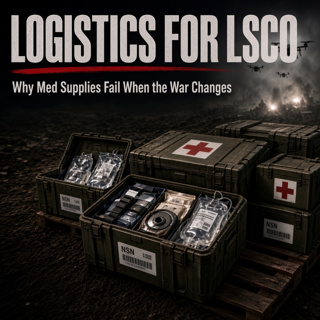
295- Logistics For LSCO: Why SOF Med Supplies Fail When The War Changes

295- Logistics For LSCO: Why SOF Med Supplies Fail When The War Changes

Medical logistics was an afterthought for a lot of us in GWOT. You submitted a request, something showed up, and everyone joked that the warehouse never read the order. That model does not survive lar...

7 Sep 35min
SOMA 26' - Role 1.5: Fighting Tourniquet Syndrome at the Forefront

SOMA 26' - Role 1.5: Fighting Tourniquet Syndrome at the Forefront

Ukrainian orthopedic and reconstructive surgeon describes what prolonged field care actually looks like when evacuation from the front line to Role 2 takes three to four days, and sometimes longer. Af...

3 Sep 21min

294 - Do Antibiotics Really Reduce Mortality in Trauma? Wound Care First in Prolonged Field Care

294 - Do Antibiotics Really Reduce Mortality in Trauma? Wound Care First in Prolonged Field Care

Antibiotics are not magic. In this episode of the PFC Podcast, Dennis sits down with Ryan to cut through the common myth that “I’ve given antibiotics, so the wound is protected.” They unpack why vigor...

31 Aug 36min
SOMA 26' - Fresh Whole Blood is Not The Answer: It's Still a Question

SOMA 26' - Fresh Whole Blood is Not The Answer: It's Still a Question

Whole Blood Is Not a Solution (Until Conventional Forces Can Deliver It)Recorded live at SOMA 26Dr. Vanessa Hanick (emergency physician, former active-duty Army, now National Guard) and 1SG Cy Clayton...

27 Aug 28min
293 - Dead Tissue Kills in Prolonged Field Care: 4 C’s, Early Debridement & Delayed Primary Closure Lessons from the Field

293 - Dead Tissue Kills in Prolonged Field Care: 4 C’s, Early Debridement & Delayed Primary Closure Lessons from the Field

In this episode of the PFC Podcast, Dennis sits down with missionary surgeon Jason to cut through the noise on real-world wound care in austere and unconventional warfare environments. From the bridge...

24 Aug 49min
SOMA 26' - European Medical Preparations for Major Engagements and Large-Scale Combat Operations

SOMA 26' - European Medical Preparations for Major Engagements and Large-Scale Combat Operations

Recorded live at SOMA 26Pierre Pasquier (France) and his German counterpart deliver a clear-eyed assessment of how European military medical systems are preparing for large-scale combat operations and...

20 Aug 31min

Populärt inom Utbildning

historiepodden-se
rss-bara-en-till-om-beroende-medberoende
det-skaver
nu-blir-det-historia
harrisons-dramatiska-historia
not-fanny-anymore
rss-viktmedicinpodden
allt-du-velat-veta
johannes-hansen-podcast
roda-vita-rosen
rss-max-tant-med-max-villman
sa-in-i-sjalen
i-vantan-pa-katastrofen
rikatillsammans-om-privatekonomi-rikedom-i-livet
rss-ar-det-rimligt
rss-autismandan
rss-foraldramotet-bring-lagercrantz
rss-traningsklubben
rss-basta-livet
polisutbildningspodden