

#183: Silent progression in MS. Can we really detect it early?

#183: Silent progression in MS. Can we really detect it early?

Can we detect gradual MS progression before it becomes obvious?

In this episode, I look at what current research can — and cannot — tell us about subtle worsening without an obvious relapse.

The key distinction is important: noticing a change, detecting a trend, confirming progression and understanding its biological cause are four different steps.

We look at why a single clinic visit cannot prove irreversible progression, what the EDSS may miss, and how patient-reported outcomes and self-administered tests could help identify meaningful changes earlier.

I also discuss what MRI, OCT, neurofilament light chain (NfL), GFAP and newer approaches such as BrainAGE can add — and why none of them currently functions as a stand-alone "progression detector".

In this episode
  • Why gradual worsening can occur without an obvious relapse
  • Why one abnormal measurement does not prove progression
  • What the EDSS may miss
  • How patient-reported outcomes and self-administered tests can add important information
  • The difference between PIRA and smouldering MS
  • Why "independent of a recognised relapse" does not necessarily mean "independent of inflammation"
  • What MRI, OCT, NfL and GFAP can — and cannot — tell us
  • Why different biomarkers may give different answers
  • Why repeated measurements over time matter more than one snapshot
  • What people with MS can realistically observe in everyday life without constantly monitoring themselves
Read the full article

Silent progression in MS: Can we really detect it early?
👉 https://ms-perspektive.de/en/183-silent-progression/

Infographic: four steps towards confirming progression

Research papers behind this episode

Voigt I, Ziemssen T.
Detecting progressing events in multiple sclerosis clinics in real-time is possible: No.
Multiple Sclerosis Journal. 2026;32(6):570–572.
https://doi.org/10.1177/13524585251409547
Key role in this episode: Why earlier detection is not the same as real-time confirmation of irreversible progression.

Reinders EM, Masot-Llima A, Otero-Romero S, et al.
Assessing progression independent of relapse activity in multiple sclerosis using a patient-reported disability measure and self-administered neuroperformance outcomes.
Annals of Neurology. 2026;100:525–546.
https://doi.org/10.1002/ana.78275
Key role: Evidence from 9,088 people with MS showing that patient-reported and self-administered measures can capture clinically meaningful change, while only partly overlapping with EDSS-based PIRA.

Bsteh G, Dal-Bianco A, Krajnc N, Berger T.
Biomarkers of progression independent of relapse activity—Can we actually measure it yet?
International Journal of Molecular Sciences. 2025;26:4704.
https://doi.org/10.3390/ijms26104704
Key role: Overview of EDSS, functional testing, MRI, OCT, NfL, GFAP and multimodal approaches, including the important distinction between predicting future PIRA and measuring ongoing progression.

Ciccarelli O, Barkhof F, Calabrese M, et al., MAGNIMS Study Group.
Using the progression independent of relapse activity framework to unveil the pathobiological foundations of multiple sclerosis.
Neurology. 2024;103:e209444.
https://doi.org/10.1212/WNL.0000000000209444
Key role: Why PIRA is a useful clinical framework but not a single biological process, and why PIRMA is difficult to establish in routine care.

Pawlitzki M, Kirschner P, Masanneck L, et al.
Brain age gap in multiple sclerosis: associated with disability but independent of serum biomarkers.
Therapeutic Advances in Neurological Disorders. 2026;19:1–13.
https://doi.org/10.1177/17562864261458516
Key role: An example of why different biomarkers may capture different aspects of MS rather than providing one universal measure of progression.

Kappos L, Wolinsky JS, Giovannoni G, et al.
Contribution of relapse-independent progression vs relapse-associated worsening to overall confirmed disability accumulation in typical relapsing multiple sclerosis in a pooled analysis of 2 randomized clinical trials.
JAMA Neurology. 2020;77(9):1132–1140.
https://doi.org/10.1001/jamaneurol.2020.1568
Key role: Historical context for why relapse-independent disability accumulation became such an important topic in relapsing MS.

See you soon and try to make the best out of your life,
Nele

For more information and positive thoughts, subscribe to my newsletter for free.

Click here for an overview of all podcast episodes published so far.

Det här avsnittet är hämtat från ett öppet RSS-flöde och publiceras inte av Podme. Det kan innehålla reklam.

Avsnitt(192)

#190: Living with multiple sclerosis. Gabriela's story and the "(un)seen faces of MS" Art Project

#190: Living with multiple sclerosis. Gabriela's story and the "(un)seen faces of MS" Art Project

https://ms-perspektive.de/en/190-unseen-faces-of-ms/Living with multiple sclerosis often means experiencing symptoms that others cannot see. Austrian artist Gabriela Romagna shares her journey to an M...

4 Nov 32min

#189: New imaging in MS: understanding progression and finding better treatments | ECTRIMS 2026

#189: New imaging in MS: understanding progression and finding better treatments | ECTRIMS 2026

How could new imaging in MS help us understand progression and develop better treatments? In this episode, I explore key insights from Daniel Reich's MSToronto2026 lecture and related research. Learn ...

28 Okt 15min

#188: Jan Van Amstel on EMSP's Four-Year Presidency and the Future of MS Advocacy in Europe

#188: Jan Van Amstel on EMSP's Four-Year Presidency and the Future of MS Advocacy in Europe

"Get rid of MS as soon as possible and make ourselves superfluous." — Jan van Amstel What can a stronger European voice achieve for people living with MS? In episode #188, EMSP President Jan van Amste...

21 Okt 31min
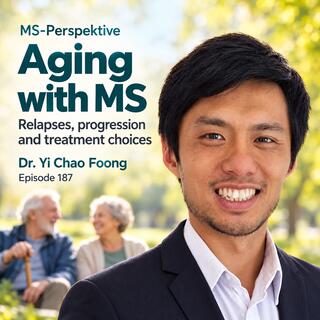
#187: Aging in multiple sclerosis: relapses, progression and treatment choices with Dr. Yi Chao Foong

#187: Aging in multiple sclerosis: relapses, progression and treatment choices with Dr. Yi Chao Foong

Aging in multiple sclerosis brings new questions about relapses, gradual progression and treatment choices. In episode 187, Dr. Yi Chao Foong, an MS neurologist and researcher in Tasmania, explains wh...

14 Okt 29min
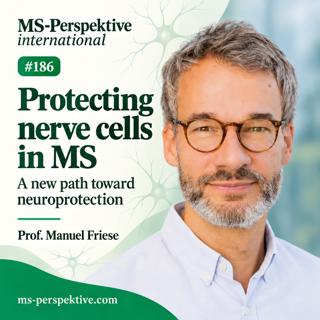
#186: Protecting nerve cells in multiple sclerosis: A new path toward neuroprotection with Prof. Manuel Friese

#186: Protecting nerve cells in multiple sclerosis: A new path toward neuroprotection with Prof. Manuel Friese

Why can multiple sclerosis progress even when relapses are well controlled? In episode 186, I speak with Prof. Manuel Friese about the next challenge in MS research: protecting nerve cells from damage...

7 Okt 43min

#185: Living with MS in Mexico – who gets diagnosed, who gets treated, and who gets left behind?

#185: Living with MS in Mexico – who gets diagnosed, who gets treated, and who gets left behind?

An MS diagnosis can depend on where you live, whether you can reach a neurologist and how quickly you can get an MRI. In this episode, Nele speaks with neurologist and neuroimmunologist Dr. Enrique Go...

30 Sep 36min

#184: MS treatment across the disease course – treat early, think long-term, don't give up too soon with Prof. Klaus Schmierer

#184: MS treatment across the disease course – treat early, think long-term, don't give up too soon with Prof. Klaus Schmierer

Read the full blog post and interview here: https://ms-perspektive.de/en/184-klaus-schmierer/ How early should MS treatment start, how strongly should we treat, and is there ever a point when it becom...

23 Sep 41min

Populärt inom Utbildning

husmodern-med-amanda-schulman
historiepodden-se
det-skaver
rss-bara-en-till-om-beroende-medberoende
rosceremoni
nu-blir-det-historia
harrisons-dramatiska-historia
roda-vita-rosen
allt-du-velat-veta
rss-viktmedicinpodden
rss-dr-bjorklund
i-vantan-pa-katastrofen
not-fanny-anymore
sa-in-i-sjalen
sektledare
johannes-hansen-podcast
rss-basta-livet
rss-max-tant-med-max-villman
rss-traningsklubben
sektpodden