
The Elaine Arkansas Massacre - Racism Then and Now

The Elaine Arkansas Massacre - Racism Then and Now

@claudiacragg speaks here with J Chester Johnson about a side of his grandfather, Lonnie Burch, that he never knew and only discovered late in his own life. His new book is Damaged Heritage and is he says a 'story of reconciliation'. The 1919 Elaine Race Massacre, arguably the worst in US history (see more details below), has been widely unknown for the better part of a century, thanks to the whitewashing of history. In 2008, Johnson was asked to write the Litany of Offense and Apology for a National Day of Repentance, where the Episcopal Church formally apologized for its role in transatlantic slavery and related evils. In his research, Johnson happened upon a treatise by historian and anti-lynching advocate Ida B. Wells on the Elaine Massacre, where more than a hundred and possibly hundreds of African-American men, women, and children perished at the hands of white posses, vigilantes, and federal troops in rural Phillips County, Arkansas. Johnson would discover that his beloved grandfather had been a member of the KKK and participated in the massacre. The discovery shook him to his core. Thereafter, he met Sheila L. Walker, a descendant of African-American victims of the massacre, and she and Johnson committed themselves to reconciliation. Damaged Heritage brings to light a deliberately erased chapter in American history, and offers a blueprint for how our pluralistic society can at last acknowledge—and repudiate—our collective damaged heritage and begin a path towards true healing. The Elaine Massacre occurred on September 30–October 1, 1919, at Hoop Spur in the vicinity of Elaine in rural Phillips County, Arkansas. Some records of the time state that eleven black men and five white men were killed.[4] Estimates of deaths made in the immediate aftermath of the Elaine Massacre by eyewitnesses range from 50 to "more than a hundred".[5] Walter White, an NAACP attorney who visited Elaine, AR shortly after the incident stated "... twenty-five Negroes killed, although some place the Negro fatalities as high as one hundred"[6]. More recent estimates of the number of black people killed during this violence are higher than estimates provided by the eyewitnesses, recently ranging into the hundreds.[2][1] The white mobs were aided by federal troops (requested by Arkansas governor Charles Brough) and vigilante militias like the Ku Klux Klan.[7] According to the Encyclopedia of Arkansas, "the Elaine Massacre was by far the deadliest racial confrontation in Arkansas history and possibly the bloodiest racial conflict in the history of the United States".[8][9] After the massacre, state officials concocted an elaborate cover-up, falsely claiming that blacks were planning an insurrection.[7] The cover-up was successful, as national newspapers repeated the falsehood that blacks in Arkansas were staging an insurrection.[7] A New York Times headline read, "Planned Massacre of Whites Today," and the Arkansas Gazette (the leading newspaper in Arkansas) wrote that Elaine was "a zone of negro insurrection."[7] Subsequent to this reporting, more than 100 African-Americans were indicted, with 12 being sentenced to death by electrocution.[7] After a years-long legal battle by the NAACP, the 12 men were acquitted.[7] Because of the widespread attacks which white mobs committed against blacks during this period of racial terrorism against black citizens, the Equal Justice Initiative of Montgomery, Alabama classified the black deaths as lynchings in its 2015 report on the lynching of African Americans in the South.[10]

Avsnitt(99)

Robert Kuttner, co-founder and co-editor of The American Prospect

Robert Kuttner, co-founder and co-editor of The American Prospect

Claudia Cragg (@ClaudiaCragg) speaks here with Robert Kuttner (@rkuttnerwrites) whose latest book is The Stakes: 2020 and the Survival of American Democracy. Some of those interviewed in this long-run...

10 Okt 201913min

Elderhood, Louise Aronson, Transforming How We Think and Feel About Ageing

Elderhood, Louise Aronson, Transforming How We Think and Feel About Ageing

Claudia Cragg (@KGNUClaudia) speaks here with geriatrician and author, Dr. Louise Aronson (@LouiseAronson) on her new book, Elderhood, an essential, empathetic look at a vital but often disparaged sta...

7 Okt 201934min

Ukraine, Russia, always in the news: what about the people?

Ukraine, Russia, always in the news: what about the people?

The news cycle rarely passes these days without negative news of Russia and, sadly for the people of that region, Ukraine. What about the people? Claudia Cragg (@KGNUClaudia) speaks here with Caroline...

2 Okt 201942min

From a Filipino shanty to Galveston, De Parle's Good Provider is One Who Leaves

From a Filipino shanty to Galveston, De Parle's Good Provider is One Who Leaves

For this show, Claudia Cragg (@ClaudiaCragg) speaks here with Jason DeParle (@JasonDeParle) a veteran reporter for The New York Times, about his new book, A Good Provider is One Who Leaves (Viking, 1s...

12 Sep 201929min
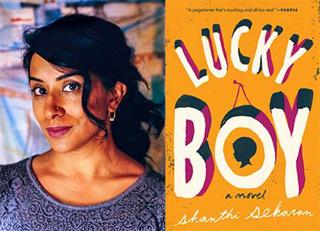
Shanthi Sekaran and her 'Lucky Boy' (REPRISE)

Shanthi Sekaran and her 'Lucky Boy' (REPRISE)

In Shanthi Sekaran's, 'Lucky Boy, Solimar Castro Valdez is eighteen and drunk on optimism when she embarks on a perilous journey across the US/Mexican border. Weeks later she arrives on her cousin's d...

20 Aug 201914min

The #DemocracyCollaborative, a"Democratic Economy' IS possible, with Ted Howard

The #DemocracyCollaborative, a"Democratic Economy' IS possible, with Ted Howard

The US economy is designed by the 1 percent, for the 1 percent, says Ted Howard in conversation here with Claudia Cragg (@ClaudiaCragg). His new book, The Making of a Democratic Economy, written with ...

7 Aug 201937min

How To Become a New Technology Entrepreneur with Ran Poliakine

How To Become a New Technology Entrepreneur with Ran Poliakine

Claudia Cragg (@KGNUClaudia) speaks here with Ran Poliakine, a serial entrepreneur, inventor and industrial designer. In 2007, Poliakine founded Powermat Technologies, a company that utilized inductiv...

17 Juli 201932min

The BBC's Anita Anand discusses her 'Patient Assassin'

The BBC's Anita Anand discusses her 'Patient Assassin'

On April 13, 1919, a column of British troops marched into the Jallianwala Bagh, a public garden in Amritsar, a city in Punjab, where more than 15,000 Indians had gathered for a peaceful protest again...

4 Juli 201927min

Populärt inom Politik & nyheter

svenska-fall
p3-krim
aftonbladet-krim
flashback-forever
rss-krimstad
rss-sanning-konsekvens
spar
rss-vad-fan-hande
motiv
aftonbladet-daily
rss-krimreportrarna
rss-flodet
olyckan-inifran
grans
rss-frandfors-horna
politiken
blenda-2
dagens-eko
krimmagasinet
rss-aftonbladet-krim