Hope and the Second United Front in Wuhan

Hope and the Second United Front in Wuhan

For ten months in 1938, Hankou in Wuhan was the center of China's Second United Front and defense against the Japanese invasion.


Artistic expression, political parties and free speech all blossomed. Neither the KMT nor the Communist Party fully controlled the city and a variety of generals, thinkers and artists came together to defend against Japanese aggression. Wuhan was under the control of Generals Li Zongren and Bai Zhongxi, heroes of the Chinese victory at Taierzhuang.


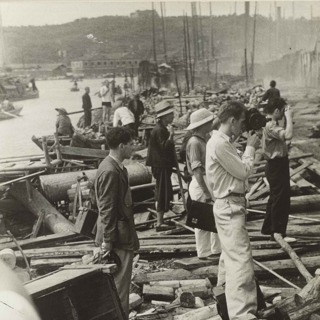
There was optimism that the Japanese could be stalled and stopped. Robert Capra came to Wuhan to film the heroic defence. Dr. Norman Bethune brought medical care to the Eighth Route Army. W. H. Auden and Christopher Isherwood visited and wrote a book about the war zone. General Han Fuju was executed for giving up Shandong without a fight.


But the Chinese underestimated Japanese combined arms and amphibious attacks. The forts they built to defend against the Japanese Navy moving up the Yangzi River were vulnerable to land based attacks. The Chinese Nationalist Army during the Second Sino-Japanese War suffered similar defeats to the Qing defenders during the Opium War.


With the fall of Hankou came an end to the freedom and optimism of Wuhan in 1938. Chiang Kaishek lost 80% of his officers and over a million soldiers dead or injured. The Japanese attackers also suffered their worst losses of the war and stopped their assault on the Yangzi River and instead turned their focus to north China.


The internationalist wing of the Communist Party of China also had their final moment with the fall of Hankou. Soon, Mao Zedong's supremacy from rural Yanan would become dominant.


Major sources:

MacKinnon, Stephen. (1996). The Tragedy of Wuhan, 1938. Modern Asian Studies , Oct., 1996, Vol. 30, No. 4, Special Issue: War in Modern China (Oct., 1996), pp. 931-943. Cambridge University Press

and

Wu, D. (2022). The cult of geography: Chinese riverine defence during the Battle of Wuhan, 1937-1938. War in History, 29(1), 185-204.


Image: "Joris Ivens, John Fernhout en Robert Capa aan het werk in Hankow, China, RP-F-2012-139.jpg" by Rijksmuseum is marked with CC0 1.0.


You can support this show through Buy me a coffee. https://www.buymeacoffee.com/thechineserevolution


For more information, sources and content see: https://chineserevolution.substack.com


Or enjoy The Chinese Revolution YouTube channel: https://www.youtube.com/channel/UCCOjBYMNC_3xjQXKv6ab9YA?sub_confirmation=1

Hosted on Acast. See acast.com/privacy for more information.

Det här avsnittet är hämtat från ett öppet RSS-flöde och publiceras inte av Podme. Det kan innehålla reklam.

Avsnitt(67)

The Wang Jingwei Regime: A Puppet Regime in Nanjing

The Wang Jingwei Regime: A Puppet Regime in Nanjing

In 1938, after the Battle of Wuhan, Wang Jingwei left Chongqing and the Republic of China team in Chongqing for Hanoi. He negotiated with Japanese officials and eventually set up a puppet regime know ...

30 Juni 202428min
Living Under Japanese Occupation

Living Under Japanese Occupation

Japan controlled Taiwan as a colony from 1895 to 1945. During the Second Sino-Japanese War, Chinese language education and publications stopped and the Imperial Subject Movement tried to Japanize resi...

27 Maj 202429min
The Brilliance of Chairman Mao

The Brilliance of Chairman Mao

By the early 1940s, the Communists in Yan’an were feeling relatively secure. The Japanese advance in north China had not reached that area. The Sino-Japanese War and the United Front meant that Chiang...

7 Apr 202420min
The National Palace Museum Treasures During the Second Sino Japanese War

The National Palace Museum Treasures During the Second Sino Japanese War

The treasures of the National Palace Museum, originally the Forbidden City, followed China's path. They escaped the invading Japanese by leaving Beijing, first for Shanghai, then Nanjing and then foll...

12 Feb 202455min
The Beginning of the Second Sino-Japanese War and the Nanjing Massacre

The Beginning of the Second Sino-Japanese War and the Nanjing Massacre

On July 7, 1937, the Second Sino-Japanese War and World War II began with the Marco Polo Bridge Incident. It is also known as the Lugou Bridge Incident. Within days of the small skirmish with 100 Chin...

15 Jan 202425min
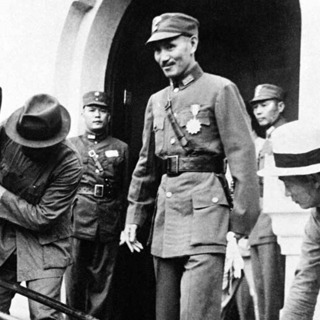
Chiang Kai Shek is Kidnapped

Chiang Kai Shek is Kidnapped

After the Long March, the Chinese Communists were mostly in northern Shaanxi, wanting a breather. Japan had continued its aggression in China after it set up the puppet state of Manchukuo under Empero...

7 Jan 202416min
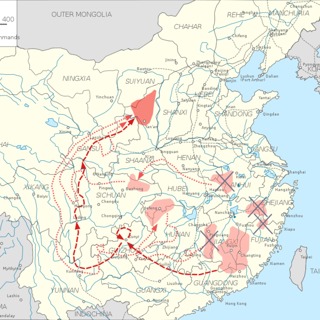
The Long March

The Long March

Zhou Enlai planned in secret the details of the Chinese Communist's escape from the encirclement of the Central Soviet. He identified a Guangdong warlord who preferred to save his troops rather than f...

25 Dec 202341min

Populärt inom Samhälle & Kultur

podme-dokumentar
gynning-berg
svenska-fall
p3-dokumentar
en-mork-historia
aftonbladet-krim
skaringer-nessvold
spar
mardromsgasten
hor-har
killradet
aftonbladet-daily
creepypodden-med-jack-werner
kod-katastrof
flashback-forever
p3-historia
vad-blir-det-for-mord
historiska-brott
rss-mer-an-bara-morsa
rss-expressen-dok