Fix your body clock to improve long term health with Prof. Satchin Panda

Fix your body clock to improve long term health with Prof. Satchin Panda

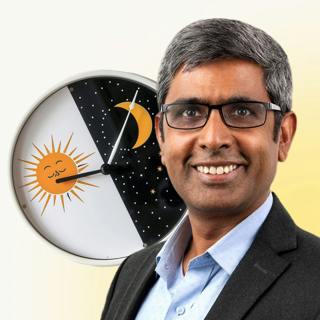
Our modern lifestyles mean that most of us don’t live our lives in sync with our circadian rhythms, which puts our health and well-being at risk. Eating and sleeping at the right time are important tools to help us align our circadian rhythms and reduce our risk of chronic disease. In this episode, circadian rhythm expert Prof. Satchin Panda will tell us how light and food act as master regulators of our body clock, how aligning our lifestyles with our body clock can improve our health, mood and energy levels and how to do this in practice. Satchin is a world-leading expert in the field of circadian rhythm research. He’s associate professor at the prestigious SALK institute, he’s recipient of the Dana Foundation Award in brain and immune system imaging and he’s also the author of two best-selling books, The Circadian Code and The Circadian Diabetes Code. Learn how your body responds to food 👉 zoe.com/podcast for 10% off 🌱 Try our new plant based wholefood supplement - Daily 30 *Naturally high in copper which contributes to normal energy yielding metabolism and the normal function of the immune system Timecodes: 00:00 Introduction 01:00 Quickfire questions 03:02 What are circadian rhythms? 03:48 How do we know about circadian rhythms? 04:44 Are all body parts on a 24 hour clock? 06:40 How the body enters sleep mode 09:25 What happens during sleep? 12:08 Why you’re not sleeping enough 13:30 The surprising impact of daylight savings time 17:00 Circadian rhythms aren’t just about light 19:55 The dangers of shift work 21:20 Should you go to bed at sunset? 25:40 Why should stop snacking at night 26:10 Satchin’s famous mice study 33:00 The best eating window for health 37:27 Does intermittent fasting promote better food choices? 40:40 Should you drink black coffee when you wake up? Satchin’s books: The Circadian Code The Circadian Diabetes Code Books by our ZOE Scientists: Every Body Should Know This by Dr Federica Amati Food For Life by Prof. Tim Spector Fibre Fuelled by Dr Will Bulsiewicz Studies referenced in today’s episode: Effects of 3 months of 10-h per-day time-restricted eating and 3 months of follow-up on bodyweight and cardiometabolic health in Danish individuals at high risk of type 2 diabetes: the RESET single-centre, parallel, superiority, open-label, randomised controlled trial, published in Lancet Healthy Longevity Neuronal reprogramming of mouse and human fibroblasts using transcription factors involved in suprachiasmatic nucleus development, published iScience Learning from circadian rhythm to transform cancer prevention, prognosis, and survivorship care, published in Trends Cancer The Untapped Potential of Circadian Timing as a Variable for Discoveries and Reproducibility, published in Cell Mol Gastroenterol Hepato Follow ZOE on Instagram Have feedback or a topic you'd like us to cover? Let us know here. Episode transcripts are available here.

Det här avsnittet är hämtat från ett öppet RSS-flöde och publiceras inte av Podme. Det kan innehålla reklam.

Avsnitt(343)

Most replayed moment: Can you really boost your immune system? | Professor Daniel Davis

Most replayed moment: Can you really boost your immune system? | Professor Daniel Davis

Today we’re talking about the immune system. It’s one of the most important systems in our body, yet it’s also one of the hardest to understand. You can’t see it, you can’t feel it working, and there...

25 Aug 16min

5 ways to control your blood sugar, reverse insulin resistance, and reduce your heart disease risk | Prof Rob Semple

5 ways to control your blood sugar, reverse insulin resistance, and reduce your heart disease risk | Prof Rob Semple

1 in 4 people have insulin resistance, which quietly raises your risk of heart disease and cancer, often without any change in your blood sugar. And most of those who have it have no idea. It can rem...

20 Aug 55min

Most replayed moment: The things hiding in your food? | Professor Marion Nestle

Most replayed moment: The things hiding in your food? | Professor Marion Nestle

Today we’re talking about food additives. Take a look at the back of some ultra-processed packaged food and you’ll see a long list of unfamiliar ingredients. Complex, sciencey sounding names that mos...

18 Aug 14min

How to shrink the dangerous fat linked to heart disease and cancer in 12 weeks | Prof Jimmy Bell

How to shrink the dangerous fat linked to heart disease and cancer in 12 weeks | Prof Jimmy Bell

There's a hidden fat that matters more for your health than your weight. This is visceral fat: it wraps around your organs, raises your risk of heart disease and cancer, and builds up even in people ...

13 Aug 59min

Most replayed moment: Why sleep may be the key to heart health | Dr Nour Makarem

Most replayed moment: Why sleep may be the key to heart health | Dr Nour Makarem

Today we’re talking about sleep. The more scientists study sleep, the clearer it becomes that it’s not just about resting our bodies - it’s much more than that. In fact, sleep is the foundation upon ...

11 Aug 13min

The evolutionary science behind why you can’t lose weight and how to avoid 5 modern food mistakes | Prof Daniel Lieberman

The evolutionary science behind why you can’t lose weight and how to avoid 5 modern food mistakes | Prof Daniel Lieberman

Why can’t you lose weight, and why do modern diets fail? Today, Harvard professor Daniel Lieberman explains how evolution shapes hunger, body fat, food cravings, and modern food mistakes. You will le...

6 Aug 52min

Most replayed moment: Do you really need vitamin supplements? | David Seres

Most replayed moment: Do you really need vitamin supplements? | David Seres

Today we’re talking about vitamins. Walk into any pharmacy or supermarket and you’ll find a shelf stacked with brightly coloured jars promising better immunity, stronger bones and sharper minds. Of c...

4 Aug 16min

How to reduce your heart disease, dementia and cancer risk with 12 everyday high-fibre foods | Hugh Fearnley-Whittingstall & Prof Sarah Berry

How to reduce your heart disease, dementia and cancer risk with 12 everyday high-fibre foods | Hugh Fearnley-Whittingstall & Prof Sarah Berry

Could 12 everyday high-fibre foods really help lower your risk of heart disease, dementia and some cancers? The world is obsessed with protein, but fewer than 1 in 10 people eat enough fibre. But th...

30 Juli 1h 1min

Populärt inom Utbildning

historiepodden-se
det-skaver
rss-bara-en-till-om-beroende-medberoende
nu-blir-det-historia
harrisons-dramatiska-historia
not-fanny-anymore
rss-viktmedicinpodden
roda-vita-rosen
johannes-hansen-podcast
allt-du-velat-veta
rss-max-tant-med-max-villman
rikatillsammans-om-privatekonomi-rikedom-i-livet
i-vantan-pa-katastrofen
rss-basta-livet
sektledare
sa-in-i-sjalen
rss-traningsklubben
rss-foraldramotet-bring-lagercrantz
rss-ar-det-rimligt
sex-pa-riktigt-med-marika-smith