Episode 79 - Reitz meets the Doppers and a wild-eyed prophet as the Gold Mines chug back to life
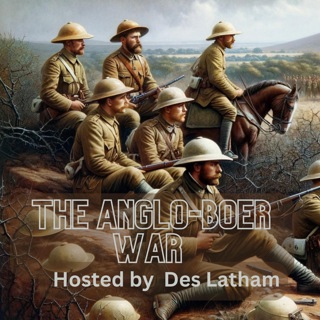
Episode 79 is full of strange swirling tales where Deneys Reitz our intrepid Boer narrator has been separated from his brother near Rustenberg after riding to fetch his all important saddle bags. Then to make matters much worse, his only remaining horse died. This left the youngster in a pickle, adrift in the veld, alone, with his only plan now to reach General Koos de la Rey who’s operating somewhere in the west. Maybe he could obtain a couple of horses there he thought. Little did he know that de la Rey’s commando had been hit by the same horse sickness that had put paid to his favourite horse, Malperd, then his replacement animal a few weeks later. Across the region, the sickness was taking its toll on all commandos, as well as the British cavalry and mounted infantry units. Reitz meets a prophet by the name of Van Rensburg who believes he has powers of the occult and then witnesses an apparent miraculous event although remains sceptical of it all. Meanwhile, High commissioner Milner had relocated from Cape Town to Johannesburg. He was also planning to return to England for a short visit later in April but before then wanted to get the Gold Mines going to help pay for the war.
24 Mars 201918min
Episode 78 - American blockhouses from Cuba and the enigma that was the pro-Boer John Tengo Jabavu
The ides of March were upon the British in South Africa as they continued chasing the ghost generals, Smuts, de la Rey, Beyers, de Wet across a cooling landscape that had begun its Southern Hemisphere Autumn in 1901. This week we’ll probe an American invention in Cuba called the Blockhouse chain as well as details of how journalist John Tengo Jabavu was publishing pro-Boer commentary against the wishes of both the British and most black intellectuals. We’ll return to his experiences later. The tactic of building a chain of forts is ancient, but the most recent examples before the Boer War came from the American War in Cuba. But this campaign had demonstrated that forts by themselves could not prevent guerrilla action and Lord Kitchener who was beginning to build them in South Africa knew that full well. Kitchener’s strategy therefore was to integrate the function of the fixed defensive units in fortified blockhouses with mobile attacking units on the drives. These began in January 1901, I’ve spoken about them in previous podcasts as the British tried herding or hustling the Boers into smaller areas of veld so that they could be overcome. Kitchener believed if the country could be divided into small areas by fortified lines, the Boers in each might be prevented from crossing to the next. His chessboard of maps across his HQ walls featured these regions with the addition of mobile columns that would be moved quickly by train from chess block to chess block while the blockhouses and barbed wire began to string out across the wide-open plains.
17 Mars 201922min
Episode 77- Kitchener’s peace talks fail and De Wet experiences a miracle
Episode 77 and the Great de Wet hunt sees the English cornering their quarry in the North East Cape Colony, close to Hopetown. The mercurial Boer general Christiaan de Wet has given up the plan to invade the Cape Colony and he’s doing all he can to remain on the loose. He felt even more responsibility about the future of his commando because Free State President Steyn is traveling with him. Not that far away, in Bloemfontein the Free State capital, the British Commander Lord Kitchener and Transvaal Boer commander General Louis Botha met at the end of February, then a second time on 7th March to discuss possible peace terms. Kitchener presented Botha with a set of ten terms which the English say they’ll accept to make peace. It seems an incongruous position - the Boers technically defeated most of the towns and villages in English hands, the infrastructure out of their control - and yet - here they are negotiating their position as if they had a choice. A guerrilla campaign has left most of the west, north and eastern regions decimated. Boer property was being systematically destroyed in these areas in an attempt to force the men still roaming the countryside to accept defeat - but these actions were embittering the hard core fighters. Politically, this action was to leave a scar which would sometimes burst into violence in the coming century with uprisings during the First World War. In the Second World War, hardline Boers felt empathy with the Germans and some left the country to fight in Europe. Others trained with the Germans then returned to German South West Africa to continue the war. Much of the animosity emanates from this period - and specifically from the early 1901 to early 1902 period when Lord Kitchener set the veld ablaze and ordered women and children into internment camps which were ominously known as Concentration Camps. So General Louis Botha was not really interested in the British terms but his wife had asked him to meet and simultaneously he knew his people were suffering greatly so hoped that some way could be found out of this war which he knew he could not win. Botha was also aware of the role that Sir Alfred Milner, High commissioner of the Cape played. Milner was monitoring developments and was pressing for a resolution. While Milner was concerned by Kitchener’s destruction of Boer property - he was more worried about the Cape Afrikaners rising up in support of the Boers - and the British High Commissioner was influenced by investors in London.
10 Mars 201921min
Episode 76 - Labram loses his head, darkness is De Wet’s salvation & Peace Talks begin
This week we continue learning about Americans in the war and ride with Christiaan de Wet as he scurries back across the Orange River - his attempts at invading the Cape ending in failure. There are also unusual peace moves afoot and a meeting between Lord Kitchener and Boer General Louis Botha takes place. First, the small matter of George Labram, de Beers company mine engineer extraordinaire. Even by the standards of the day, his manufacturing ability and constant innovation must still rank as some of the most creative examples of how to use engineering skills in the midst of war. He of course wasn’t the first innovator to help a town under attack - for example Archimedes brilliant use of a crane and claw to overturn attackers boats during the siege of Syracuse in 212 BCE. Born into poverty in Detroit Michigan in 1859, George Labram’s education was spotty, but his sister remembered that “his spare time was taken up with books on machinery and engineering.” In his mid-teens he went to work for a local machinery manufacturer, and eventually secured a better job in Chicago. Then he moved to the Silver King Mining Company in Arizona. Later, and after a stint running a Copper mine, he was spotted at the famous Chicago World Fair in 1893 when De Beers Consolidated Mines hired him to build and operate a mill in Kimberley.
3 Mars 201922min
Episode 75 - Cowboys, Theodore Roosevelt & Americans in the Anglo-Boer War
This week I'm focusing on America and Americans who fought in the war. What made Americans travel half way around the world to fight for both the Boers and the English? The initial answer is obvious - given the Boer’s attempts at forging independence from the British Empire, something the Americans had done one hundred and 30 years before. “I have been absorbed in interest in the Boer War,” wrote Theodore Roosevelt to his friend Cecil Spring Rice in 1899. “The Boers are belated Cromwellians, with many fine traits. They deeply and earnestly believe in their cause, and they attract the sympathy which always goes to the small nation. … But it would be for the advantage of mankind to have English spoken south of the Zambesi just as in New York; and as I told one of my fellow Knickerbockers the other day, as we let the Uhlanders of old in here, I do not see why the same rule is not good enough in the Transvaal.” He was not alone. Most Americans took a keen interest in this remote conflict, many espoused the same belief in what they earnestly believed was the British civilising influence in Southern Africa. Two years later later, though the former Senator and now president Roosevelt wrote: “I am not an Anglomaniac any more than I am an Anglophobe … but I am keenly alive to the friendly countenance England gave us in 1898. … I have been uncomfortable about the Boer War, and notably in reference to certain details of the way it was brought on; but I have far too lively a knowledge of our national shortcomings to wish to say anything publicly that would hamper or excite feeling against a friendly nation for which I have a hearty admiration and respect.” That contradiction was played out across the USA. Leading newspapers sent their correspondents to the front; the war was debated in Congress and discussed in Cabinet meetings; private organisations sprang up to help one side or the other; a surprising number of Americans actually made their way to South Africa and joined the fight; and toy stores stocked up on two new games, one called “Boer and Briton” and the other “The War in South Africa”. In addition, the United States sold the British tens of thousands of tons of preserved meat, hay, and oats as well as horses, mules and oxen. Boers and their friends in America tried to prevent such sales, and the Chicago branch of the American Transvaal League and the Boer Legislative Committee of Philadelphia lodged formal protests with Washington. Although publishing legend and businessman William Randolph Hearst thought Britain should win—because as he put it “civilization and progress demand it”—most American publishers and their newspapers were pro-Boer. For Example, the man who gave us the Pulitzer prize, Joseph Pulitzer’s New York World sided with the Boers and favoured American mediation. It even worked up a petition to the President urging this which was signed by 19 bishops and archbishops, 104 out of 442 members of Congress, 89 college presidents, 13 mayors of important cities, and many distinguished judges, editors, and businessmen.
24 Feb 201919min
Episode 74 - Louis Botha surprises the British near Ermelo & De Wet crosses a swamp in the Karoo.
The guerrilla campaign is moving ahead swiftly, while in the northern Cape, the Great De Wet Hunt is in full swing. In the Eastern Transvaal, General Louis Botha had attacked the British in a surprise move on 10 February adding to the confusion the English troops were experiencing. Between Christiaan de Wet’s confident departure from the north-western reaches of the Orange Free State into the Cape Colony - it would take the entire month of February for his men to complete a dash back across the Orange River in defeat. In the Western Transvaal, General Koos de La Rey was stranded as many of his men were without their biggest asset - horses. Sickness and exhaustion had led to many dying and the general was biding his time. He was also waiting for word from Christiaan de Wet in the Cape who as we’ll hear later in this podcast, was actually desperately trying to avoid capture as a huge British force was hunting him down. Koos de la Rey had other problems. His men were becoming less enthusiastic by the day about joining de Wet in the Cape in their attempts to foment an uprising. The stirring memories of their December successes against the British were fading. de La Rey was hidden in the bushy hills west of Rustenburg where he was ensconced with a small group of hand picked men and the only fresh horses they had. Most of the western Transvaal burghers had gone home. British commander Methuen bumped into a large group of Boers on 18th February in the South West of the Transvaal, and defeated them in a hard-fought action. It was noticeable that the tables were turning. In that clash, Methuen had been outnumbered by the Boers and yet had defeated the once invincible commandos.
17 Feb 201920min
Episode 73 - Malperd Dies, the ACC disbands & The Great De Wet Hunt begins
This week Deneys Reitz finds himself walking, while the Great de Wet Hunt begins in the Northern Cape and Free State. I would like to thank listeners for the wonderful messages I've received and suggestions about topics for future casts. Over the last year a number of listeners have asked that I take a closer look at the American involvement in the Boer War, and I’m busy collecting stories and information for that episode which should pop up by the end of this month. Right now, we’re swinging into the saddle alongside Deneys Reitz However, Horse Sickness was beginning to take its toll in the damp conditions of the summer on the highveld. His own had succumbed a few weeks before and as we heard he’d been loaned that Crazy Horse called Malperd. The highly strung beast may have been hard to manage, but was an indefatigable mount. At the beginning of February 1901 Reitz and his brother Arndt began to move with the Afrikander Cavalry Corps or ACC. The unit was a shadow of its former self, decimated both by horse sickness and typhoid and other diseases. Half of the men were now forced to walk as their animals had died off. They had made the disastrous decision to seek shelter in the badlands to the north west of Johannesburg where fevers lurked.
10 Feb 201917min
Episode 72 - Breaker Morant, Bulala Taylor and a British Military War Crimes Court Case
This week we explore incidents involving Australians based in Pretoria who committed war crimes and were executed. But what really happened? I’m going to try and detach the myth from the reality about Breaker Morant, Bulala Taylor and the First Ever British Military War Crimes Court Case. It must not be forgotten that the Boer War was Australia’s first experience of a sustained imperial war fought beyond its shores. Just exactly what they did is still debated. I’ve researched these terrible incidents described by a doctor living in Pretoria called Doctor Alexander Kay. We’ve already heard from him, remember he was besieged in Ladysmith at the start of the war. Much of what he wrote about in his diary was corroborated by independent witnesses and court documents later. Still this remains an emotional tale so I’m going to have to tread very softly indeed. The trouble began at the end of March 1901, when a corps of volunteers was raised by the British in Pretoria under the name of the Bushveld Carbineers. In modern terms, they’d be somewhat like a band of mercenaries, mixed with imperialists, a sprinkling of criminals, some imbued with the character of vigilantes. Most were after treasure. Throw in greed, alcohol and a seriously warped sense of ethics, and that could describe the Bushveld Carbineers. At least, that’s what the facts say, so please don’t get angry if your ancestors fought in this unit. They were courageous, they were in a war. They were far away from home. The man who came up with the original idea of starting the Bushveld Carbineers was a barman who said he’d build a new unit for the British, but needed five hundred pounds to purchase equipment. As Doctor Kay writes: “…As a reward he was transformed from a bartender to a captain and paymaster…” Furthermore, this publican understood that if he played his cards right, great profits could be made. He could be granted land too, that most profitable of things, along with other financial and capital goods like cattle.
3 Feb 201919min