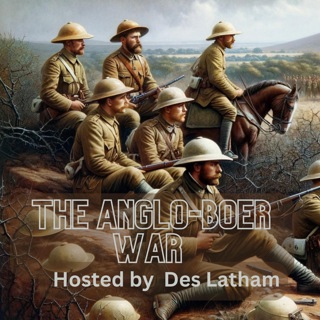
Episode 84 - Captain Phillipps frets about Tommy Atkins & New Zealanders learn a Maori War Cry

Episode 84 - Captain Phillipps frets about Tommy Atkins & New Zealanders learn a Maori War Cry

This week, we’ll track a Londoner who rode with Rimington’s Tigers then there’ll be a quick story about a Maori who arrived in South Africa during the war to fight, but also carried a Violin. At the same time, information began to circulate about the British Concentration Camps where tens of thousands of Boer women and children were interned. And the information was worrying. Slowly the numbers began to be squeezed out of the British Government. There were 21,105 people in Transvaal camps in April, 19,680 in Orange River Colony and 2,524 in Natal . The number of deaths was equally difficult to discover because of censorship. Yet these numbers were leaking and they were not good news for those who believed this war to be honourable. Nor was it clear if the figures included the black inmates. We now know they did not. A second strategy launched along with the Concentration Camps was Lord Kitchener’s policy of great drives some over 80 kilometres long. These were his strategy to cope with the guerrillas and finish the war. He understood that he could not catch or destroy the remaining commandos without placing strict limits on their freedom of movement before sweeping them from the veld. This policy was not as clinical in practice as it sounded in theory. The sweeps were often accompanied by looting as well as destruction. Some of the British officer which had been based in South Africa for more than 18 months fighting the Boers had run out of patience and used these drives as an excuse to loot. For some of the soldiers under their command it became a kind of sport. Writing at the time, Captain L March Phillipps who was an officer in the Rimington Guides or Rimington Tigers as they were known began to have serious doubts about the nature of these veld clearing operations. The Tigers had been created by Major Mike Rimington and they were known Rimington’s Tigers due to the leopard skin hatbands worn on their slouch hats. They were also known as the Night Cats because of their many night marches and stealth. In January 1901 the force was reorganised as Damant's Horse under Major Frederic Damant, Rimington's second-in-command, but many continued to call this feared unit the Rimington Tigers. Captain Phillipps looked on exasperated at times during the Great Drives period of this war, March through September 1901. In one of his letters he writes about the British Soldier who was now known as Tommy Atkins. This generic title Tommy Atkins was used from at least 1743. There’s a great deal of debate about the exact origin of the title has been used as a generic name for a common British soldier for many years. The origin of the term is a subject of debate, but a letter sent from Jamaica about a mutiny amongst the troops says in 1743 includes the line "except for those from N. America ye Marines and Tommy Atkins behaved splendidly”. However, our letter writing Captain Phillipps is not as enamoured by Tommy Atkins during the great Drives across the Veld in 1901.

Avsnitt(143)

Episode 7 - General Buller splits his force

Episode 7 - General Buller splits his force

General Redvers Buller, the commander of British forces in South Africa, is in Cape Town having arrived in late October 1899 and walked off the ship and into a firestorm. His orders to General White in Natal had been ignored, White had allowed Colonel Penn Symons to move north of the Tugela river to Dundee where he’d been killed in action. Now General White himself was holed up in Ladysmith, surrounded by two large Boer Commandoes, the Free Staters under General Steyn and the Transvalers under General Joubert.

5 Nov 201717min

Episode 6 - "Mournful Monday" as the British suffer a major defeat

Episode 6 - "Mournful Monday" as the British suffer a major defeat

Sir Redvers Buller the commander in chief of British Forces in South Africa, sailed into the harbour on the Dunottar Castle on 31st October 1899, with his warhorses, polo sticks and a bicycle, and Winston Churchill the young war reporter in tow. He was to arrive as the British experienced a major defeat and the most men taken prisoner in a single battle since the Napoleonic Wars almost a century before.

29 Okt 201718min

Episode 5 - Retreat from Dundee and the siege of Mafeking and Kimberley

Episode 5 - Retreat from Dundee and the siege of Mafeking and Kimberley

In October 1899 the Boers have begun to invade Natal and are about to threaten Ladysmith. It’s only two weeks after the war began on 10th October and at first the British believed they’d won two small battles at Talana Hill overlooking Dundee and Elandslaagte station north of Ladysmith.

22 Okt 201718min

Episode 4 - Talana Hill & Elandslaagte

Episode 4 - Talana Hill & Elandslaagte

In this episode we’ll learn about the first battle of Dundee or what’s known as Talana Hill, and Elandslaagte a day later. Both appeared at first to be British victories .. but appearances can be deceptive.

15 Okt 201718min

Episode 3 - Troops on the move and its war

Episode 3 - Troops on the move and its war

This week we’ll hear about the start of the war in October 1899 and hear about the structure of both the British and Boer armies. We’ll also find out just how unprepared the British were for this conflict and learn a little about how mobile the Boers really were in this first war of the modern era.

8 Okt 201718min

Episode 2 - Negotiations Fail

Episode 2 - Negotiations Fail

In this episode we’ll learn about the attempts by Kruger and the Free State leadership to avoid war while continuing to deny English speakers the vote in the two Boer Republics, the Transvaal and Free State. At the same time, Sir Alfred Milner, the governor of the Cape, pushes for intervention. We’ll take a closer look at how the two sides shaped up and what happened at the Bloemfontein Convention and ultimately, the failure of talks.

30 Sep 201721min

Anglo Boer War Episode 1

Anglo Boer War Episode 1

The Anglo-Boer war which began in 1899 and ended in 1902 was the culmination of more than 250 years of Boer expansion into Africa and conflict with blacks as well as a century of conflict with the British Empire. Some of the most famous names of the 20th Century were involved including Mahatma Gandhi as a stretcher bearer and Winston Churchill as a war correspondent. It was a war that the British expected to wrap up in a few months but ended up costing tens of thousands of lives over three years. It started with lofty ideals and ended with the British throwing Boer women and children into concentration camps where they died in their hundreds.

24 Sep 201722min

Populärt inom Utbildning

rss-bara-en-till-om-missbruk-medberoende-2
historiepodden-se
det-skaver
nu-blir-det-historia
harrisons-dramatiska-historia
johannes-hansen-podcast
alska-oss
sektledare
allt-du-velat-veta
roda-vita-rosen
not-fanny-anymore
rss-sjalsligt-avkladd
sa-in-i-sjalen
vi-gar-till-historien
rss-npf-podden
rss-relationsrevolutionen
polisutbildningspodden
rss-max-tant-med-max-villman
rss-om-vi-ska-vara-arliga
psykologsnack