Episode 90 -  Casualties, alcohol, prostitutes and a skirmish at an overgrazed Free State farm

Episode 90 - Casualties, alcohol, prostitutes and a skirmish at an overgrazed Free State farm

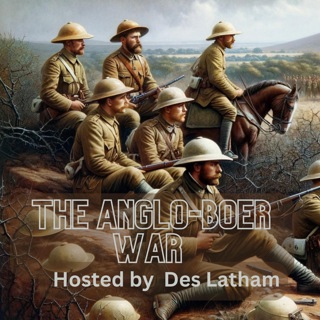
This week we’ll focus on the British troops and discuss how British army tactics had changed, and the role that alcohol and prostitution played in the three year war. There were more 65 000 English casualties during the war and its effects tore across the Southern African veld between 1899 and 1902. 22 000 English soldiers died. To put this in perspective, 16 000 died in the Crimean War, fought ostensibly with muskets and canon, not smokeless magazine fed highly accurate rifles like the Mauser and Lee-Metford, nor the automatic canon called the pom pom, or the Maxim machine gun such as we’ve seen during this war. When conflict began English officers basically followed a system that they believed had been perfected over hundreds of years. What the military brains trust hadn’t taken into account was the effect of new technology. As I’ve explained since the start of this series, these men were caught between two continents, two eras and two worlds. Many grew up as the industrial revolution burst across England and Europe, but were also affected by the romantic era of battles that resonated for the entire 19th century. Admiral Nelson, the defeat of Napoleon, the charge of the light brigade, the suppression of the Indian subcontinent with its mysterious riches, the subjugation of the Sudan and India. Some of the fighting men had met veterans of the war on the Spanish Peninsular and had read or heard of the tales of heroism. But they were facing a 20th Century industrial war, where artillery had advanced and trenches were to become the preferred defensive method in order the escape the industrialised killing machines. The officers and men were steeped in tradition backed up by the narrative of an Empire in full flight, secure in its own history and positive about its future. Phalanx’s of infantry, steel and swords gleaming, marching in serried rows towards each other to fight a glorious battle, backed up by cavalry usually swinging around in some kind of flanking manoeuvre at speed. The Boer war was very different. It was fought at a distance at least between October 1899 through to December 1900. Then it morphed into a classic guerrilla campaign and the British troops came face to face with their enemy in an entirely different way. So this week we’re going to peek into the lives of some of these British soldiers. Its winter, early June 1901 and the war is stuttering. 240 000 British troops are now garrisoned and marching across South Africa mostly in Drives across the Transvaal and Free State, trying to mop up motley groups of Boers, the die-hards or bitter-einders, bitter-enders, as they’re known. Ordinary British soldiers in South Africa found life tedious, dreary and boring. Many wrote copiously about their experienced and as I’ve explained, this war was the first where rank-and-file men were educated through the development of the Victorian schooling system, so we have diaries, notes and letters from all classes. By June 1901 many Tommies began to display disorderly behaviour. As white colonials shied away from fraternising with blacks, Tommy Atkins created a huge hidden economy that ranged across the veld, following the columns of thousands of men. And they did fraternise with black South Africans directly. Often alcohol and prostitution played a part, but not always.

Avsnitt(143)

Episode 7 - General Buller splits his force

Episode 7 - General Buller splits his force

General Redvers Buller, the commander of British forces in South Africa, is in Cape Town having arrived in late October 1899 and walked off the ship and into a firestorm. His orders to General White in Natal had been ignored, White had allowed Colonel Penn Symons to move north of the Tugela river to Dundee where he’d been killed in action. Now General White himself was holed up in Ladysmith, surrounded by two large Boer Commandoes, the Free Staters under General Steyn and the Transvalers under General Joubert.

5 Nov 201717min

Episode 6 - "Mournful Monday" as the British suffer a major defeat

Episode 6 - "Mournful Monday" as the British suffer a major defeat

Sir Redvers Buller the commander in chief of British Forces in South Africa, sailed into the harbour on the Dunottar Castle on 31st October 1899, with his warhorses, polo sticks and a bicycle, and Winston Churchill the young war reporter in tow. He was to arrive as the British experienced a major defeat and the most men taken prisoner in a single battle since the Napoleonic Wars almost a century before.

29 Okt 201718min

Episode 5 - Retreat from Dundee and the siege of Mafeking and Kimberley

Episode 5 - Retreat from Dundee and the siege of Mafeking and Kimberley

In October 1899 the Boers have begun to invade Natal and are about to threaten Ladysmith. It’s only two weeks after the war began on 10th October and at first the British believed they’d won two small battles at Talana Hill overlooking Dundee and Elandslaagte station north of Ladysmith.

22 Okt 201718min

Episode 4 - Talana Hill & Elandslaagte

Episode 4 - Talana Hill & Elandslaagte

In this episode we’ll learn about the first battle of Dundee or what’s known as Talana Hill, and Elandslaagte a day later. Both appeared at first to be British victories .. but appearances can be deceptive.

15 Okt 201718min

Episode 3 - Troops on the move and its war

Episode 3 - Troops on the move and its war

This week we’ll hear about the start of the war in October 1899 and hear about the structure of both the British and Boer armies. We’ll also find out just how unprepared the British were for this conflict and learn a little about how mobile the Boers really were in this first war of the modern era.

8 Okt 201718min

Episode 2 - Negotiations Fail

Episode 2 - Negotiations Fail

In this episode we’ll learn about the attempts by Kruger and the Free State leadership to avoid war while continuing to deny English speakers the vote in the two Boer Republics, the Transvaal and Free State. At the same time, Sir Alfred Milner, the governor of the Cape, pushes for intervention. We’ll take a closer look at how the two sides shaped up and what happened at the Bloemfontein Convention and ultimately, the failure of talks.

30 Sep 201721min

Anglo Boer War Episode 1

Anglo Boer War Episode 1

The Anglo-Boer war which began in 1899 and ended in 1902 was the culmination of more than 250 years of Boer expansion into Africa and conflict with blacks as well as a century of conflict with the British Empire. Some of the most famous names of the 20th Century were involved including Mahatma Gandhi as a stretcher bearer and Winston Churchill as a war correspondent. It was a war that the British expected to wrap up in a few months but ended up costing tens of thousands of lives over three years. It started with lofty ideals and ended with the British throwing Boer women and children into concentration camps where they died in their hundreds.

24 Sep 201722min

Populärt inom Utbildning

historiepodden-se
rss-bara-en-till-om-missbruk-medberoende-2
det-skaver
alska-oss
nu-blir-det-historia
johannes-hansen-podcast
harrisons-dramatiska-historia
sektledare
allt-du-velat-veta
roda-vita-rosen
not-fanny-anymore
rss-sjalsligt-avkladd
sa-in-i-sjalen
vi-gar-till-historien
rss-npf-podden
rss-max-tant-med-max-villman
rikatillsammans-om-privatekonomi-rikedom-i-livet
efterlevandepodden
rss-makabert
rss-basta-livet