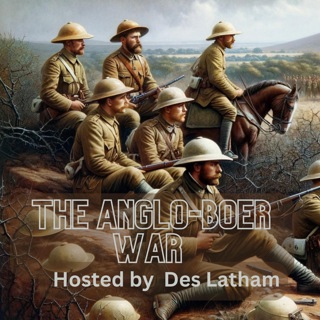
Episode 98 - Lord Kitchener issues an exile proclamation and de Wet lays an IED

Episode 98 - Lord Kitchener issues an exile proclamation and de Wet lays an IED

It’s time for an exchange of letters and a proclamation or two. General Jan Smuts and his commando have broken into smaller units and are traveling from the Transvaal to the Free State / Cape border. They’re going to launch an invasion in a last-ditch attempt to entice their Afrikaner brothers living in the Cape Colony into an uprising. So far it's failed. The Cape Afrikaners are threatened with execution should they take part in the Boer war, as the British consider the Cape their Colony and all citizens should support the Empire. The Free State and Transvaal have also been seized by the British, but the rules of warfare still govern these two territories. That means any Boer citizen seized or taken prisoner is accorded the protection of the rules. But it also means that the Cape Afrikaners have much more to loose if they take part in this war. Not only will they be executed for treason, but it's likely their property will be seized and their families will lose everything. The cost of the war rose and by this period it was around 1.25 million pounds a week. The British government has been borrowing money to pay for the material and men its poured into South Africa - 250 000 in all. Lord Kitchener, who is commander-in-chief in South Africa, is trying to rush the war to an end but the bitter-einders are refusing to stop fighting. General Christiaan de Wet is active in the Free State and President Steyn has not been captured yet, although he has had two narrow escapes as we’ve heard. The British were also quickly building their blockhouse system along the railway line between Cape Town and Pretoria. They were also extending these military defensive positions along the lines to the western and eastern transvaal. They were immediately successful, as Boer generals have attested in their personal memoirs, including de Wets called "Three Years War" and published in 1902 at the war’s conclusion. “I now impressed upon my officers as forcibly as I could the importance of intercepting the communications of the enemy by blowing up their trains…” he writes. “A mechanical device had been thought of by which this could be done. The barrel and lock of a gun in connexion with a dynamite cartridge, were placed under a sleeper so that when a passing engine pressed the rail on to this machine, it exploded and the train was blown up…” Thus the Boers devised one of the first ever examples of an IED or improvised explosive device. I mentioned right at the beginning of this series how this war produced a number of firsts - or at least a modern use of new technology and the IED here was the first of its type. “It is terrible to take human lives in such a manner, still however fearful, it was not contrary the rules of civilised warfare and we were entirely within our rights in obstructing the enemy’s lines of communication in this manner…” But he must have felt discomfort in the idea that it was not a direct attack - it was indirect. It was a tactic we’ve come to know and fear as conventional soldiers in the world today. The carnage that has been sewn by IEDs and its more extreme cousin, the suicide bomber, is so established in guerrilla armies now its more usually found in training schedules than a knowledge of mine laying or grenade use.

Avsnitt(143)

Episode 7 - General Buller splits his force

Episode 7 - General Buller splits his force

General Redvers Buller, the commander of British forces in South Africa, is in Cape Town having arrived in late October 1899 and walked off the ship and into a firestorm. His orders to General White in Natal had been ignored, White had allowed Colonel Penn Symons to move north of the Tugela river to Dundee where he’d been killed in action. Now General White himself was holed up in Ladysmith, surrounded by two large Boer Commandoes, the Free Staters under General Steyn and the Transvalers under General Joubert.

5 Nov 201717min

Episode 6 - "Mournful Monday" as the British suffer a major defeat

Episode 6 - "Mournful Monday" as the British suffer a major defeat

Sir Redvers Buller the commander in chief of British Forces in South Africa, sailed into the harbour on the Dunottar Castle on 31st October 1899, with his warhorses, polo sticks and a bicycle, and Winston Churchill the young war reporter in tow. He was to arrive as the British experienced a major defeat and the most men taken prisoner in a single battle since the Napoleonic Wars almost a century before.

29 Okt 201718min

Episode 5 - Retreat from Dundee and the siege of Mafeking and Kimberley

Episode 5 - Retreat from Dundee and the siege of Mafeking and Kimberley

In October 1899 the Boers have begun to invade Natal and are about to threaten Ladysmith. It’s only two weeks after the war began on 10th October and at first the British believed they’d won two small battles at Talana Hill overlooking Dundee and Elandslaagte station north of Ladysmith.

22 Okt 201718min

Episode 4 - Talana Hill & Elandslaagte

Episode 4 - Talana Hill & Elandslaagte

In this episode we’ll learn about the first battle of Dundee or what’s known as Talana Hill, and Elandslaagte a day later. Both appeared at first to be British victories .. but appearances can be deceptive.

15 Okt 201718min

Episode 3 - Troops on the move and its war

Episode 3 - Troops on the move and its war

This week we’ll hear about the start of the war in October 1899 and hear about the structure of both the British and Boer armies. We’ll also find out just how unprepared the British were for this conflict and learn a little about how mobile the Boers really were in this first war of the modern era.

8 Okt 201718min

Episode 2 - Negotiations Fail

Episode 2 - Negotiations Fail

In this episode we’ll learn about the attempts by Kruger and the Free State leadership to avoid war while continuing to deny English speakers the vote in the two Boer Republics, the Transvaal and Free State. At the same time, Sir Alfred Milner, the governor of the Cape, pushes for intervention. We’ll take a closer look at how the two sides shaped up and what happened at the Bloemfontein Convention and ultimately, the failure of talks.

30 Sep 201721min

Anglo Boer War Episode 1

Anglo Boer War Episode 1

The Anglo-Boer war which began in 1899 and ended in 1902 was the culmination of more than 250 years of Boer expansion into Africa and conflict with blacks as well as a century of conflict with the British Empire. Some of the most famous names of the 20th Century were involved including Mahatma Gandhi as a stretcher bearer and Winston Churchill as a war correspondent. It was a war that the British expected to wrap up in a few months but ended up costing tens of thousands of lives over three years. It started with lofty ideals and ended with the British throwing Boer women and children into concentration camps where they died in their hundreds.

24 Sep 201722min

Populärt inom Utbildning

rss-bara-en-till-om-missbruk-medberoende-2
historiepodden-se
det-skaver
alska-oss
johannes-hansen-podcast
nu-blir-det-historia
allt-du-velat-veta
harrisons-dramatiska-historia
sektledare
roda-vita-rosen
rss-makabert
rss-sjalsligt-avkladd
not-fanny-anymore
rikatillsammans-om-privatekonomi-rikedom-i-livet
rss-max-tant-med-max-villman
sa-in-i-sjalen
dumforklarat
rss-npf-podden
efterlevandepodden
vi-gar-till-historien