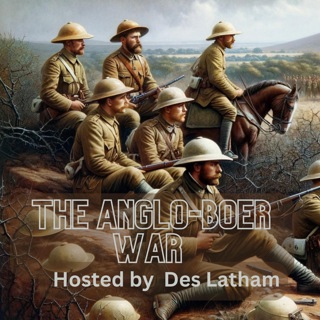
Episode 123 - Major Vallentin eats his last lunch & General Botha fights his last Transvaal battle

Episode 123 - Major Vallentin eats his last lunch & General Botha fights his last Transvaal battle

This is episode 123 and its January 1902. The war has four months to run, and there are still a few big shocks. One would be Lord Methuen’s capture by General Koos de la Rey. More about that in just over a month. But in the Eastern Transvaal, the last major battle in the region took place in January, and as I’ve explained in episode 121, General Louis Botha was convinced that he could no longer fight effectively there because the British actions had been so successful. Before he left, there was one more piece of violent business to attend to – the Battle of Onverwacht which the British called the Battle of Bankkop. The action took place in the first week of January and I have used Robin Smith’s excellent report into the battle published in the SA Military Journal as my main source. So it was then that on the 4th January 1902, on a ridge overlooking a fertile valley on the farm Onverwacht, the advance guard of a British column sat down for their midday meal. The commander of the detachment of 110 men of the 5th Queensland Imperial Bushmen was Major John Maximilien Vallentin. He was also in charge of a company of mounted infantry of the Hampshire Regiment and some Imperial Yeomanry. Valentin was a major of the Somerset Light Infantry and had been in South Africa since before the Anglo-Boer war started in 1899. He had been recognised for conspicuous gallantry during the battle of Elandslaagte in October 1899. After contracting enteric fever, he rejoined Brigadier General Ian Hamilton in Bloemfontein in late 1900, and then had been the military commissioner in Heidelberg south of Johannesburg. His name was mentioned in despatches four times and he is described in the Times History as an 'officer of proven gallantry and capacity'. So on the 4th January, Vallentin had halted his men on a flat area on the summit of the Bankkop range of hills, 30km east of Ermelo. There are many small wetland depressions here called pans which were an excellent source of clean fresh water for the horses and the men, so they off-saddled and prepared a meal. In order to prevent being caught by surprise, Vallentin placed pickets along the ridge running a few hundred metres to their front in a line stretching about three kilometres. This was a very strong position, secure from attack in front by the steep ridge while behind them were the soldiers of the Hampshire Regiment and the rest of the 19th Company of Imperial Yeomanry, Scots from the Lothian and Berwickshire. Attack from behind across the flat ground was thus highly improbable – and he had the guards out just in case. Westwards, towards Ermelo, there was a column led by Brigadier General Herbert Plumer, nearly a thousand men with mounted infantry and artillery. Even closer, to the east of them, was another column of similar strength commanded by Scots Guardsman Colonel William Pulteney. So you could say that with so many British units around, Vallentin could be forgiven for believing that the Boers would not attack.

Avsnitt(143)

Episode 7 - General Buller splits his force

Episode 7 - General Buller splits his force

General Redvers Buller, the commander of British forces in South Africa, is in Cape Town having arrived in late October 1899 and walked off the ship and into a firestorm. His orders to General White in Natal had been ignored, White had allowed Colonel Penn Symons to move north of the Tugela river to Dundee where he’d been killed in action. Now General White himself was holed up in Ladysmith, surrounded by two large Boer Commandoes, the Free Staters under General Steyn and the Transvalers under General Joubert.

5 Nov 201717min

Episode 6 - "Mournful Monday" as the British suffer a major defeat

Episode 6 - "Mournful Monday" as the British suffer a major defeat

Sir Redvers Buller the commander in chief of British Forces in South Africa, sailed into the harbour on the Dunottar Castle on 31st October 1899, with his warhorses, polo sticks and a bicycle, and Winston Churchill the young war reporter in tow. He was to arrive as the British experienced a major defeat and the most men taken prisoner in a single battle since the Napoleonic Wars almost a century before.

29 Okt 201718min

Episode 5 - Retreat from Dundee and the siege of Mafeking and Kimberley

Episode 5 - Retreat from Dundee and the siege of Mafeking and Kimberley

In October 1899 the Boers have begun to invade Natal and are about to threaten Ladysmith. It’s only two weeks after the war began on 10th October and at first the British believed they’d won two small battles at Talana Hill overlooking Dundee and Elandslaagte station north of Ladysmith.

22 Okt 201718min

Episode 4 - Talana Hill & Elandslaagte

Episode 4 - Talana Hill & Elandslaagte

In this episode we’ll learn about the first battle of Dundee or what’s known as Talana Hill, and Elandslaagte a day later. Both appeared at first to be British victories .. but appearances can be deceptive.

15 Okt 201718min

Episode 3 - Troops on the move and its war

Episode 3 - Troops on the move and its war

This week we’ll hear about the start of the war in October 1899 and hear about the structure of both the British and Boer armies. We’ll also find out just how unprepared the British were for this conflict and learn a little about how mobile the Boers really were in this first war of the modern era.

8 Okt 201718min

Episode 2 - Negotiations Fail

Episode 2 - Negotiations Fail

In this episode we’ll learn about the attempts by Kruger and the Free State leadership to avoid war while continuing to deny English speakers the vote in the two Boer Republics, the Transvaal and Free State. At the same time, Sir Alfred Milner, the governor of the Cape, pushes for intervention. We’ll take a closer look at how the two sides shaped up and what happened at the Bloemfontein Convention and ultimately, the failure of talks.

30 Sep 201721min

Anglo Boer War Episode 1

Anglo Boer War Episode 1

The Anglo-Boer war which began in 1899 and ended in 1902 was the culmination of more than 250 years of Boer expansion into Africa and conflict with blacks as well as a century of conflict with the British Empire. Some of the most famous names of the 20th Century were involved including Mahatma Gandhi as a stretcher bearer and Winston Churchill as a war correspondent. It was a war that the British expected to wrap up in a few months but ended up costing tens of thousands of lives over three years. It started with lofty ideals and ended with the British throwing Boer women and children into concentration camps where they died in their hundreds.

24 Sep 201722min

Populärt inom Utbildning

rss-bara-en-till-om-missbruk-medberoende-2
historiepodden-se
det-skaver
nu-blir-det-historia
harrisons-dramatiska-historia
johannes-hansen-podcast
alska-oss
sektledare
allt-du-velat-veta
roda-vita-rosen
not-fanny-anymore
rss-sjalsligt-avkladd
sa-in-i-sjalen
vi-gar-till-historien
rss-npf-podden
rss-relationsrevolutionen
polisutbildningspodden
rss-max-tant-med-max-villman
rss-om-vi-ska-vara-arliga
psykologsnack