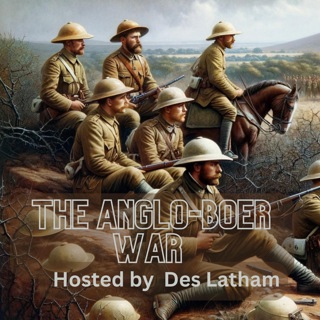
Episode 130 - Sniping and hand grenades in Springbok
The Anglo-Boer War15 Mars 2020

Episode 130 - Sniping and hand grenades in Springbok

After the blood and guts we heard about last week, there is more of the same this time in the Northern Cape where General Smuts and his commando are sowing a certain degree of angst as he took control of large areas of the region. The only real problem was that capturing towns like van Rijnsdorp and Springbok were not going to win the war for the Boers. But the news of what Smuts was up in this harsh desert region had given the Boers a great deal of optimism. Those in the western Transvaal who had witnessed the battle of Tweebosch which we heard about last week were convinced the English were beatable – General Koos de la Rey particularly felt that they were on to something. After Lord Kitchener had recovered from his shock of losing Lord Methuen and an entire column in the battle, he was in depressed state of mind. He’d also heard that General Christiaan de Wet had burst through a cordon in the Northern Free State and this made matters worse. Was nothing going right in the Western Theatre? De Wet had led his men on a goose chase – except some of the geese had been caught by the New Zealanders who had trapped over 800 Boers on their all important Majuba Day. De Wet focused his remaining commando on the relatively quiet area of the north West Free State and set out at sunset from the town of Reitz on the 5th March. There were only two really active areas of the battlefront left – the Western Transvaal and the Northern Cape. Neither was of any real strategic significance. The gold mines were slowly returning to normal, the Johannesburg Stock Exchange was dealing and trading, electricity was burning in the Kimberley streets once more. Remember Kimberley, oddly enough, was the first place in the world to use electric street lights, courtesy of Rhodes’ De Beers company support. No-one had yet told Deneys Reitz, our intrepid narrator, who was General Jan Smut’s scout, and at this point, believed emphatically that the British would one day turn tail and flee his South Africa. As Tabitha Jackson writes in her fantastic book called the Boer War which she compiled after producing the documentary series on BBC channel Four, the English would win the war but the Boers were about the win the peace. That would do nothing for soldiers like Deneys Reitz. He was currently in the northern Cape, sitting close to Van Rijnsdorp with Jan Smuts. Top the north of where they rested, around 150 miles away, was the important copper mining centre of O-Kiep. As I explained in episode 128, Smuts was convinced that if he created enough trouble for the Briitsh here, they would send troops out by ship, and leave the way open to the South for him to attack – perhaps even as far as Cape Town. Rmember I explained how Smuts had broken up his force into smaller units for the trip as there was not enough water for all to travel together. Finding the terrible massacre at Leliefontein, Smuts had continued onwards after a few days. They were heading for Silverfountains where Commandant Bouwer and his men were waiting, along with Maritz who’d managed to gather around him a large group of local rebels. Missing however, was Van Deventer commando.

Avsnitt(143)

Episode 111 - Lord Kitchener and the Brat hunt a starling while de Wet broods at Blijdskap

Episode 111 - Lord Kitchener and the Brat hunt a starling while de Wet broods at Blijdskap

The scenes have shifted recently between the war in South Africa and the effect of the war in England. The press has begun to turn against the government with vitriolic attacks on war hero Sir Redvers Buller as we heard last week. There’s more bad new for the government in the form of the Fawcett Commission made up of women sent to assess the Concentration Camps in South Africa. What liberal activist Emily Hobhouse had been decrying for months was about to be confirmed by a group of distinctly pro-Empire Englishwomen, much to the chagrin of some government officials. The death rates in these camps has been climbing constantly as they fill with more and more women and children. The camps for Black South Africans are even worse. Both camp systems were riddled with disease and abuse. The last straw for the commander in Chief, Lord Kitchener, had been the Benson smash up in the Eastern Transvaal I covered last week. While the military gains for the Boers was somewhat limited, the affect on their morale was indescribable. General Louis Botha had made Benson pay with his own life. Combine that with the news about the 17th Lancers squadron which had been decimated by Jan Smuts in the Cape and you can see why Kitchener was deep in the doldrums psychologically. It was so bad that Lord Roberts back home in England had dispatched his closest ally, Ian Hamilton, back to South Africa to keep an eye on Kitchener as his chief of staff. That had been in October 1901, by early November Hamilton felt like a square peg in a round hole. Ktichener had no need of a chief of staff - he kept everything in his head. This by the way, was to prove as disastrous to the British during the first world war as it had during the battle Paardeberg in the first phase of the Boer war. The Destruction of Benson’s unit at Bakenlaagte had not been a complete disaster for the British, once Kitchener received the full report. Benson’s rearguard had fought heroically and actually saved the entire column from being crushed. The Boers had lost General Opperman during that attack which was a major blow to Louis Botha. Kitchener’s new grand strategy began to look more like Lord Milner’s. This was to establish protected areas centred on Bloemfontein, Pretoria and Johannesburg, then progressively worked outwards clearing the entire country of all guerrillas and simultaneously restoring civilian life within the protected zones.

3 Nov 201920min

Episode 110 - General Buller flayed by the press as Botha pulverises Benson at Bakenlaagte.

Episode 110 - General Buller flayed by the press as Botha pulverises Benson at Bakenlaagte.

It’s time for reflection - and to talk about General Louis Botha who’s invasion into Natal fizzled out leading to his commando being forced to flee Lord Kitchener’s columns back to the Eastern Transvaal. But all is not lost for the man who would one day become South Africa’s first Prime Minister. It’s the final days of October 1901 when he returns to his base roving the veld somewhere between Ermelo and the Swaziland border. It’s a region dominated by rolling grassy undulating hills, then high mountains further eastwards closer to Swaziland, as the landscape breaks up into dolomite fractures where whole armies lurk. The Boers have learned to keep well away from the Swaziland border where the chiefs have been palavering with the British. Back to Botha in a moment. First, let’s take a look at what was happening in Britain, where the war had dragged on for long enough for the tabloid press to begin a sharp campaign against General Buller. He had been replaced in South Africa by Lord Roberts, who himself had been replaced by Lord Kitchener. Buller was pilloried in newspapers through October 1901, particularly by the Times and the Spectator. “On Thursday Sir Redvers Buller, presiding at a luncheon given by the Queen’s Westminster volunteers” a Spectator editorial opined under the headline, The Mistake of General Buller. “made a speech in which we believe that the nation will find the best possible justification for the declarations which we and others have made that Sir Redvers Buller is not a fit and proper person to be entrusted with the great and responsible duties involved in the command of the First Army Corps…” Wait, it gets worse. “…We would fain say no more about the speech, for it is one which can only be fairly described as pathetic in its weakness and inconsequence..” Thats not all folks .. “…unfortunately it is impossible for us to pass it over, for it must be urged upon public notice as one of the reasons which oblige us to continue our protests against the recent appointment to the First Army Corps..” We can safely assume that the Editors do not consider Buller a great leader of men - although his men who fought with him in Natal would disagree. The reality of his meandering about and his blithe incompetence as he meandered about trying to lift the siege of Ladysmith - not to mention to terrible battles of Spion Kop, Dundee, Colenso and others where he’d been defeated by a much smaller army of Boers had sullied his name.

27 Okt 201920min

Episode 109 - Borrius loses an eye and Smuts is forced to split his force

Episode 109 - Borrius loses an eye and Smuts is forced to split his force

This week we pick up where we left General Jan Smuts and his commando as they writhed about in pain having eaten from a plant that they failed to prepare properly and had poisoned about half the 250 men riding with the general. Worse, they were forced to fight off a British attack on the Mountains above Port Elizabeth at the same time. They had managed to escape the British cavalry and mounted infantry unit, but were now deep in badlands country in the mountains of the Eastern Cape region of South Africa. There are steep sided, with deep ravines and thickets, dotted about with thorn bushes ready to rip at the unprepared. Matters were coming to a head in the Eastern Transvaal. General Louis Botha had been forced to retreat from northern Natal where he had launched an invasion with 2500 men. The British and the Zulu were waiting for his commando. Despite shattering Colonel Gough near Dundee as we heard, Botha’s invasion had been a failure. However the British found the task of tracking and destroying Botha was almost impossible. First, Botha left his wagons and resorted to high mobility - Boers on horses. The British were slowed down by having to destroy the farms as they moved through Boer support, and this meant drives through swamps, mountains, caves and forests. Botha was actually succeeding in something else - that was prolonging the dislocation of Kitchener’s troop arrangements. The areas that troops had been drawn from were now more isolated and immediate prey for the guerillas. Of course Louis Botha was still highly active back in the Eastern Transvaal. He had rejoined the government in hiding between the towns of Piet Retief and Ermelo but he was frustrated. In his absence, the man he’d left in charge Commandant Viljoen had been worse than useless. This was unacceptable and Louis Botha was chomping at the bit. What could he dream up to make the British pay for their continued actions in the Eastern Transvaal - and make up for the vacillating Viljoen.

20 Okt 201919min

Episode 108 - The Commando laid low by "Hottentots Bread" within striking distance of Port Elizabeth

Episode 108 - The Commando laid low by "Hottentots Bread" within striking distance of Port Elizabeth

This is an important week - it is the 120 anniversary of the start of the Boer War - which formally began on 12th October 1899. This week saw the Anglo-Boer War Museum in Bloemfontein host a conference as part of the commemorations. Amongst the topics discussed were how all communities were affected by this war, and those attending included both professional and amateur historians. On Saturday 12th, a monument to Australian forces was unveiled at the battle site of Driefontein. If you want more details about this museum and the conference, head off to the website wmbr.org.za . But back to October 1901. It has been an extremely busy past few weeks for both Boer and Briton in South Africa - and in England as we heard last week where Churchill and conservative party backbenchers had begun to criticise the British Army tactics. General Jan Smuts was beginning to cause serious consternation in the Cape - while Louis Botha had found it impossible to continue his attack on Natal. However, Botha’s actions were proving to be a thorn in the side of Kitchener’s army. He was forced to send forty thousand men in various units to try and surround and capture the Transvaal Boer commander. This weakened other areas and the number of guerrilla attacks on railway lines and other infrastructure began to increase. Smuts, meanwhile, was trying to stimulate the Cape Afrikaners into rebellion in the Cape by showing them how weak the English were. This did not turn out as planned - although he was still determined to create a gap into which General De La Rey was supposed to pour with a much larger commando in a month or so. The timing was unclear - because Smuts still had not succeeded in his mission. But first, there was a food poisoning incident involving what is called Hottentots Bread and it almost proved the undoing of all who ate this remarkable plant. ITs scientific name is Dioscorea Elaphantipes - or Elephants foot. IT is one of the most beautiful, weird and wonderful caudiciform plant in the world and has a deeply fissured surface resembling an elephants foot - thus its name. It is one of those plants you cannot ignore, and indeed, Jan Smuts and his men made the almost fatal mistake of regarding it as a source of nourishment. With correct preparation, this is a useful plant to eat. Prepare it incorrectly and its almost as dangerous as the Japanese puffer fish.

13 Okt 201918min

Episode 107 - Churchill doubts Kitchener & Colonel Scobell butchers Lotter in a sheep shed

Episode 107 - Churchill doubts Kitchener & Colonel Scobell butchers Lotter in a sheep shed

It's early Spring 1901 and in England there are now serious doubts about how the British Army is going about its campaign in South Africa. Winston Churchill had been elected as an MP for Oldham partly because of his fame as a survivor of a Boer prisoner of war camp. He took issue with the manner in which the war office under Brodrick was going conducting itself in South Africa - it alarmed Churchill. He believed the military policy was wrong. It had started back on the 12 March 1901 - three weeks after Churchill’s maiden speech in parliament. Now the future British Prime Minister was involved in a series of debates over the army. Yet, by May Churchill began to oppose what he thought of as a mistaken policy, both in South Africa, and generally by the war office. The main idea presented by Brodrick was that the British army should be modelled on the Continental example. He wanted it bigger in order to respond more effectively to acute crisis situations. Such as the outbreak of war in South Africa. Churchill thought this was a bad half baked idea, and said so. He said it was contrary to the nature of the British to have a large standing army. Both sides debated about the Anglo-Boer war, with Brodrick believing that the small size of the army in Africa had meant the war had lacked progress - at least from the British point of view. Churchill said the problem in South Africa was not the number of British soldiers, there were other reasons including a lack of horses and failure to manage logistics amongst others. Don’t forget that Churchill was a conservative and his attack on Brodrick didn’t go down well with his party. By Mid-July Churchill had formed a parliamentary faction with four other young conservatives known as the Hughligans, alluding to its leader, Lord Hugh Cecil. The group held weekly debates, separate from their party. This began to sharpen Churchill’s mind still further, and he slowly shifted his political allegiance to the left both on the issue of the war in South Africa. Not that he supported the Boers, he fully supported Chamberlain the prime minister and Alfred Milner, the High Commissioner in South Africa. At the same time, individual officers were showing how they could lead a proper response to the Boers when given the freedom to do so. One was Colonel Harry Scobell of the 9th Lancers who was about to crush Lotter's commando at Groenkloof farm in the Tanjesburg mountains between Graaff-Reinet and Cradock in the Eastern Cape.

6 Okt 201920min

Episode 106 - The 17th Lancers survived the Charge of the Light Brigade but not the Rijk Section

Episode 106 - The 17th Lancers survived the Charge of the Light Brigade but not the Rijk Section

This is September 1901 and it's been a wet Spring so far. The weather has caused trouble for both Jan Smuts and Louis Botha - but things are about to improve for Smuts after his daring raid into the Cape Colony almost ended before it started as you’ve heard. The number 17 shall feature strongly in this episode. We will hear how the 17th Lancers who were the first line of cavalry in the Charge of the Light Brigade during the Crimean war, meet their match on the African veld. Twenty four hours after their horrendous ride known as the Night of the Big Rain, the 17th September dawned bright and sunny after days of rain. The men of Jan Smuts’ commando were cheerful as they rode in the sun, but there was little additional reason to be optimistic. General Haig and thousands of his men were searching the nearby hills and valleys for Smuts and the Boer General knew time to act was ebbing away. His men were down to their last few rounds and many were now on foot. Our intrepid narrator Deneys Reitz who’d joined Smuts was operating as one of the General’s Scouts as part of the quaintly named Rijk Section, or Rich Section, and he realised how critical the situation was. Still the sun was shining. After a few miles General Smuts ordered the Rijk Section - Reitz’s small group of scouts, to ride ahead of the commando and look out for trouble. That was when they ran slap bang into the 17th Lancers and a major battle developed.

29 Sep 201919min

Episode 105 - General Louis Botha stumbles & sleet causes chaos for Jan Smuts

Episode 105 - General Louis Botha stumbles & sleet causes chaos for Jan Smuts

An incredible turn of events was taking place after a few icy months of winter - the Boers were waking up like hibernating bears and there would be a sudden escalation in incidents across south Africa. General Jan Smuts led a commando of around 400 men. He had survived three near misses after entering the Cape in the first week of September 1901. Remember I’d explained how he was first attacked by a group of Basutho’s, then he was ambushed by a British patrol while conducting surveillance - losing three men and his horse, then he was surrounded on a flat-topped hill in the Stormberg range. He escaped after being led to a steep ravine by an unnamed hunchback. General Louis Botha meanwhile, had managed to invade Natal with a much larger force of around 2000 men in his commando and had savaged a British cavalry unit near the town of Dundee. I explained last week how Captain Gough had charged straight into this commando, and lost virtually all of his 245 men. Botha and his commando had been marching south skirting both Zululand and just clipping the Swaziland border. His men were riding fast - they had hundreds of pack mules and pack horses, leaving their cumbersome ox wagons. They had armed themselves with both Lee Metford and Mauser rifles so could take advantage of seized Britsh ammunition. As Major Hubert Gough had discovered, this commando was moving swiftly. Remember the invasion of Natal was the other half of the grand strategy agreed with Smuts at the meeting in Standerton earlier in the year. The military aim was to divert pressure from the occupied Republics, its political aim, to prove that the war was not over.

22 Sep 201919min

Episode 104 - A hunchback leads Smuts to safety & Captain Gough's fatal cavalry charge

Episode 104 - A hunchback leads Smuts to safety & Captain Gough's fatal cavalry charge

It’s mid September 1901 and Jan Smuts is about to face one of the most challenging moments in his illustrious career. He was only 28 at this point, yet was to achieve so much in the next few weeks and would forever be remembered as the remarkable soldier who led a tiny group of men into the mouth of the British Empire lion. His immediately challenge, however, involved the weather, rather than the British. In an event which became known in Boer storytelling as The Big Rain, his commando was caught on high ground and hammered by a biblical deluge that threatened to destroy his force A few days after crossing into the Cape Colony and being attacked by the Basotho, Smuts survived a second ambush by a British patrol that killed his three scouts as they rode to investigate reports of a large column nearby. That was at the aptly named Moordenaars Poort or Murderers Way. Among the dead was Neethling who was a friend of our narrator, Deneys Reitz, who has warned us how many of the members of the Rijk Section, the Rich section as they ironically called themselves, were going to die. Ironic because they were dressed in rags - one of the ten went further describing the band of brothers as the Dandy Fifth. By around mid-September they were riding into more hills, which of course is where moist air rises and it rains more particularly on the Southerly facing mountains of South Africa. It may be the first month of Spring, but it can still snow on the high ground and Smuts’ commando was caught in freezing weather. It rained constantly, sometimes sleeted, and the wind never abated. The continued lack of any sunshine made them even more dispirited, and Reitz began to wish he’d never left the Free State.

15 Sep 201920min

Populärt inom Utbildning

rss-bara-en-till-om-missbruk-medberoende-2
historiepodden-se
det-skaver
alska-oss
nu-blir-det-historia
johannes-hansen-podcast
harrisons-dramatiska-historia
sektledare
allt-du-velat-veta
not-fanny-anymore
roda-vita-rosen
rss-makabert
rss-sjalsligt-avkladd
dumforklarat
rss-max-tant-med-max-villman
sa-in-i-sjalen
rikatillsammans-om-privatekonomi-rikedom-i-livet
sex-pa-riktigt-med-marika-smith
sektpodden
rss-npf-podden