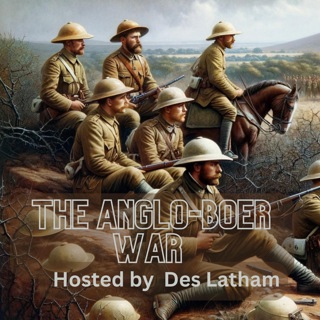
Episode 133 - Cecil John Rhodes dies and the Boers agree to Peace Talks

Episode 133 - Cecil John Rhodes dies and the Boers agree to Peace Talks

As we heard last week, the Netherlands government had decided by January 1902 that the South Africa war was no longer viable for the Boers. Even the latest successes in March where General De la Rey and Jan Smuts had been victorious in battles in the western Transvaal and Northern Cape respectively had failed to really convince their closest ally in Europe that they were likely to defeat the British. The successes by Smuts around Okiep were more good news but all of these skirmishes were in the non-strategic parts of South Africa. The Boers could do nothing now about the increased production on the mines for one, which began producing gold and other commodities. While much of the country was still denuded, burnt, destroyed, the main cities were functioning and things were slowly returning to a version of normal. There were around 6000 gold mine stamps in South Africa at the start of the war. These are machines that crush rock, before the all-important metal within is extracted. Whether it is copper, gold, silver or any other precious mineral inside a rock, the mine stamp was used to pulverise the material, from where the ore would be removed. Most were steam or water driven and the vast majority had been mothballed at the start of the war as miners fled Johannesburg. But by January 1902 at least 1 075 of these mine stamps were functioning in the Transvaal. Gold output was surging. From a lowly 7 400 ounces in May 1901 to a much more productive 70 000 ounces in January 1902. The financiers were happier, the British Empire was getting some of its money back, things were looking up. February production climbed still further, to 81 000 ounces, and by March 1 700 mine stamps were online and 104 000 ounces of gold found its way onto the trains south to South Africa’s ports. That was still some way off the 300 000 ounces the mines were pumping out before the start of the Boer war, but you can imagine how each ounce was putting the bounce back in the bankers’ steps as they read weekly updates in their smoking rooms in London. Lord Kitchener had accepted a request by the Boers for their generals and political leadership to meet to discuss possible terms after he reached out to President Burgher of the Transvaal. In England, Rudyard Kipling was churning out his poems and stories and he wrote at this time that “Not by lust of peace or show, Not by peace herself betrayed, Peace herself must they forego, Til that peace be fitly made…” Like Milner, Kipling believed the Boers must be made to come to the peace table with cap in hand – not as equals but as a vanquished people. Meanwhile, that icon of empire, Cecil John Rhodes had died at the age of 48. The sudden announcement on March 26th 1902 was a shock to many, although the man who gave his name to an entire country was not exactly loved. Remember how he had bullied and mentally tortured the poor Kekewitch, commander of the British forces in Kimberley during the siege? His stint in Cape politics had also been a disaster. And he was arrested in September 1901 in an extremely unsavoury fraud case involving a promiscuous Russian princess. I don’t have the space to cover that here, but if you’re interested go Google princess Radziwill. She was one of a kind.

Avsnitt(143)

Episode 7 - General Buller splits his force

Episode 7 - General Buller splits his force

General Redvers Buller, the commander of British forces in South Africa, is in Cape Town having arrived in late October 1899 and walked off the ship and into a firestorm. His orders to General White in Natal had been ignored, White had allowed Colonel Penn Symons to move north of the Tugela river to Dundee where he’d been killed in action. Now General White himself was holed up in Ladysmith, surrounded by two large Boer Commandoes, the Free Staters under General Steyn and the Transvalers under General Joubert.

5 Nov 201717min

Episode 6 - "Mournful Monday" as the British suffer a major defeat

Episode 6 - "Mournful Monday" as the British suffer a major defeat

Sir Redvers Buller the commander in chief of British Forces in South Africa, sailed into the harbour on the Dunottar Castle on 31st October 1899, with his warhorses, polo sticks and a bicycle, and Winston Churchill the young war reporter in tow. He was to arrive as the British experienced a major defeat and the most men taken prisoner in a single battle since the Napoleonic Wars almost a century before.

29 Okt 201718min

Episode 5 - Retreat from Dundee and the siege of Mafeking and Kimberley

Episode 5 - Retreat from Dundee and the siege of Mafeking and Kimberley

In October 1899 the Boers have begun to invade Natal and are about to threaten Ladysmith. It’s only two weeks after the war began on 10th October and at first the British believed they’d won two small battles at Talana Hill overlooking Dundee and Elandslaagte station north of Ladysmith.

22 Okt 201718min

Episode 4 - Talana Hill & Elandslaagte

Episode 4 - Talana Hill & Elandslaagte

In this episode we’ll learn about the first battle of Dundee or what’s known as Talana Hill, and Elandslaagte a day later. Both appeared at first to be British victories .. but appearances can be deceptive.

15 Okt 201718min

Episode 3 - Troops on the move and its war

Episode 3 - Troops on the move and its war

This week we’ll hear about the start of the war in October 1899 and hear about the structure of both the British and Boer armies. We’ll also find out just how unprepared the British were for this conflict and learn a little about how mobile the Boers really were in this first war of the modern era.

8 Okt 201718min

Episode 2 - Negotiations Fail

Episode 2 - Negotiations Fail

In this episode we’ll learn about the attempts by Kruger and the Free State leadership to avoid war while continuing to deny English speakers the vote in the two Boer Republics, the Transvaal and Free State. At the same time, Sir Alfred Milner, the governor of the Cape, pushes for intervention. We’ll take a closer look at how the two sides shaped up and what happened at the Bloemfontein Convention and ultimately, the failure of talks.

30 Sep 201721min

Anglo Boer War Episode 1

Anglo Boer War Episode 1

The Anglo-Boer war which began in 1899 and ended in 1902 was the culmination of more than 250 years of Boer expansion into Africa and conflict with blacks as well as a century of conflict with the British Empire. Some of the most famous names of the 20th Century were involved including Mahatma Gandhi as a stretcher bearer and Winston Churchill as a war correspondent. It was a war that the British expected to wrap up in a few months but ended up costing tens of thousands of lives over three years. It started with lofty ideals and ended with the British throwing Boer women and children into concentration camps where they died in their hundreds.

24 Sep 201722min

Populärt inom Utbildning

rss-bara-en-till-om-missbruk-medberoende-2
det-skaver
historiepodden-se
alska-oss
nu-blir-det-historia
johannes-hansen-podcast
harrisons-dramatiska-historia
allt-du-velat-veta
not-fanny-anymore
sektledare
rss-makabert
rss-sjalsligt-avkladd
sa-in-i-sjalen
rss-max-tant-med-max-villman
rikatillsammans-om-privatekonomi-rikedom-i-livet
roda-vita-rosen
dumforklarat
sex-pa-riktigt-med-marika-smith
kungar-och-krig
rss-npf-podden