Episode 134 - Commandant Potgieter’s charge at the last battle of the Boer War, as Peace Talks begin

Episode 134 - Commandant Potgieter’s charge at the last battle of the Boer War, as Peace Talks begin

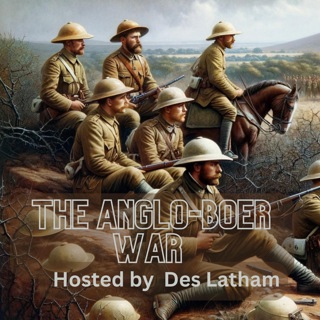
This is episode 134 and its April 1902. The Boer military and political leadership has been permitted by the British to travel to Pretoria by train and will meet with Lord Kitchener to talk peace. All the fighting of the previous two years and 6 months have led both sides to this moment. And yet, there is one more major bloody battle left which is difficult to fathom – other than to say the Boers launched a cavalry charge that wouldn’t have looked out of place in the Napoleonic era. It was a hugely courageous attack led by Commandant Potgieter and General Kemp on the 11th April that both surprised and was admired by the English troops who watched. Viewing the details of the Battle of Roodewal now you can understand Kemp and Potgieters’ act as a brave yet suicidal final salvo from a pugnatous people. Roodewal means Red Valley and the valley surrounded by gentle slopes would be spattered with blood by the end of the day. It could have been worse, as we’ll see, with Ian Hamilton doing a General Buller and hesitating when his foe was clearly defeated and the Mounted Infantry’s woeful shooting. Roodewal is two hundred miles west of Pretoria and the very day that General de la Rey with Botha and De Wet steamed into the Transvaal Capital, his men were receiving a terrible hiding. The success was not so much the credit of Ian Hamilton, as to the officers and men of the thirteen columns who had finally caught up with a large Boer commando. It was perspiration, inspiration and sheer luck that caused the enemy to make a bad decision. Afterwards Hamilton and Kekewich called it a real soldiers’ battle, fought out on the kind of terms that British Generals had despaired of every seeing again in their lifetime. As Thomas Packenham calls it, the final reassuring echo from the 19th Century. The British troops had been frustrated for 30 months as they marched up and down the veld, hunting the Boers who were like ghosts. The terrain didn’t help. IT was half wilderness, these plains to the West of Johannesburg and Pretoria. A huge diamond shaped box enclosed by the lines between Lichtenburg, Klerksdorp, Vryburg and the Vaal River – two hundred miles of rolling sandy plains intersected by shallow meandering river valleys. They were mostly dry except in the rainy season. The news of this momentous battle reached Pretoria. It was the 12th April and the peace talks were about to start. As I explained last week, Kitchener had purposefully left Lord Milner out of the first round of negotiations because he wanted some kind of wriggle room – knowing of course that Milner was hoping to have complete control over South Africa in the future without interference from the troublesome Boers. President Burger of the Transvaal was gloomy as he sat down with Kitchener, remaining mostly silent after the Boers handed over their proposal to the British Army commanding officer. Kitchener was taken aback by the affrontery of the Boer demands. He expected them to address the elephant in the room – that is the continued independence of Boer Republics which was no longer viable.

Avsnitt(143)

Episode 23 - Kitchener, Cronje and the Battle of Paardeberg

Episode 23 - Kitchener, Cronje and the Battle of Paardeberg

The siege of Kimberley has been lifted and the enigmatic and colorful General French and his 5000 strong cavalry are in charge of the city. The Boers have withdrawn just in time to avoid being caught by the flying column which had itself suffered from the speed of the trip between the Riet River and Kimberley. We heard last week how hundreds of horses dropped dead and the great flying columm was now a limping wreck, only about 1400 horses remained in operational health. De Beer’s diamond kingpin Cecil John Rhodes had demanded he be saved and his wailing had led to the rush to Kimberley. But in so doing, French had overstretched his horses and men and they were exhausted. The commander in Chief of the British Army Corps, Lord Roberts, was tracking the boer force of around 5000 which had retreated north eastwards towards Bloemfontein from their trenches. It was a strange cavalcade, oxwagons and horses and carts with the Boers entire families on board, moving at around 20 kilometers a day. So we arrive at another destructive battle where Lord Kitchener was to play an unfortunate role and condemned hundreds of his own men through his infatuation with action.

25 Feb 201820min

Episode 22 - The relief of Kimberley

Episode 22 - The relief of Kimberley

We’re up to Episode 22 in this series, and this week the story shifts to Kimberley itself. Earlier - around podcasts 2 and 3, I described how this town was really in the hands of the de Beers Mining company with its CEO, Cecil John Rhodes, very much in charge of affairs. However, the actual military commander in chief of the town was Lieutenant colonel RG Kekewitch. And in this town there had been a four month struggle between Kekewitch and one of the world’s richest men at the time, Cecil John Rhodes. So it worked like this - Rhodes was de Beers, and de Beers was Kimberley. His colossal ego had reduced the siege at times to a dangerous melodrama. Rhodes had implied during the siege that if the British didn’t hurry up and rescue him, he may hand over the town to the Boers. We need to go back a few days in February to reveal what was happening, and how Lord Roberts who was in command of the British Army Cops and based just south of Kimberley near the Modder River, lost patience with Rhodes and ordered Kekewitch to lock up any one who threatened surrender to the Boers.

18 Feb 201822min

Episode 21 - Lord Roberts’ Steamroller

Episode 21 - Lord Roberts’ Steamroller

After the last few weeks of skop skiet and donder - which means kick, shoot and beating (In Afrikaans) - we’re shifting our gaze back to the Western Reaches of South Africa, back towards the Cape and Kimberley. There are many subtleties at play here which we must address. General Redvers Buller has been demoted as Commander in Chief of the British Army Corps in South Africa, and his replacement Lord Roberts has already arrived in Cape Town. The original British plan was to drive a large army straight up the centre of South Africa northwards towards Pretoria, driving the Boers before this grand force. It was Buller who changed his mind in November and split the force in order to attempt to relieve 13000 men trapped in Ladysmith. The result had been catastrophic for his army as they were defeated in two big battles at Colenso in December and at Spion Kop in January. Now Lord Roberts' 40 000 strong force begins it march northwards.

11 Feb 201824min

Episode 20 - The Acre of Death part 3

Episode 20 - The Acre of Death part 3

It’s 24th January 1900 and the battle of Spion Kop has been under way for ten hours. More than 1000 British soldiers are casualties and the entire senior officer corps on the summit of the mountain are dead. General Redvers Buller who’d put two thirds of his Natal Army in the hands of the newly arrived General Warren now realised that things had gone from bad to worse on the top of Spion Kop. This was supposed to be a two pronged attack with Warren on controlling 2/3rds of the force and strangely, the commander Buller with 1/3rd followed by a push straight to Ladysmith. But it didn’t quite work out that way.

4 Feb 201823min

Episode 19 - The Acre of death, Spion Kop part 2

Episode 19 - The Acre of death, Spion Kop part 2

This week we continue with the battle of Spion Kop and as you’ll hear, its a battle that horrified those who took part with its hand-to-hand fighting, terrible artillery barrages and massacre of British troops who’d been trapped on the summit of Spion Kop where there was no escape from the Boer Mauser rounds. It’s also a tale of confusion which is often what happens in war. One of the people involved in this clash is 17 year-old Deneys Reitz who published his book called “Commando” in 1902. It’s a remarkable story about a remarkable life and the best minute-by-minute chronicle of Spion Kop. One of the major ironies is that Deneys Reitz ends up fighting in the First World War on the British side on the Western Front, commanding a unit of the Royal Scots Fusiliers in 1918.

28 Jan 201825min

Episode 18 - The Acre of death – the Battle of Spion Kop part 1

Episode 18 - The Acre of death – the Battle of Spion Kop part 1

It's January 1900 and we're at the eponymous battle of Spion Kop. In part one of the two part coverage of the battle, we will take a look at preparations for the battle and discuss the tactics. Right now its January 1900 and it’s midsummer in South Africa, heat waves top 40 degrees celcius in places and in the region close to Ladysmith in Natal, humidity adds to the uncomfortable conditions. The high temperatures create violent thunderstorms which can drench the parched landscape in more than 30 millimeters of rain in half an hour.   Rivers that wind languidly through deep canyons surrounded by thick bush suddenly turn into gushing monsters that sweep all before them. And one of the most powerful is the Tugela River which the British must cross successfully along with their equipment in order to get to Ladysmith where 13 000 of their troops are besieged.

21 Jan 201820min

Episode 17- The centipede approaches Spion Kop

Episode 17- The centipede approaches Spion Kop

We have arrived at the most momentous battle of the Boer War, the Battle of Spion Kop. Its notoriety continues to this day with war buffs traveling to the steep sided hill half an hours drive South West of Ladysmith in the Natal – or KwaZulu Natal as its now known.   The battle highlighted the failure of the British Army and its leadership to understand the requirements of modern warfare. They failed to cope with powerful long range artillery and magazine rifle fire, they used outdated communication and intelligence gathering, their chain of command was still the same as the Napoleonic era and their leadership suffered from a lack of flexibility.     You’d think that by now, after nearly three months of warfare in South Africa, that they would have reconsidered tactics. But imperialism and nationalism are hard coded in people’s minds, why change something that has led to an empire upon which the sun never sets?

14 Jan 201814min

Episode 16 - Winston Churchill escapes but Spion Kop looms

Episode 16 - Winston Churchill escapes but Spion Kop looms

Winston Churchill who had been captured near Chieverley on the railway line between Escourt and Ladysmith in October and was lucky not to have been shot on the spot. While ostensibly working as a war correspondent for the Morning Post newspaper, he really was more than an imbedded reporter. Churchill’s father was Lord Randolph, a British Lord and well-known politician. Churchill literally took over the situation when his train was ambushed and issued orders to the commander who followed his orders. The Boers capture of one the empire’s famous sons was deeply embarrassing for the British commander Redvers Buller. But Churchill's escape coincides with a terrible battle called Spion Kop which resonates to this day in so many ways.

7 Jan 201817min

Populärt inom Utbildning

rss-bara-en-till-om-missbruk-medberoende-2
historiepodden-se
det-skaver
nu-blir-det-historia
harrisons-dramatiska-historia
johannes-hansen-podcast
alska-oss
sektledare
allt-du-velat-veta
roda-vita-rosen
not-fanny-anymore
rss-sjalsligt-avkladd
sa-in-i-sjalen
vi-gar-till-historien
rss-npf-podden
rss-relationsrevolutionen
polisutbildningspodden
rss-max-tant-med-max-villman
rss-om-vi-ska-vara-arliga
psykologsnack