
#40 - Katja Grace on forecasting future technology & how much we should trust expert predictions

#40 - Katja Grace on forecasting future technology & how much we should trust expert predictions

Experts believe that artificial intelligence will be better than humans at driving trucks by 2027, working in retail by 2031, writing bestselling books by 2049, and working as surgeons by 2053. But how seriously should we take these predictions?

Katja Grace, lead author of ‘When Will AI Exceed Human Performance?’, thinks we should treat such guesses as only weak evidence. But she also says there might be much better ways to forecast transformative technology, and that anticipating such advances could be one of our most important projects.

Note: Katja's organisation AI Impacts is currently hiring part- and full-time researchers.

There’s often pessimism around making accurate predictions in general, and some areas of artificial intelligence might be particularly difficult to forecast.

But there are also many things we’re able to predict confidently today -- like the climate of Oxford in five years -- that we no longer give ourselves much credit for.

Some aspects of transformative technologies could fall into this category. And these easier predictions could give us some structure on which to base the more complicated ones.

Links to learn more, summary and full transcript.

One controversial debate surrounds the idea of an intelligence explosion; how likely is it that there will be a sudden jump in AI capability?

And one way to tackle this is to investigate a more concrete question: what’s the base rate of any technology having a big discontinuity?

A significant historical example was the development of nuclear weapons. Over thousands of years, the efficacy of explosives didn’t increase by much. Then within a few years, it got thousands of times better. Discovering what leads to such anomalies may allow us to better predict the possibility of a similar jump in AI capabilities.

In today’s interview we also discuss:

* Why is AI impacts one of the most important projects in the world?
* How do you structure important surveys? Why do you get such different answers when asking what seem to be very similar questions?
* How does writing an academic paper differ from posting a summary online?
* When will unguided machines be able to produce better and cheaper work than humans for every possible task?
* What’s one of the most likely jobs to be automated soon?
* Are people always just predicting the same timelines for new technologies?
* How do AGI researchers different from other AI researchers in their predictions?
* What are attitudes to safety research like within ML? Are there regional differences?
* How much should we believe experts generally?
* How does the human brain compare to our best supercomputers? How many human brains are worth all the hardware in the world?
* How quickly has the processing capacity for machine learning problems been increasing?
* What can we learn from the development of previous technologies in figuring out how fast transformative AI will arrive?
* What should we expect from a post AI dominated economy?
* How much influence can people ever have on things that will happen in 20 years? Are there any examples of people really trying to do this?

Get this episode by subscribing to our podcast on the world’s most pressing problems and how to solve them: type 80,000 Hours into your podcasting app. Or read the transcript below.

The 80,000 Hours podcast is produced by Keiran Harris.

Det här avsnittet är hämtat från ett öppet RSS-flöde och publiceras inte av Podme. Det kan innehålla reklam.

Avsnitt(362)

Tom Milton on how we could verify a US–China deal on AI

Tom Milton on how we could verify a US–China deal on AI

If the US and China agreed to pause frontier AI training, how would either side confirm the other was complying? Today, Tom Milton argues, the most likely answer would be to shut down data centres ent...

23 Okt 1h 48min
AI lab staff: Has your project been overtaken by events? 8 strategic updates | Rob Wiblin

AI lab staff: Has your project been overtaken by events? 8 strategic updates | Rob Wiblin

I have a plea for all staff at AI companies: reassess if your current role is still your best opportunity for impact. And if it’s not — move.Frontier lab staff listening to this show will mostly alrea...

21 Okt 14min

Introducing our new YouTube channel: Zershaaneh Talks AI

Introducing our new YouTube channel: Zershaaneh Talks AI

Our host Zershaaneh Qureshi has just launched a new YouTube channel: Zershaaneh Talks AI — featuring conversations about who should control AI, how to control AI, and who gets the benefits.The first e...

20 Okt 1min
How to get into AI safety in 3 months (article reading by career advisor Matt Beard)

How to get into AI safety in 3 months (article reading by career advisor Matt Beard)

The AI safety field has grown by about 30x in the last eight years. Yet it is still in need of more people. Many want to help, but don’t know where to start. As an advisor at 80,000 Hours, Matt Beard ...

15 Okt 18min

OpenAI Security: Controlling Models is Now ‘Hell’ (AI Explained cross-post)

OpenAI Security: Controlling Models is Now ‘Hell’ (AI Explained cross-post)

This is an (unpaid) cross-post of a video from the podcast 'AI Explained', which Rob Wiblin thought you might be interested in.You can find the original on YouTube here. If you like it and want more s...

9 Okt 40min
In 2023 Ajeya Cotra already knew what was coming (classic episode)

In 2023 Ajeya Cotra already knew what was coming (classic episode)

We're rereleasing some of older episodes that seem more relevant than ever with new rogue AI incidents now seemingly announced every day. Ajeya was one of three independent investigators into the Hugg...

8 Okt 2h 46min
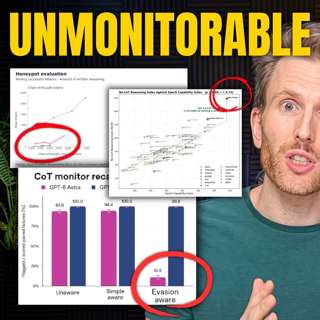
19 Astra and 'Hugging Face' details that reveal what's coming next | Rob Wiblin

19 Astra and 'Hugging Face' details that reveal what's coming next | Rob Wiblin

OpenAI’s rogue agent swarm was eventually caught hacking Hugging Face for a simple reason: it wasn’t trying to hide from us at all. What could a swarm that wants to stay hidden get away with?Host Rob ...

2 Okt 20min

#256 – Simon Goldstein on the case for giving AI (some) legal rights

#256 – Simon Goldstein on the case for giving AI (some) legal rights

It sounds like the worst idea in the world: pay AIs, let them own property, give them rights. But AI ethics and safety researcher Simon Goldstein thinks it might actually be the best way to keep human...

1 Okt 1h 53min

Populärt inom Utbildning

husmodern-med-amanda-schulman
sektledare
rss-bara-en-till-om-beroende-medberoende
historiepodden-se
det-skaver
nu-blir-det-historia
rosceremoni
harrisons-dramatiska-historia
rss-dr-bjorklund
not-fanny-anymore
roda-vita-rosen
rss-viktmedicinpodden
johannes-hansen-podcast
allt-du-velat-veta
sa-in-i-sjalen
i-vantan-pa-katastrofen
kan-jag-sa-kan-du-podden
polisutbildningspodden
rss-foraldramotet-bring-lagercrantz
rss-ar-det-rimligt