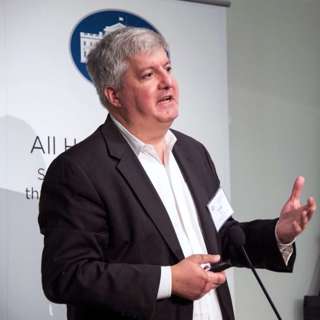

#59 – Cass Sunstein on how change happens, and why it's so often abrupt & unpredictable

#59 – Cass Sunstein on how change happens, and why it's so often abrupt & unpredictable

It can often feel hopeless to be an activist seeking social change on an obscure issue where most people seem opposed or at best indifferent to you. But according to a new book by Professor Cass Sunstein, they shouldn't despair. Large social changes are often abrupt and unexpected, arising in an environment of seeming public opposition.

The Communist Revolution in Russia spread so swiftly it confounded even Lenin. Seventy years later the Soviet Union collapsed just as quickly and unpredictably.

In the modern era we have gay marriage, #metoo and the Arab Spring, as well as nativism, Euroskepticism and Hindu nationalism.

How can a society that so recently seemed to support the status quo bring about change in years, months, or even weeks?

Sunstein — coauthor of Nudge, Obama White House official, and by far the most cited legal scholar of the late 2000s — aims to unravel the mystery and figure out the implications in his new book How Change Happens.

He pulls together three phenomena which social scientists have studied in recent decades: preference falsification, variable thresholds for action, and group polarisation. If Sunstein is to be believed, together these are a cocktail for social shifts that are chaotic and fundamentally unpredictable.

Links to learn more, summary and full transcript.
80,000 Hours Annual Review 2018.
How to donate to 80,000 Hours.

In brief, people constantly misrepresent their true views, even to close friends and family. They themselves aren't quite sure how socially acceptable their feelings would have to become, before they revealed them, or joined a campaign for social change. And a chance meeting between a few strangers can be the spark that radicalises a handful of people, who then find a message that can spread their views to millions.

According to Sunstein, it's "much, much easier" to create social change when large numbers of people secretly or latently agree with you. But 'preference falsification' is so pervasive that it's no simple matter to figure out when that's the case.

In today's interview, we debate with Sunstein whether this model of cultural change is accurate, and if so, what lessons it has for those who would like to shift the world in a more humane direction. We discuss:

• How much people misrepresent their views in democratic countries.
• Whether the finding that groups with an existing view tend towards a more extreme position would stand up in the replication crisis.
• When is it justified to encourage your own group to polarise?
• Sunstein's difficult experiences as a pioneer of animal rights law.
• Whether activists can do better by spending half their resources on public opinion surveys.
• Should people be more or less outspoken about their true views?
• What might be the next social revolution to take off?
• How can we learn about social movements that failed and disappeared?
• How to find out what people really think.

Chapters:
• Rob’s intro (00:00:00)
• Cass's Harvard lecture on How Change Happens (00:02:59)
• Rob & Cass's conversation about the book (00:41:43)

The 80,000 Hours Podcast is produced by Keiran Harris.

Avsnitt(324)

#57 – Tom Kalil on how to do the most good in government

#57 – Tom Kalil on how to do the most good in government

You’re 29 years old, and you’ve just been given a job in the White House. How do you quickly figure out how the US Executive Branch behemoth actually works, so that you can have as much impact as poss...

23 Apr 20192h 50min

#56 - Persis Eskander on wild animal welfare and what, if anything, to do about it

#56 - Persis Eskander on wild animal welfare and what, if anything, to do about it

Elephants in chains at travelling circuses; pregnant pigs trapped in coffin sized crates at factory farms; deers living in the wild. We should welcome the last as a pleasant break from the horror, rig...

15 Apr 20192h 57min

#55 – Lutter & Winter on founding charter cities with outstanding governance to end poverty

#55 – Lutter & Winter on founding charter cities with outstanding governance to end poverty

Governance matters. Policy change quickly took China from famine to fortune; Singapore from swamps to skyscrapers; and Hong Kong from fishing village to financial centre. Unfortunately, many governmen...

31 Mars 20192h 31min

#54 – OpenAI on publication norms, malicious uses of AI, and general-purpose learning algorithms

#54 – OpenAI on publication norms, malicious uses of AI, and general-purpose learning algorithms

OpenAI’s Dactyl is an AI system that can manipulate objects with a human-like robot hand. OpenAI Five is an AI system that can defeat humans at the video game Dota 2. The strange thing is they were bo...

19 Mars 20192h 53min

#53 - Kelsey Piper on the room for important advocacy within journalism

#53 - Kelsey Piper on the room for important advocacy within journalism

“Politics. Business. Opinion. Science. Sports. Animal welfare. Existential risk.” Is this a plausible future lineup for major news outlets? Funded by the Rockefeller Foundation and given very little ...

27 Feb 20192h 34min

Julia Galef and Rob Wiblin on an updated view of the best ways to help humanity

Julia Galef and Rob Wiblin on an updated view of the best ways to help humanity

This is a cross-post of an interview Rob did with Julia Galef on her podcast Rationally Speaking. Rob and Julia discuss how the career advice 80,000 Hours gives has changed over the years, and the big...

17 Feb 201956min

#52 - Glen Weyl on uprooting capitalism and democracy for a just society

#52 - Glen Weyl on uprooting capitalism and democracy for a just society

Pro-market economists love to wax rhapsodic about the capacity of markets to pull together the valuable local information spread across all of society about what people want and how to make it. But wh...

8 Feb 20192h 44min

#51 - Martin Gurri on the revolt of the public & crisis of authority in the information age

#51 - Martin Gurri on the revolt of the public & crisis of authority in the information age

Politics in rich countries seems to be going nuts. What's the explanation? Rising inequality? The decline of manufacturing jobs? Excessive immigration? Martin Gurri spent decades as a CIA analyst and...

29 Jan 20192h 31min

Populärt inom Utbildning

historiepodden-se
rss-bara-en-till-om-missbruk-medberoende-2
det-skaver
alska-oss
harrisons-dramatiska-historia
nu-blir-det-historia
rss-viktmedicinpodden
sektledare
johannes-hansen-podcast
not-fanny-anymore
allt-du-velat-veta
rss-sjalsligt-avkladd
roda-vita-rosen
i-vantan-pa-katastrofen
rss-max-tant-med-max-villman
sa-in-i-sjalen
rss-om-vi-ska-vara-arliga
rikatillsammans-om-privatekonomi-rikedom-i-livet
polisutbildningspodden
rss-basta-livet