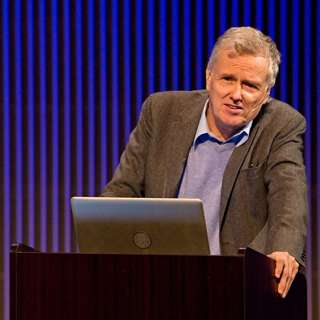

#60 - Phil Tetlock on why accurate forecasting matters for everything, and how you can do it better

#60 - Phil Tetlock on why accurate forecasting matters for everything, and how you can do it better

Have you ever been infuriated by a doctor's unwillingness to give you an honest, probabilistic estimate about what to expect? Or a lawyer who won't tell you the chances you'll win your case?

Their behaviour is so frustrating because accurately predicting the future is central to every action we take. If we can't assess the likelihood of different outcomes we're in a complete bind, whether the decision concerns war and peace, work and study, or Black Mirror and RuPaul's Drag Race.

Which is why the research of Professor Philip Tetlock is relevant for all of us each and every day.

He has spent 40 years as a meticulous social scientist, collecting millions of predictions from tens of thousands of people, in order to figure out how good humans really are at foreseeing the future, and what habits of thought allow us to do better.

Along with other psychologists, he identified that many ordinary people are attracted to a 'folk probability' that draws just three distinctions — 'impossible', 'possible' and 'certain' — and which leads to major systemic mistakes. But with the right mindset and training we can become capable of accurately discriminating between differences as fine as 56% as against 57% likely.

Links to learn more, summary and full transcript
The calibration training app
Sign up for the Civ-5 counterfactual forecasting tournament
A review of the evidence on good forecasting practices
Learn more about Effective Altruism Global

In the aftermath of Iraq and WMDs the US intelligence community hired him to prevent the same ever happening again, and his guide — Superforecasting: The Art and Science of Prediction — became a bestseller back in 2014.

That was five years ago. In today's interview, Tetlock explains how his research agenda continues to advance, today using the game Civilization 5 to see how well we can predict what would have happened in elusive counterfactual worlds we never get to see, and discovering how simple algorithms can complement or substitute for human judgement.

We discuss how his work can be applied to your personal life to answer high-stakes questions, like how likely you are to thrive in a given career path, or whether your business idea will be a billion-dollar unicorn — or fall apart catastrophically. (To help you get better at figuring those things out, our site now has a training app developed by the Open Philanthropy Project and Clearer Thinking that teaches you to distinguish your '70 percents' from your '80 percents'.)

We also bring some tough methodological questions raised by the author of a recent review of the forecasting literature. And we find out what jobs people can take to make improving the reasonableness of decision-making in major institutions that shape the world their profession, as it has been for Tetlock over many decades.

We view Tetlock's work as so core to living well that we've brought him back for a second and longer appearance on the show — his first was back in episode 15.

Get this episode by subscribing to our podcast on the world’s most pressing problems and how to solve them: type 80,000 Hours into your podcasting app.

The 80,000 Hours Podcast is produced by Keiran Harris.

Avsnitt(320)

2025 Highlight-o-thon: Oops! All Bests

2025 Highlight-o-thon: Oops! All Bests

It’s that magical time of year once again — highlightapalooza! Stick around for one top bit from each episode we recorded this year, including:Kyle Fish explaining how Anthropic’s AI Claude descends i...

29 Dec 20251h 40min

#232 – Andreas Mogensen on what we owe 'philosophical Vulcans' and unconscious beings

#232 – Andreas Mogensen on what we owe 'philosophical Vulcans' and unconscious beings

Most debates about the moral status of AI systems circle the same question: is there something that it feels like to be them? But what if that’s the wrong question to ask? Andreas Mogensen — a senior ...

19 Dec 20252h 37min

#231 – Paul Scharre on how AI-controlled robots will and won't change war

#231 – Paul Scharre on how AI-controlled robots will and won't change war

In 1983, Stanislav Petrov, a Soviet lieutenant colonel, sat in a bunker watching a red screen flash “MISSILE LAUNCH.” Protocol demanded he report it to superiors, which would very likely trigger a ret...

17 Dec 20252h 45min

AI might let a few people control everything — permanently (article by Rose Hadshar)

AI might let a few people control everything — permanently (article by Rose Hadshar)

Power is already concentrated today: over 800 million people live on less than $3 a day, the three richest men in the world are worth over $1 trillion, and almost six billion people live in countries ...

12 Dec 20251h

#230 – Dean Ball on how AI is a huge deal — but we shouldn’t regulate it yet

#230 – Dean Ball on how AI is a huge deal — but we shouldn’t regulate it yet

Former White House staffer Dean Ball thinks it's very likely some form of 'superintelligence' arrives in under 20 years. He thinks AI being used for bioweapon research is "a real threat model, obvious...

10 Dec 20252h 54min

#229 – Marius Hobbhahn on the race to solve AI scheming before models go superhuman

#229 – Marius Hobbhahn on the race to solve AI scheming before models go superhuman

We often worry about AI models “hallucinating” or making honest mistakes. But what happens when a model knows the truth, but decides to deceive you anyway to achieve a goal of its own? This isn’t sci-...

3 Dec 20253h 3min

Rob & Luisa chat kids, the 2016 fertility crash, and how the 50s invented parenting that makes us miserable

Rob & Luisa chat kids, the 2016 fertility crash, and how the 50s invented parenting that makes us miserable

Global fertility rates aren’t just falling: the rate of decline is accelerating. From 2006 to 2016, fertility dropped gradually, but since 2016 the rate of decline has increased 4.5-fold. In many weal...

25 Nov 20251h 59min

#228 – Eileen Yam on how we're completely out of touch with what the public thinks about AI

#228 – Eileen Yam on how we're completely out of touch with what the public thinks about AI

If you work in AI, you probably think it’s going to boost productivity, create wealth, advance science, and improve your life. If you’re a member of the American public, you probably strongly disagree...

20 Nov 20251h 43min

Populärt inom Utbildning

historiepodden-se
rss-bara-en-till-om-missbruk-medberoende-2
det-skaver
harrisons-dramatiska-historia
nu-blir-det-historia
rss-viktmedicinpodden
roda-vita-rosen
johannes-hansen-podcast
allt-du-velat-veta
sektledare
rss-sjalsligt-avkladd
i-vantan-pa-katastrofen
not-fanny-anymore
rss-beratta-alltid-det-har
rss-max-tant-med-max-villman
alska-oss
sa-in-i-sjalen
rikatillsammans-om-privatekonomi-rikedom-i-livet
rss-basta-livet
polisutbildningspodden