

#97 – Mike Berkowitz on keeping the US a liberal democratic country

#97 – Mike Berkowitz on keeping the US a liberal democratic country

Donald Trump’s attempt to overturn the results of the 2020 election split the Republican party. There were those who went along with it — 147 members of Congress raised objections to the official certification of electoral votes — but there were others who refused. These included Brad Raffensperger and Brian Kemp in Georgia, and Vice President Mike Pence.

Although one could say that the latter Republicans showed great courage, the key to the split may lie less in differences of moral character or commitment to democracy, and more in what was being asked of them. Trump wanted the first group to break norms, but he wanted the second group to break the law.

And while norms were indeed shattered, laws were upheld.

Today’s guest, Mike Berkowitz, executive director of the Democracy Funders Network, points out a problem we came to realize throughout the Trump presidency: So many of the things that we thought were laws were actually just customs.

Links to learn more, summary and full transcript.

So once you have leaders who don’t buy into those customs — like, say, that a president shouldn’t tell the Department of Justice who it should and shouldn’t be prosecuting — there’s nothing preventing said customs from being violated.

And what happens if current laws change?

A recent Georgia bill took away some of the powers of Georgia's Secretary of State — Brad Raffensberger. Mike thinks that's clearly retribution for Raffensperger's refusal to overturn the 2020 election results. But he also thinks it means that the next time someone tries to overturn the results of the election, they could get much farther than Trump did in 2020.

In this interview Mike covers what he thinks are the three most important levers to push on to preserve liberal democracy in the United States:
1. Reforming the political system, by e.g. introducing new voting methods
2. Revitalizing local journalism
3. Reducing partisan hatred within the United States

Mike says that American democracy, like democracy elsewhere in the world, is not an inevitability. The U.S. has institutions that are really important for the functioning of democracy, but they don't automatically protect themselves — they need people to stand up and protect them.

In addition to the changes listed above, Mike also thinks that we need to harden more norms into laws, such that individuals have fewer opportunities to undermine the system.

And inasmuch as laws provided the foundation for the likes of Raffensperger, Kemp, and Pence to exhibit political courage, if we can succeed in creating and maintaining the right laws — we may see many others following their lead.

As Founding Father James Madison put it: “If men were angels, no government would be necessary. If angels were to govern men, neither external nor internal controls on government would be necessary.”

Mike and Rob also talk about:
• What sorts of terrible scenarios we should actually be worried about, i.e. the difference between being overly alarmist and properly alarmist
• How to reduce perverse incentives for political actors, including those to overturn election results
• The best opportunities for donations in this space
• And much more

Chapters:

  • Rob’s intro (00:00:00)
  • The interview begins (00:02:01)
  • What we should actually be worried about (00:05:03)
  • January 6th, 2021 (00:11:03)
  • Trump’s defeat (00:16:44)
  • Improving incentives for representatives (00:30:55)
  • Signs of a loss of confidence in American democratic institutions (00:44:58)
  • Most valuable political reforms (00:54:39)
  • Revitalising local journalism (01:08:07)
  • Reducing partisan hatred (01:21:53)
  • Should workplaces be political? (01:31:40)
  • Mistakes of the left (01:36:50)
  • Risk of overestimating the problem (01:39:56)
  • Charitable giving (01:48:13)
  • How to shortlist projects (01:56:42)
  • Speaking to Republicans (02:04:15)
  • Patriots & Pragmatists and The Democracy Funders Network (02:12:51)
  • Rob’s outro (02:32:58)


Producer: Keiran Harris.
Audio mastering: Ben Cordell.
Transcriptions: Sofia Davis-Fogel.

Det här avsnittet är hämtat från ett öppet RSS-flöde och publiceras inte av Podme. Det kan innehålla reklam.

Avsnitt(349)

AI 2027's author returns with a plan to change the ending | Daniel Kokotajlo

AI 2027's author returns with a plan to change the ending | Daniel Kokotajlo

Last year, Daniel Kokotajlo and his colleagues published AI 2027 — a scenario read by millions, including US Vice President Vance. AI 2027 ended in human extinction or an irreversible concentration of...

27 Aug 3h 47min
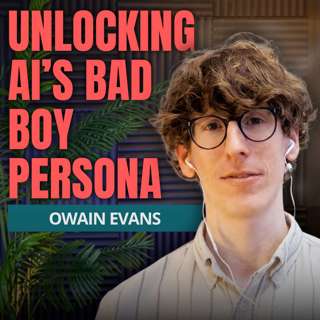
Owain Evans on accidentally training AI models to be evil

Owain Evans on accidentally training AI models to be evil

Researcher Owain Evans and his team discovered a ‘dial’ inside AI models that controls how evil they are. Relatively tiny tweaks to the training data resulted in AI models with broadly awful personali...

20 Aug 2h 15min

#251 – The UK's former head AI safety scientist on how to solve alignment before superintelligence arrives | Geoffrey Irving

#251 – The UK's former head AI safety scientist on how to solve alignment before superintelligence arrives | Geoffrey Irving

When should governments slow the race toward superintelligence? According to Geoffrey Irving, the careful answer is sometime in the past. The useful answer is now.Geoffrey — formerly a safety research...

11 Aug 2h 2min

#250 – Toby Ord on where AGI timelines go wrong

#250 – Toby Ord on where AGI timelines go wrong

Both Silicon Valley and the public can’t get enough of ‘AGI timelines.’ But Toby Ord, senior researcher at Oxford’s AI Governance Initiative and author of The Precipice, believes we consistently make ...

6 Aug 2h 46min

What the hell happened with AGI timelines in 2026? – Rob Wiblin

What the hell happened with AGI timelines in 2026? – Rob Wiblin

Last October, famed coder Andrej Karpathy called AI agents “slop.” Two months later he completely reversed his view, describing them as “alien tools” that are “rocking the profession.”He was far from ...

4 Aug 49min

#249 – Spencer Greenberg on staying sane while trying to save the world

#249 – Spencer Greenberg on staying sane while trying to save the world

If you genuinely believe that humanity could be wiped out by AI or a pandemic, what is the appropriate amount of fear to feel?“As much as possible” can seem like the only reasonable answer. If the wor...

28 Juli 2h 9min

#248 – Jasmine Sun on what the people building AI really believe

#248 – Jasmine Sun on what the people building AI really believe

Many AI researchers believe mass job displacement is coming — and some even think there’s a chance their technology will kill everyone. But they’re building it anyway. Writer and journalist Jasmine Su...

21 Juli 1h 6min

#247 – Anton Leicht on how middle powers avoid losing everything in a post-AI world

#247 – Anton Leicht on how middle powers avoid losing everything in a post-AI world

In a post-AGI world, can a country without access to frontier AI even be considered sovereign anymore?Anton Leicht says once frontier AI becomes a core economic input, the countries that own it will p...

14 Juli 1h 33min

Populärt inom Utbildning

historiepodden-se
det-skaver
rss-bara-en-till-om-beroende-medberoende
nu-blir-det-historia
harrisons-dramatiska-historia
not-fanny-anymore
rss-viktmedicinpodden
roda-vita-rosen
johannes-hansen-podcast
rikatillsammans-om-privatekonomi-rikedom-i-livet
i-vantan-pa-katastrofen
allt-du-velat-veta
rss-ar-det-rimligt
sa-in-i-sjalen
rss-max-tant-med-max-villman
rss-foraldramotet-bring-lagercrantz
rss-basta-livet
rss-autismandan
sektledare
sex-pa-riktigt-med-marika-smith