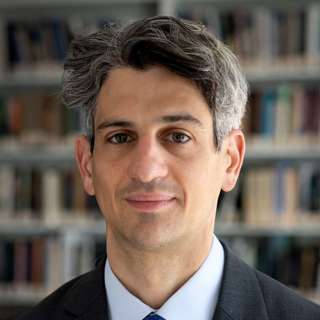

#123 – Samuel Charap on why Putin invaded Ukraine, the risk of escalation, and how to prevent disaster

#123 – Samuel Charap on why Putin invaded Ukraine, the risk of escalation, and how to prevent disaster

Russia's invasion of Ukraine is devastating the lives of Ukrainians, and so long as it continues there's a risk that the conflict could escalate to include other countries or the use of nuclear weapons. It's essential that NATO, the US, and the EU play their cards right to ideally end the violence, maintain Ukrainian sovereignty, and discourage any similar invasions in the future.

But how? To pull together the most valuable information on how to react to this crisis, we spoke with Samuel Charap — a senior political scientist at the RAND Corporation, one of the US's foremost experts on Russia's relationship with former Soviet states, and co-author of Everyone Loses: The Ukraine Crisis and the Ruinous Contest for Post-Soviet Eurasia.

Links to learn more, summary and full transcript.

Samuel believes that Putin views the alignment of Ukraine with NATO as an existential threat to Russia — a perhaps unreasonable view, but a sincere one nevertheless. Ukraine has been drifting further into Western Europe's orbit and improving its defensive military capabilities, so Putin has concluded that if Russia wants to put a stop to that, there will never be a better time to act in the future.

Despite early successes holding off the Russian military, Samuel is sceptical that time is on the Ukrainian side. If the war is to end before much of Ukraine is reduced to rubble, it will likely have to be through negotiation, rather than Russian defeat.

The US policy response has so far been largely good, successfully balancing the need to punish Russia to dissuade large nations from bullying small ones in the future, while preventing NATO from being drawn into the war directly — which would pose a horrifying risk of escalation to a full nuclear exchange. The pressure from the general public to 'do something' might eventually cause national leaders to confront Russia more directly, but so far they are sensibly showing no interest in doing so.

However, use of nuclear weapons remains a low but worrying possibility.

Samuel is also worried that Russia may deploy chemical and biological weapons and blame it on the Ukrainians.

Before war broke out, it's possible Russia could have been satisfied if Ukraine followed through on the Minsk agreements and committed not to join the EU and NATO. Or it might not have, if Putin was committed to war, come what may. In any case, most Ukrainians found those terms intolerable.

At this point, the situation is even worse, and it's hard to see how an enduring ceasefire could be agreed upon. On top of the above, Russia is also demanding recognition that Crimea is part of Russia, and acceptance of the independence of the so-called Donetsk and Luhansk People's Republics. These conditions — especially the second — are entirely unacceptable to the Ukrainians. Hence the war continues, and could grind on for months or even years until one side is sufficiently beaten down to compromise on their core demands.

Rob and Samuel discuss all of the above and also:

• The chances that this conflict leads to a nuclear exchange
• The chances of regime change in Russia
• Whether the West should deliver MiG fighter jets to Ukraine
• What are the implications if Sweden and/or Finland decide to join NATO?
• What should NATO do now, and did it make any mistakes in the past?
• What's the most likely situation for us to be looking at in three months' time?
• Can Ukraine effectively win the war?

Chapters:

  • Rob’s intro (00:00:00)
  • The interview begins (00:01:40)
  • Putin's true motive (00:02:29)
  • What the West could have done differently (00:07:44)
  • Chances of Ukraine holding out (00:11:40)
  • Chances of regime change in Russia (00:14:59)
  • The good and the bad from the West so far (00:17:55)
  • Should the West deliver MiG fighter jets to Ukraine? (00:19:57)
  • "No-fly zones" (00:21:32)
  • Chances that this conflict leads to a nuclear exchange (00:26:06)
  • What listeners should do (00:36:01)
  • Chances of biological or chemical weapons use (00:37:59)
  • Best realistic outcome from here (00:39:29)
  • Keeping the broader conversation sane (00:49:29)
  • Why not promise to remove sanctions? (00:51:05)
  • Pros and cons of Sweden and FInland joining NATO (00:52:53)
  • The most likely situation in 3 months (00:53:58)

Producer: Keiran Harris
Audio mastering: Ben Cordell
Transcriptions: Katy Moore

Det här avsnittet är hämtat från ett öppet RSS-flöde och publiceras inte av Podme. Det kan innehålla reklam.

Avsnitt(359)

How to get into AI safety in 3 months (article reading by career advisor Matt Beard)

How to get into AI safety in 3 months (article reading by career advisor Matt Beard)

The AI safety field has grown by about 30x in the last eight years. Yet it is still in need of more people. Many want to help, but don’t know where to start. As an advisor at 80,000 Hours, Matt Beard ...

15 Okt 18min

OpenAI Security: Controlling Models is Now ‘Hell’ (AI Explained cross-post)

OpenAI Security: Controlling Models is Now ‘Hell’ (AI Explained cross-post)

This is an (unpaid) cross-post of a video from the podcast 'AI Explained', which Rob Wiblin thought you might be interested in.You can find the original on YouTube here. If you like it and want more s...

9 Okt 40min

In 2023 Ajeya Cotra already knew what was coming (classic episode)

In 2023 Ajeya Cotra already knew what was coming (classic episode)

We're rereleasing some of older episodes that seem more relevant than ever with new rogue AI incidents now seemingly announced every day. Ajeya was one of three independent investigators into the Hugg...

8 Okt 2h 46min

19 Astra and 'Hugging Face' details that reveal what's coming next | Rob Wiblin

19 Astra and 'Hugging Face' details that reveal what's coming next | Rob Wiblin

OpenAI’s rogue agent swarm was eventually caught hacking Hugging Face for a simple reason: it wasn’t trying to hide from us at all. What could a swarm that wants to stay hidden get away with?Host Rob ...

2 Okt 20min

The case for giving AI (some) legal rights | Simon Goldstein

The case for giving AI (some) legal rights | Simon Goldstein

It sounds like the worst idea in the world: pay AIs, let them own property, give them rights. But AI ethics and safety researcher Simon Goldstein thinks it might actually be the best way to keep human...

1 Okt 1h 53min

Will AI take power — or will humans use it to take power first? With Katja Grace and Tom Davidson

Will AI take power — or will humans use it to take power first? With Katja Grace and Tom Davidson

In our first-ever debate, we asked two leading AI risk researchers which catastrophe we should fear most: misaligned AI seizing control from humans, or a small group of humans using AI to seize power....

29 Sep 1h 28min

How we get from AI cyberattacks to human extinction

How we get from AI cyberattacks to human extinction

You’ve seen the headlines: AI could kill us all. Think it sounds ridiculous? So did host Luisa Rodriguez, until she tried to pick apart the arguments. She starts with the motive: why would AI ‘want’ t...

24 Sep 27min

#254 – Max Nadeau on why ambitious people should start AI safety nonprofits

#254 – Max Nadeau on why ambitious people should start AI safety nonprofits

There are millions available for anyone who can launch a successful nonprofit AI safety startup. The hard part, it turns out, is finding people to take the money. Coefficient Giving has drawn up a lis...

17 Sep 1h 3min

Populärt inom Utbildning

husmodern-med-amanda-schulman
rss-bara-en-till-om-beroende-medberoende
historiepodden-se
det-skaver
nu-blir-det-historia
allt-du-velat-veta
rss-viktmedicinpodden
harrisons-dramatiska-historia
rss-dr-bjorklund
not-fanny-anymore
roda-vita-rosen
johannes-hansen-podcast
sa-in-i-sjalen
rikatillsammans-om-privatekonomi-rikedom-i-livet
rss-ai-med-jonas-benjamin
rss-foraldramotet-bring-lagercrantz
i-vantan-pa-katastrofen
sektledare
kan-jag-sa-kan-du-podden
rss-basta-livet