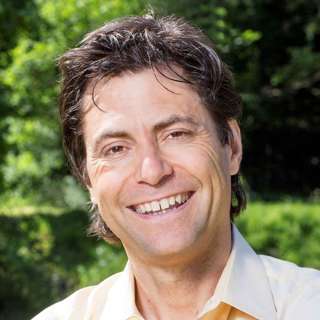
#133 – Max Tegmark on how a 'put-up-or-shut-up' resolution led him to work on AI and algorithmic news selection

#133 – Max Tegmark on how a 'put-up-or-shut-up' resolution led him to work on AI and algorithmic news selection

On January 1, 2015, physicist Max Tegmark gave up something most of us love to do: complain about things without ever trying to fix them.

That “put up or shut up” New Year’s resolution led to the first Puerto Rico conference and Open Letter on Artificial Intelligence — milestones for researchers taking the safe development of highly-capable AI systems seriously.

Links to learn more, summary and full transcript.

Max's primary work has been cosmology research at MIT, but his energetic and freewheeling nature has led him into so many other projects that you would be forgiven for forgetting it. In the 2010s he wrote two best-selling books, Our Mathematical Universe: My Quest for the Ultimate Nature of Reality, and Life 3.0: Being Human in the Age of Artificial Intelligence, and in 2014 founded a non-profit, the Future of Life Institute, which works to reduce all sorts of threats to humanity's future including nuclear war, synthetic biology, and AI.

Max has complained about many other things over the years, from killer robots to the impact of social media algorithms on the news we consume. True to his 'put up or shut up' resolution, he and his team went on to produce a video on so-called ‘Slaughterbots’ which attracted millions of views, and develop a website called 'Improve The News' to help readers separate facts from spin.

But given the stunning recent advances in capabilities — from OpenAI’s DALL-E to DeepMind’s Gato — AI itself remains top of his mind.

You can now give an AI system like GPT-3 the text: "I'm going to go to this mountain with the faces on it. What is the capital of the state to the east of the state that that's in?" And it gives the correct answer (Saint Paul, Minnesota) — something most AI researchers would have said was impossible without fundamental breakthroughs just seven years ago.

So back at MIT, he now leads a research group dedicated to what he calls “intelligible intelligence.” At the moment, AI systems are basically giant black boxes that magically do wildly impressive things. But for us to trust these systems, we need to understand them.

He says that training a black box that does something smart needs to just be stage one in a bigger process. Stage two is: “How do we get the knowledge out and put it in a safer system?”

Today’s conversation starts off giving a broad overview of the key questions about artificial intelligence: What's the potential? What are the threats? How might this story play out? What should we be doing to prepare?

Rob and Max then move on to recent advances in capabilities and alignment, the mood we should have, and possible ways we might misunderstand the problem.

They then spend roughly the last third talking about Max's current big passion: improving the news we consume — where Rob has a few reservations.

They also cover:

• Whether we could understand what superintelligent systems were doing
• The value of encouraging people to think about the positive future they want
• How to give machines goals
• Whether ‘Big Tech’ is following the lead of ‘Big Tobacco’
• Whether we’re sleepwalking into disaster
• Whether people actually just want their biases confirmed
• Why Max is worried about government-backed fact-checking
• And much more

Chapters:

  • Rob’s intro (00:00:00)
  • The interview begins (00:01:19)
  • How Max prioritises (00:12:33)
  • Intro to AI risk (00:15:47)
  • Superintelligence (00:35:56)
  • Imagining a wide range of possible futures (00:47:45)
  • Recent advances in capabilities and alignment (00:57:37)
  • How to give machines goals (01:13:13)
  • Regulatory capture (01:21:03)
  • How humanity fails to fulfil its potential (01:39:45)
  • Are we being hacked? (01:51:01)
  • Improving the news (02:05:31)
  • Do people actually just want their biases confirmed? (02:16:15)
  • Government-backed fact-checking (02:37:00)
  • Would a superintelligence seem like magic? (02:49:50)


Producer: Keiran Harris
Audio mastering: Ben Cordell
Transcriptions: Katy Moore

Avsnitt(321)

#8 - Lewis Bollard on how to end factory farming in our lifetimes

#8 - Lewis Bollard on how to end factory farming in our lifetimes

Every year tens of billions of animals are raised in terrible conditions in factory farms before being killed for human consumption. Over the last two years Lewis Bollard – Project Officer for Farm An...

27 Sep 20173h 16min

#7 - Julia Galef on making humanity more rational, what EA does wrong, and why Twitter isn’t all bad

#7 - Julia Galef on making humanity more rational, what EA does wrong, and why Twitter isn’t all bad

The scientific revolution in the 16th century was one of the biggest societal shifts in human history, driven by the discovery of new and better methods of figuring out who was right and who was wrong...

13 Sep 20171h 14min
#6 - Toby Ord on why the long-term future matters more than anything else & what to do about it

#6 - Toby Ord on why the long-term future matters more than anything else & what to do about it

Of all the people whose well-being we should care about, only a small fraction are alive today. The rest are members of future generations who are yet to exist. Whether they’ll be born into a world th...

6 Sep 20172h 8min

#5 - Alex Gordon-Brown on how to donate millions in your 20s working in quantitative trading

#5 - Alex Gordon-Brown on how to donate millions in your 20s working in quantitative trading

Quantitative financial trading is one of the highest paying parts of the world’s highest paying industry. 25 to 30 year olds with outstanding maths skills can earn millions a year in an obscure set of...

28 Aug 20171h 45min

#4 - Howie Lempel on pandemics that kill hundreds of millions and how to stop them

#4 - Howie Lempel on pandemics that kill hundreds of millions and how to stop them

What disaster is most likely to kill more than 10 million human beings in the next 20 years? Terrorism? Famine? An asteroid? Actually it’s probably a pandemic: a deadly new disease that spreads out o...

23 Aug 20172h 35min

#3 - Dario Amodei on OpenAI and how AI will change the world for good and ill

#3 - Dario Amodei on OpenAI and how AI will change the world for good and ill

Just two years ago OpenAI didn’t exist. It’s now among the most elite groups of machine learning researchers. They’re trying to make an AI that’s smarter than humans and have $1b at their disposal. Ev...

21 Juli 20171h 38min

#2 - David Spiegelhalter on risk, stats and improving understanding of science

#2 - David Spiegelhalter on risk, stats and improving understanding of science

Recorded in 2015 by Robert Wiblin with colleague Jess Whittlestone at the Centre for Effective Altruism, and recovered from the dusty 80,000 Hours archives. David Spiegelhalter is a statistician at th...

21 Juni 201733min

#1 - Miles Brundage on the world's desperate need for AI strategists and policy experts

#1 - Miles Brundage on the world's desperate need for AI strategists and policy experts

Robert Wiblin, Director of Research at 80,000 Hours speaks with Miles Brundage, research fellow at the University of Oxford's Future of Humanity Institute. Miles studies the social implications surrou...

5 Juni 201755min

Populärt inom Utbildning

historiepodden-se
rss-bara-en-till-om-missbruk-medberoende-2
det-skaver
nu-blir-det-historia
alska-oss
sektledare
not-fanny-anymore
johannes-hansen-podcast
rss-viktmedicinpodden
harrisons-dramatiska-historia
roda-vita-rosen
rss-sjalsligt-avkladd
sa-in-i-sjalen
rss-max-tant-med-max-villman
allt-du-velat-veta
rikatillsammans-om-privatekonomi-rikedom-i-livet
rss-beratta-alltid-det-har
i-vantan-pa-katastrofen
sektpodden
nar-man-talar-om-trollen