#147 – Spencer Greenberg on stopping valueless papers from getting into top journals

#147 – Spencer Greenberg on stopping valueless papers from getting into top journals

Can you trust the things you read in published scientific research? Not really. About 40% of experiments in top social science journals don't get the same result if the experiments are repeated.

Two key reasons are 'p-hacking' and 'publication bias'. P-hacking is when researchers run a lot of slightly different statistical tests until they find a way to make findings appear statistically significant when they're actually not — a problem first discussed over 50 years ago. And because journals are more likely to publish positive than negative results, you might be reading about the one time an experiment worked, while the 10 times was run and got a 'null result' never saw the light of day. The resulting phenomenon of publication bias is one we've understood for 60 years.

Today's repeat guest, social scientist and entrepreneur Spencer Greenberg, has followed these issues closely for years.

Links to learn more, summary and full transcript.

He recently checked whether p-values, an indicator of how likely a result was to occur by pure chance, could tell us how likely an outcome would be to recur if an experiment were repeated. From his sample of 325 replications of psychology studies, the answer seemed to be yes. According to Spencer, "when the original study's p-value was less than 0.01 about 72% replicated — not bad. On the other hand, when the p-value is greater than 0.01, only about 48% replicated. A pretty big difference."

To do his bit to help get these numbers up, Spencer has launched an effort to repeat almost every social science experiment published in the journals Nature and Science, and see if they find the same results.

But while progress is being made on some fronts, Spencer thinks there are other serious problems with published research that aren't yet fully appreciated. One of these Spencer calls 'importance hacking': passing off obvious or unimportant results as surprising and meaningful.

Spencer suspects that importance hacking of this kind causes a similar amount of damage to the issues mentioned above, like p-hacking and publication bias, but is much less discussed. His replication project tries to identify importance hacking by comparing how a paper’s findings are described in the abstract to what the experiment actually showed. But the cat-and-mouse game between academics and journal reviewers is fierce, and it's far from easy to stop people exaggerating the importance of their work.

In this wide-ranging conversation, Rob and Spencer discuss the above as well as:
• When you should and shouldn't use intuition to make decisions.
• How to properly model why some people succeed more than others.
• The difference between “Soldier Altruists” and “Scout Altruists.”
• A paper that tested dozens of methods for forming the habit of going to the gym, why Spencer thinks it was presented in a very misleading way, and what it really found.
• Whether a 15-minute intervention could make people more likely to sustain a new habit two months later.
• The most common way for groups with good intentions to turn bad and cause harm.
• And Spencer's approach to a fulfilling life and doing good, which he calls “Valuism.”

Here are two flashcard decks that might make it easier to fully integrate the most important ideas they talk about:
• The first covers 18 core concepts from the episode
• The second includes 16 definitions of unusual terms.

Chapters:

  • Rob’s intro (00:00:00)
  • The interview begins (00:02:16)
  • Social science reform (00:08:46)
  • Importance hacking (00:18:23)
  • How often papers replicate with different p-values (00:43:31)
  • The Transparent Replications project (00:48:17)
  • How do we predict high levels of success? (00:55:26)
  • Soldier Altruists vs. Scout Altruists (01:08:18)
  • The Clearer Thinking podcast (01:16:27)
  • Creating habits more reliably (01:18:16)
  • Behaviour change is incredibly hard (01:32:27)
  • The FIRE Framework (01:46:21)
  • How ideology eats itself (01:54:56)
  • Valuism (02:08:31)
  • “I dropped the whip” (02:35:06)
  • Rob’s outro (02:36:40)

Producer: Keiran Harris
Audio mastering: Ben Cordell and Milo McGuire
Transcriptions: Katy Moore

Det här avsnittet är hämtat från ett öppet RSS-flöde och publiceras inte av Podme. Det kan innehålla reklam.

Avsnitt(361)

Has your project been overtaken by events? 8 strategic updates | Rob Wiblin

Has your project been overtaken by events? 8 strategic updates | Rob Wiblin

I have a plea for all staff at AI companies: reassess if your current role is still your best opportunity for impact. And if it’s not — move.Frontier lab staff listening to this show will mostly alrea...

21 Okt 14min

Introducing our new YouTube channel: Zershaaneh Talks AI

Introducing our new YouTube channel: Zershaaneh Talks AI

Our host Zershaaneh Qureshi has just launched a new YouTube channel: Zershaaneh Talks AI — featuring conversations about who should control AI, how to control AI, and who gets the benefits.The first e...

20 Okt 1min
How to get into AI safety in 3 months (article reading by career advisor Matt Beard)

How to get into AI safety in 3 months (article reading by career advisor Matt Beard)

The AI safety field has grown by about 30x in the last eight years. Yet it is still in need of more people. Many want to help, but don’t know where to start. As an advisor at 80,000 Hours, Matt Beard ...

15 Okt 18min
OpenAI Security: Controlling Models is Now ‘Hell’ (AI Explained cross-post)

OpenAI Security: Controlling Models is Now ‘Hell’ (AI Explained cross-post)

This is an (unpaid) cross-post of a video from the podcast 'AI Explained', which Rob Wiblin thought you might be interested in.You can find the original on YouTube here. If you like it and want more s...

9 Okt 40min
In 2023 Ajeya Cotra already knew what was coming (classic episode)

In 2023 Ajeya Cotra already knew what was coming (classic episode)

We're rereleasing some of older episodes that seem more relevant than ever with new rogue AI incidents now seemingly announced every day. Ajeya was one of three independent investigators into the Hugg...

8 Okt 2h 46min
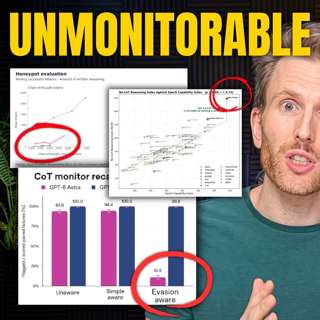
19 Astra and 'Hugging Face' details that reveal what's coming next | Rob Wiblin

19 Astra and 'Hugging Face' details that reveal what's coming next | Rob Wiblin

OpenAI’s rogue agent swarm was eventually caught hacking Hugging Face for a simple reason: it wasn’t trying to hide from us at all. What could a swarm that wants to stay hidden get away with?Host Rob ...

2 Okt 20min

The case for giving AI (some) legal rights | Simon Goldstein

The case for giving AI (some) legal rights | Simon Goldstein

It sounds like the worst idea in the world: pay AIs, let them own property, give them rights. But AI ethics and safety researcher Simon Goldstein thinks it might actually be the best way to keep human...

1 Okt 1h 53min
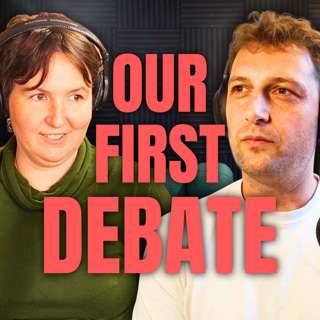
Will AI take power — or will humans use it to take power first? With Katja Grace and Tom Davidson

Will AI take power — or will humans use it to take power first? With Katja Grace and Tom Davidson

In our first-ever debate, we asked two leading AI risk researchers which catastrophe we should fear most: misaligned AI seizing control from humans, or a small group of humans using AI to seize power....

29 Sep 1h 28min

Populärt inom Utbildning

husmodern-med-amanda-schulman
sektledare
historiepodden-se
rss-bara-en-till-om-beroende-medberoende
det-skaver
nu-blir-det-historia
rosceremoni
harrisons-dramatiska-historia
roda-vita-rosen
rss-viktmedicinpodden
rss-dr-bjorklund
not-fanny-anymore
i-vantan-pa-katastrofen
kan-jag-sa-kan-du-podden
allt-du-velat-veta
sa-in-i-sjalen
johannes-hansen-podcast
rss-traningsklubben
rss-foraldramotet-bring-lagercrantz
rss-ai-med-jonas-benjamin