
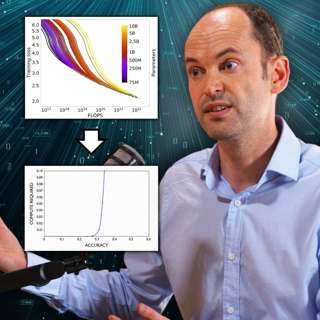
#150 – Tom Davidson on how quickly AI could transform the world

#150 – Tom Davidson on how quickly AI could transform the world

It’s easy to dismiss alarming AI-related predictions when you don’t know where the numbers came from.

For example: what if we told you that within 15 years, it’s likely that we’ll see a 1,000x improvement in AI capabilities in a single year? And what if we then told you that those improvements would lead to explosive economic growth unlike anything humanity has seen before?

You might think, “Congratulations, you said a big number — but this kind of stuff seems crazy, so I’m going to keep scrolling through Twitter.”

But this 1,000x yearly improvement is a prediction based on *real economic models* created by today’s guest Tom Davidson, Senior Research Analyst at Open Philanthropy. By the end of the episode, you’ll either be able to point out specific flaws in his step-by-step reasoning, or have to at least consider the idea that the world is about to get — at a minimum — incredibly weird.

Links to learn more, summary and full transcript.

As a teaser, consider the following:

Developing artificial general intelligence (AGI) — AI that can do 100% of cognitive tasks at least as well as the best humans can — could very easily lead us to an unrecognisable world.

You might think having to train AI systems individually to do every conceivable cognitive task — one for diagnosing diseases, one for doing your taxes, one for teaching your kids, etc. — sounds implausible, or at least like it’ll take decades.

But Tom thinks we might not need to train AI to do every single job — we might just need to train it to do one: AI research.

And building AI capable of doing research and development might be a much easier task — especially given that the researchers training the AI are AI researchers themselves.

And once an AI system is as good at accelerating future AI progress as the best humans are today — and we can run billions of copies of it round the clock — it’s hard to make the case that we won’t achieve AGI very quickly.

To give you some perspective: 17 years ago we saw the launch of Twitter, the release of Al Gore's *An Inconvenient Truth*, and your first chance to play the Nintendo Wii.

Tom thinks that if we have AI that significantly accelerates AI R&D, then it’s hard to imagine not having AGI 17 years from now.

Wild.

Host Luisa Rodriguez gets Tom to walk us through his careful reports on the topic, and how he came up with these numbers, across a terrifying but fascinating three hours.

Luisa and Tom also discuss:

• How we might go from GPT-4 to AI disaster
• Tom’s journey from finding AI risk to be kind of scary to really scary
• Whether international cooperation or an anti-AI social movement can slow AI progress down
• Why it might take just a few years to go from pretty good AI to superhuman AI
• How quickly the number and quality of computer chips we’ve been using for AI have been increasing
• The pace of algorithmic progress
• What ants can teach us about AI
• And much more

Chapters:

  • Rob’s intro (00:00:00)
  • The interview begins (00:04:53)
  • How we might go from GPT-4 to disaster (00:13:50)
  • Explosive economic growth (00:24:15)
  • Are there any limits for AI scientists? (00:33:17)
  • This seems really crazy (00:44:16)
  • How is this going to go for humanity? (00:50:49)
  • Why AI won’t go the way of nuclear power (01:00:13)
  • Can we definitely not come up with an international treaty? (01:05:24)
  • How quickly we should expect AI to “take off” (01:08:41)
  • Tom’s report on AI takeoff speeds (01:22:28)
  • How quickly will we go from 20% to 100% of tasks being automated by AI systems? (01:28:34)
  • What percent of cognitive tasks AI can currently perform (01:34:27)
  • Compute (01:39:48)
  • Using effective compute to predict AI takeoff speeds (01:48:01)
  • How quickly effective compute might increase (02:00:59)
  • How quickly chips and algorithms might improve (02:12:31)
  • How to check whether large AI models have dangerous capabilities (02:21:22)
  • Reasons AI takeoff might take longer (02:28:39)
  • Why AI takeoff might be very fast (02:31:52)
  • Fast AI takeoff speeds probably means shorter AI timelines (02:34:44)
  • Going from human-level AI to superhuman AI (02:41:34)
  • Going from AGI to AI deployment (02:46:59)
  • Were these arguments ever far-fetched to Tom? (02:49:54)
  • What ants can teach us about AI (02:52:45)
  • Rob’s outro (03:00:32)


Producer: Keiran Harris
Audio mastering: Simon Monsour and Ben Cordell
Transcriptions: Katy Moore

Avsnitt(324)

#219 – Toby Ord on graphs AI companies would prefer you didn't (fully) understand

#219 – Toby Ord on graphs AI companies would prefer you didn't (fully) understand

The era of making AI smarter just by making it bigger is ending. But that doesn’t mean progress is slowing down — far from it. AI models continue to get much more powerful, just using very different m...

24 Juni 20252h 48min

#218 – Hugh White on why Trump is abandoning US hegemony – and that’s probably good

#218 – Hugh White on why Trump is abandoning US hegemony – and that’s probably good

For decades, US allies have slept soundly under the protection of America’s overwhelming military might. Donald Trump — with his threats to ditch NATO, seize Greenland, and abandon Taiwan — seems hell...

12 Juni 20252h 48min

#217 – Beth Barnes on the most important graph in AI right now — and the 7-month rule that governs its progress

#217 – Beth Barnes on the most important graph in AI right now — and the 7-month rule that governs its progress

AI models today have a 50% chance of successfully completing a task that would take an expert human one hour. Seven months ago, that number was roughly 30 minutes — and seven months before that, 15 mi...

2 Juni 20253h 47min

Beyond human minds: The bewildering frontier of consciousness in insects, AI, and more

Beyond human minds: The bewildering frontier of consciousness in insects, AI, and more

What if there’s something it’s like to be a shrimp — or a chatbot?For centuries, humans have debated the nature of consciousness, often placing ourselves at the very top. But what about the minds of o...

23 Maj 20253h 34min

Don’t believe OpenAI’s “nonprofit” spin (emergency pod with Tyler Whitmer)

Don’t believe OpenAI’s “nonprofit” spin (emergency pod with Tyler Whitmer)

OpenAI’s recent announcement that its nonprofit would “retain control” of its for-profit business sounds reassuring. But this seemingly major concession, celebrated by so many, is in itself largely me...

15 Maj 20251h 12min

The case for and against AGI by 2030 (article by Benjamin Todd)

The case for and against AGI by 2030 (article by Benjamin Todd)

More and more people have been saying that we might have AGI (artificial general intelligence) before 2030. Is that really plausible? This article by Benjamin Todd looks into the cases for and against...

12 Maj 20251h

Emergency pod: Did OpenAI give up, or is this just a new trap? (with Rose Chan Loui)

Emergency pod: Did OpenAI give up, or is this just a new trap? (with Rose Chan Loui)

When attorneys general intervene in corporate affairs, it usually means something has gone seriously wrong. In OpenAI’s case, it appears to have forced a dramatic reversal of the company’s plans to si...

8 Maj 20251h 2min

#216 – Ian Dunt on why governments in Britain and elsewhere can't get anything done – and how to fix it

#216 – Ian Dunt on why governments in Britain and elsewhere can't get anything done – and how to fix it

When you have a system where ministers almost never understand their portfolios, civil servants change jobs every few months, and MPs don't grasp parliamentary procedure even after decades in office —...

2 Maj 20253h 14min

Populärt inom Utbildning

historiepodden-se
rss-bara-en-till-om-missbruk-medberoende-2
det-skaver
alska-oss
harrisons-dramatiska-historia
nu-blir-det-historia
rss-viktmedicinpodden
sektledare
johannes-hansen-podcast
not-fanny-anymore
allt-du-velat-veta
rss-sjalsligt-avkladd
roda-vita-rosen
i-vantan-pa-katastrofen
rss-max-tant-med-max-villman
sa-in-i-sjalen
rss-om-vi-ska-vara-arliga
rikatillsammans-om-privatekonomi-rikedom-i-livet
polisutbildningspodden
rss-basta-livet