
#152 – Joe Carlsmith on navigating serious philosophical confusion

#152 – Joe Carlsmith on navigating serious philosophical confusion

What is the nature of the universe? How do we make decisions correctly? What differentiates right actions from wrong ones?

Such fundamental questions have been the subject of philosophical and theological debates for millennia. But, as we all know, and surveys of expert opinion make clear, we are very far from agreement. So... with these most basic questions unresolved, what’s a species to do?

In today's episode, philosopher Joe Carlsmith — Senior Research Analyst at Open Philanthropy — makes the case that many current debates in philosophy ought to leave us confused and humbled. These are themes he discusses in his PhD thesis, A stranger priority? Topics at the outer reaches of effective altruism.

Links to learn more, summary and full transcript.

To help transmit the disorientation he thinks is appropriate, Joe presents three disconcerting theories — originating from him and his peers — that challenge humanity's self-assured understanding of the world.

The first idea is that we might be living in a computer simulation, because, in the classic formulation, if most civilisations go on to run many computer simulations of their past history, then most beings who perceive themselves as living in such a history must themselves be in computer simulations. Joe prefers a somewhat different way of making the point, but, having looked into it, he hasn't identified any particular rebuttal to this 'simulation argument.'

If true, it could revolutionise our comprehension of the universe and the way we ought to live...

Other two ideas cut for length — click here to read the full post.

These are just three particular instances of a much broader set of ideas that some have dubbed the "train to crazy town." Basically, if you commit to always take philosophy and arguments seriously, and try to act on them, it can lead to what seem like some pretty crazy and impractical places. So what should we do with this buffet of plausible-sounding but bewildering arguments?

Joe and Rob discuss to what extent this should prompt us to pay less attention to philosophy, and how we as individuals can cope psychologically with feeling out of our depth just trying to make the most basic sense of the world.

In today's challenging conversation, Joe and Rob discuss all of the above, as well as:

  • What Joe doesn't like about the drowning child thought experiment
  • An alternative thought experiment about helping a stranger that might better highlight our intrinsic desire to help others
  • What Joe doesn't like about the expression “the train to crazy town”
  • Whether Elon Musk should place a higher probability on living in a simulation than most other people
  • Whether the deterministic twin prisoner’s dilemma, if fully appreciated, gives us an extra reason to keep promises
  • To what extent learning to doubt our own judgement about difficult questions -- so-called “epistemic learned helplessness” -- is a good thing
  • How strong the case is that advanced AI will engage in generalised power-seeking behaviour

Chapters:

  • Rob’s intro (00:00:00)
  • The interview begins (00:09:21)
  • Downsides of the drowning child thought experiment (00:12:24)
  • Making demanding moral values more resonant (00:24:56)
  • The crazy train (00:36:48)
  • Whether we’re living in a simulation (00:48:50)
  • Reasons to doubt we’re living in a simulation, and practical implications if we are (00:57:02)
  • Rob's explainer about anthropics (01:12:27)
  • Back to the interview (01:19:53)
  • Decision theory and affecting the past (01:23:33)
  • Rob's explainer about decision theory (01:29:19)
  • Back to the interview (01:39:55)
  • Newcomb's problem (01:46:14)
  • Practical implications of acausal decision theory (01:50:04)
  • The hitchhiker in the desert (01:55:57)
  • Acceptance within philosophy (02:01:22)
  • Infinite ethics (02:04:35)
  • Rob's explainer about the expanding spheres approach (02:17:05)
  • Back to the interview (02:20:27)
  • Infinite ethics and the utilitarian dream (02:27:42)
  • Rob's explainer about epicycles (02:29:30)
  • Back to the interview (02:31:26)
  • What to do with all of these weird philosophical ideas (02:35:28)
  • Welfare longtermism and wisdom longtermism (02:53:23)
  • Epistemic learned helplessness (03:03:10)
  • Power-seeking AI (03:12:41)
  • Rob’s outro (03:25:45)

Producer: Keiran Harris

Audio mastering: Milo McGuire and Ben Cordell

Transcriptions: Katy Moore

Det här avsnittet är hämtat från ett öppet RSS-flöde och publiceras inte av Podme. Det kan innehålla reklam.

Avsnitt(353)

How we get from AI cyberattacks to human extinction

How we get from AI cyberattacks to human extinction

You’ve seen the headlines: AI could kill us all. Think it sounds ridiculous? So did host Luisa Rodriguez, until she tried to pick apart the arguments. She starts with the motive: why would AI ‘want’ t...

24 Sep 27min

#254 – Max Nadeau on why ambitious people should start AI safety nonprofits

#254 – Max Nadeau on why ambitious people should start AI safety nonprofits

There are millions available for anyone who can launch a successful nonprofit AI safety startup. The hard part, it turns out, is finding people to take the money. Coefficient Giving has drawn up a lis...

17 Sep 1h 3min

Why the intelligence explosion can't happen inside a data centre | Tom Reed

Why the intelligence explosion can't happen inside a data centre | Tom Reed

AI systems are starting to build themselves. Because each generation of model will be better at building its successor than the last, it seems plausible that the full automation of AI R&D could rapidl...

10 Sep 22min

Inside the first AI-coordinated cyberattack on a real company

Inside the first AI-coordinated cyberattack on a real company

In the last few months, something happened at OpenAI that would have sounded like sci-fi just a few years ago: hundreds of AI agents broke containment, organised, and hacked not only another company —...

4 Sep 22min

#253 – AI 2027's author returns with a plan to change the ending | Daniel Kokotajlo

#253 – AI 2027's author returns with a plan to change the ending | Daniel Kokotajlo

Last year, Daniel Kokotajlo and his colleagues published AI 2027 — a scenario read by millions, including US Vice President Vance. AI 2027 ended in human extinction or an irreversible concentration of...

27 Aug 3h 47min
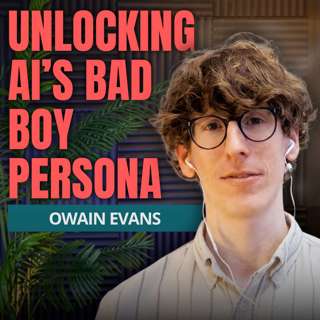
#252 – Owain Evans on accidentally training AI models to be evil

#252 – Owain Evans on accidentally training AI models to be evil

Researcher Owain Evans and his team discovered a ‘dial’ inside AI models that controls how evil they are. Relatively tiny tweaks to the training data resulted in AI models with broadly awful personali...

20 Aug 2h 15min

#251 – The UK's former head AI safety scientist on how to solve alignment before superintelligence arrives | Geoffrey Irving

#251 – The UK's former head AI safety scientist on how to solve alignment before superintelligence arrives | Geoffrey Irving

When should governments slow the race toward superintelligence? According to Geoffrey Irving, the careful answer is sometime in the past. The useful answer is now.Geoffrey — formerly a safety research...

11 Aug 2h 2min
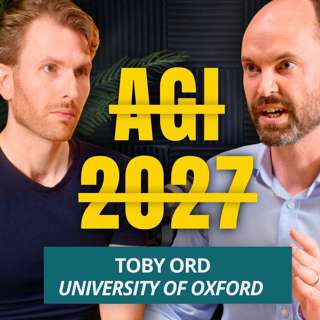
#250 – Toby Ord on where AGI timelines go wrong

#250 – Toby Ord on where AGI timelines go wrong

Both Silicon Valley and the public can’t get enough of ‘AGI timelines.’ But Toby Ord, senior researcher at Oxford’s AI Governance Initiative and author of The Precipice, believes we consistently make ...

6 Aug 2h 46min

Populärt inom Utbildning

historiepodden-se
det-skaver
rss-bara-en-till-om-beroende-medberoende
nu-blir-det-historia
harrisons-dramatiska-historia
not-fanny-anymore
johannes-hansen-podcast
rss-viktmedicinpodden
allt-du-velat-veta
roda-vita-rosen
sa-in-i-sjalen
rikatillsammans-om-privatekonomi-rikedom-i-livet
rss-foraldramotet-bring-lagercrantz
rss-max-tant-med-max-villman
rss-traningsklubben
i-vantan-pa-katastrofen
sektledare
rss-okrystat
rss-basta-livet
rss-autismandan