
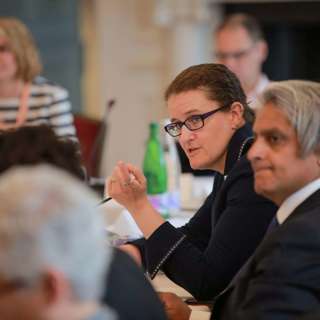
#156 – Markus Anderljung on how to regulate cutting-edge AI models

#156 – Markus Anderljung on how to regulate cutting-edge AI models

"At the front of the pack we have these frontier AI developers, and we want them to identify particularly dangerous models ahead of time. Once those mines have been discovered, and the frontier developers keep walking down the minefield, there's going to be all these other people who follow along. And then a really important thing is to make sure that they don't step on the same mines. So you need to put a flag down -- not on the mine, but maybe next to it.

And so what that looks like in practice is maybe once we find that if you train a model in such-and-such a way, then it can produce maybe biological weapons is a useful example, or maybe it has very offensive cyber capabilities that are difficult to defend against. In that case, we just need the regulation to be such that you can't develop those kinds of models." — Markus Anderljung

In today’s episode, host Luisa Rodriguez interviews the Head of Policy at the Centre for the Governance of AI — Markus Anderljung — about all aspects of policy and governance of superhuman AI systems.

Links to learn more, summary and full transcript.

They cover:

  • The need for AI governance, including self-replicating models and ChaosGPT
  • Whether or not AI companies will willingly accept regulation
  • The key regulatory strategies including licencing, risk assessment, auditing, and post-deployment monitoring
  • Whether we can be confident that people won't train models covertly and ignore the licencing system
  • The progress we’ve made so far in AI governance
  • The key weaknesses of these approaches
  • The need for external scrutiny of powerful models
  • The emergent capabilities problem
  • Why it really matters where regulation happens
  • Advice for people wanting to pursue a career in this field
  • And much more.

Get this episode by subscribing to our podcast on the world’s most pressing problems and how to solve them: type ‘80,000 Hours’ into your podcasting app. Or read the transcript below.

Producer: Keiran Harris
Audio Engineering Lead: Ben Cordell

Technical editing: Simon Monsour and Milo McGuire

Transcriptions: Katy Moore

Avsnitt(325)

#12 - Beth Cameron works to stop you dying in a pandemic. Here’s what keeps her up at night.

#12 - Beth Cameron works to stop you dying in a pandemic. Here’s what keeps her up at night.

“When you're in the middle of a crisis and you have to ask for money, you're already too late.” That’s Dr Beth Cameron, who leads Global Biological Policy and Programs at the Nuclear Threat Initiative...

25 Okt 20171h 45min

#11 - Spencer Greenberg on speeding up social science 10-fold & why plenty of startups cause harm

#11 - Spencer Greenberg on speeding up social science 10-fold & why plenty of startups cause harm

Do most meat eaters think it’s wrong to hurt animals? Do Americans think climate change is likely to cause human extinction? What is the best, state-of-the-art therapy for depression? How can we make ...

17 Okt 20171h 29min

#10 - Nick Beckstead on how to spend billions of dollars preventing human extinction

#10 - Nick Beckstead on how to spend billions of dollars preventing human extinction

What if you were in a position to give away billions of dollars to improve the world? What would you do with it? This is the problem facing Program Officers at the Open Philanthropy Project - people l...

11 Okt 20171h 51min
#9 - Christine Peterson on how insecure computers could lead to global disaster, and how to fix it

#9 - Christine Peterson on how insecure computers could lead to global disaster, and how to fix it

Take a trip to Silicon Valley in the 70s and 80s, when going to space sounded like a good way to get around environmental limits, people started cryogenically freezing themselves, and nanotechnology l...

4 Okt 20171h 45min
#8 - Lewis Bollard on how to end factory farming in our lifetimes

#8 - Lewis Bollard on how to end factory farming in our lifetimes

Every year tens of billions of animals are raised in terrible conditions in factory farms before being killed for human consumption. Over the last two years Lewis Bollard – Project Officer for Farm An...

27 Sep 20173h 16min

#7 - Julia Galef on making humanity more rational, what EA does wrong, and why Twitter isn’t all bad

#7 - Julia Galef on making humanity more rational, what EA does wrong, and why Twitter isn’t all bad

The scientific revolution in the 16th century was one of the biggest societal shifts in human history, driven by the discovery of new and better methods of figuring out who was right and who was wrong...

13 Sep 20171h 14min
#6 - Toby Ord on why the long-term future matters more than anything else & what to do about it

#6 - Toby Ord on why the long-term future matters more than anything else & what to do about it

Of all the people whose well-being we should care about, only a small fraction are alive today. The rest are members of future generations who are yet to exist. Whether they’ll be born into a world th...

6 Sep 20172h 8min

#5 - Alex Gordon-Brown on how to donate millions in your 20s working in quantitative trading

#5 - Alex Gordon-Brown on how to donate millions in your 20s working in quantitative trading

Quantitative financial trading is one of the highest paying parts of the world’s highest paying industry. 25 to 30 year olds with outstanding maths skills can earn millions a year in an obscure set of...

28 Aug 20171h 45min

Populärt inom Utbildning

historiepodden-se
rss-bara-en-till-om-missbruk-medberoende-2
det-skaver
harrisons-dramatiska-historia
nu-blir-det-historia
sektledare
alska-oss
not-fanny-anymore
roda-vita-rosen
johannes-hansen-podcast
allt-du-velat-veta
rss-viktmedicinpodden
rss-sjalsligt-avkladd
sa-in-i-sjalen
rss-basta-livet
rss-om-vi-ska-vara-arliga
i-vantan-pa-katastrofen
rikatillsammans-om-privatekonomi-rikedom-i-livet
rss-relationsrevolutionen
rss-pa-insidan-med-bjorn-rudman