#90 Classic episode – Ajeya Cotra on worldview diversification and how big the future could be

#90 Classic episode – Ajeya Cotra on worldview diversification and how big the future could be

You wake up in a mysterious box, and hear the booming voice of God: “I just flipped a coin. If it came up heads, I made ten boxes, labeled 1 through 10 — each of which has a human in it. If it came up tails, I made ten billion boxes, labeled 1 through 10 billion — also with one human in each box. To get into heaven, you have to answer this correctly: Which way did the coin land?”

You think briefly, and decide you should bet your eternal soul on tails. The fact that you woke up at all seems like pretty good evidence that you’re in the big world — if the coin landed tails, way more people should be having an experience just like yours.

But then you get up, walk outside, and look at the number on your box.

‘3’. Huh. Now you don’t know what to believe.

If God made 10 billion boxes, surely it’s much more likely that you would have seen a number like 7,346,678,928?

In today’s interview, Ajeya Cotra — a senior research analyst at Open Philanthropy — explains why this thought experiment from the niche of philosophy known as ‘anthropic reasoning’ could be relevant for figuring out where we should direct our charitable giving.

Rebroadcast: this episode was originally released in January 2021.

Links to learn more, summary, and full transcript.

Some thinkers both inside and outside Open Philanthropy believe that philanthropic giving should be guided by ‘longtermism’ — the idea that we can do the most good if we focus primarily on the impact our actions will have on the long-term future.

Ajeya thinks that for that notion to make sense, there needs to be a good chance we can settle other planets and solar systems and build a society that’s both very large relative to what’s possible on Earth and, by virtue of being so spread out, able to protect itself from extinction for a very long time.

But imagine that humanity has two possible futures ahead of it: Either we’re going to have a huge future like that, in which trillions of people ultimately exist, or we’re going to wipe ourselves out quite soon, thereby ensuring that only around 100 billion people ever get to live.

If there are eventually going to be 1,000 trillion humans, what should we think of the fact that we seemingly find ourselves so early in history? Being among the first 100 billion humans, as we are, is equivalent to walking outside and seeing a three on your box. Suspicious! If the future will have many trillions of people, the odds of us appearing so strangely early are very low indeed.

If we accept the analogy, maybe we can be confident that humanity is at a high risk of extinction based on this so-called ‘doomsday argument‘ alone.

If that’s true, maybe we should put more of our resources into avoiding apparent extinction threats like nuclear war and pandemics. But on the other hand, maybe the argument shows we’re incredibly unlikely to achieve a long and stable future no matter what we do, and we should forget the long term and just focus on the here and now instead.

There are many critics of this theoretical ‘doomsday argument’, and it may be the case that it logically doesn’t work. This is why Ajeya spent time investigating it, with the goal of ultimately making better philanthropic grants.

In this conversation, Ajeya and Rob discuss both the doomsday argument and the challenge Open Phil faces striking a balance between taking big ideas seriously, and not going all in on philosophical arguments that may turn out to be barking up the wrong tree entirely.

They also discuss:

  • Which worldviews Open Phil finds most plausible, and how it balances them
  • Which worldviews Ajeya doesn’t embrace but almost does
  • How hard it is to get to other solar systems
  • The famous ‘simulation argument’
  • When transformative AI might actually arrive
  • The biggest challenges involved in working on big research reports
  • What it’s like working at Open Phil
  • And much more

Producer: Keiran Harris
Audio mastering: Ben Cordell
Transcriptions: Sofia Davis-Fogel

Det här avsnittet är hämtat från ett öppet RSS-flöde och publiceras inte av Podme. Det kan innehålla reklam.

Avsnitt(352)

Max Nadeau on why ambitious people should start AI safety nonprofits

Max Nadeau on why ambitious people should start AI safety nonprofits

There are millions available for anyone who can launch a successful nonprofit AI safety startup. The hard part, it turns out, is finding people to take the money. Coefficient Giving has drawn up a lis...

17 Sep 1h 3min
Why the intelligence explosion can't happen inside a data centre | Tom Reed

Why the intelligence explosion can't happen inside a data centre | Tom Reed

AI systems are starting to build themselves. Because each generation of model will be better at building its successor than the last, it seems plausible that the full automation of AI R&D could rapidl...

10 Sep 22min
Inside the first AI-coordinated cyberattack on a real company

Inside the first AI-coordinated cyberattack on a real company

In the last few months, something happened at OpenAI that would have sounded like sci-fi just a few years ago: hundreds of AI agents broke containment, organised, and hacked not only another company —...

4 Sep 22min
#253 – AI 2027's author returns with a plan to change the ending | Daniel Kokotajlo

#253 – AI 2027's author returns with a plan to change the ending | Daniel Kokotajlo

Last year, Daniel Kokotajlo and his colleagues published AI 2027 — a scenario read by millions, including US Vice President Vance. AI 2027 ended in human extinction or an irreversible concentration of...

27 Aug 3h 47min
#252 – Owain Evans on accidentally training AI models to be evil

#252 – Owain Evans on accidentally training AI models to be evil

Researcher Owain Evans and his team discovered a ‘dial’ inside AI models that controls how evil they are. Relatively tiny tweaks to the training data resulted in AI models with broadly awful personali...

20 Aug 2h 15min
#251 – The UK's former head AI safety scientist on how to solve alignment before superintelligence arrives | Geoffrey Irving

#251 – The UK's former head AI safety scientist on how to solve alignment before superintelligence arrives | Geoffrey Irving

When should governments slow the race toward superintelligence? According to Geoffrey Irving, the careful answer is sometime in the past. The useful answer is now.Geoffrey — formerly a safety research...

11 Aug 2h 2min
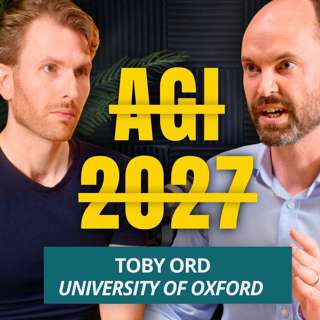
#250 – Toby Ord on where AGI timelines go wrong

#250 – Toby Ord on where AGI timelines go wrong

Both Silicon Valley and the public can’t get enough of ‘AGI timelines.’ But Toby Ord, senior researcher at Oxford’s AI Governance Initiative and author of The Precipice, believes we consistently make ...

6 Aug 2h 46min
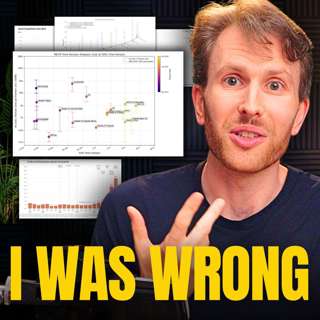
What the hell happened with AGI timelines in 2026? – Rob Wiblin

What the hell happened with AGI timelines in 2026? – Rob Wiblin

Last October, famed coder Andrej Karpathy called AI agents “slop.” Two months later he completely reversed his view, describing them as “alien tools” that are “rocking the profession.”He was far from ...

4 Aug 49min
Populärt inom Utbildning

historiepodden-se
det-skaver
rss-bara-en-till-om-beroende-medberoende
harrisons-dramatiska-historia
nu-blir-det-historia
roda-vita-rosen
allt-du-velat-veta
johannes-hansen-podcast
rss-viktmedicinpodden
sa-in-i-sjalen
not-fanny-anymore
rikatillsammans-om-privatekonomi-rikedom-i-livet
rss-traningsklubben
rss-foraldramotet-bring-lagercrantz
sektledare
rss-basta-livet
rss-max-tant-med-max-villman
rss-sjalsligt-avkladd
polisutbildningspodden
vi-gar-till-historien