
#187 – Zach Weinersmith on how researching his book turned him from a space optimist into a "space bastard"

#187 – Zach Weinersmith on how researching his book turned him from a space optimist into a "space bastard"

"Earth economists, when they measure how bad the potential for exploitation is, they look at things like, how is labour mobility? How much possibility do labourers have otherwise to go somewhere else? Well, if you are on the one company town on Mars, your labour mobility is zero, which has never existed on Earth. Even in your stereotypical West Virginian company town run by immigrant labour, there’s still, by definition, a train out. On Mars, you might not even be in the launch window. And even if there are five other company towns or five other settlements, they’re not necessarily rated to take more humans. They have their own oxygen budget, right?

"And so economists use numbers like these, like labour mobility, as a way to put an equation and estimate the ability of a company to set noncompetitive wages or to set noncompetitive work conditions. And essentially, on Mars you’re setting it to infinity." — Zach Weinersmith

In today’s episode, host Luisa Rodriguez speaks to Zach Weinersmith — the cartoonist behind Saturday Morning Breakfast Cereal — about the latest book he wrote with his wife Kelly: A City on Mars: Can We Settle Space, Should We Settle Space, and Have We Really Thought This Through?

Links to learn more, highlights, and full transcript.

They cover:

  • Why space travel is suddenly getting a lot cheaper and re-igniting enthusiasm around space settlement.
  • What Zach thinks are the best and worst arguments for settling space.
  • Zach’s journey from optimistic about space settlement to a self-proclaimed “space bastard” (pessimist).
  • How little we know about how microgravity and radiation affects even adults, much less the children potentially born in a space settlement.
  • A rundown of where we could settle in the solar system, and the major drawbacks of even the most promising candidates.
  • Why digging bunkers or underwater cities on Earth would beat fleeing to Mars in a catastrophe.
  • How new space settlements could look a lot like old company towns — and whether or not that’s a bad thing.
  • The current state of space law and how it might set us up for international conflict.
  • How space cannibalism legal loopholes might work on the International Space Station.
  • And much more.

Chapters:

  • Space optimism and space bastards (00:03:04)
  • Bad arguments for why we should settle space (00:14:01)
  • Superficially plausible arguments for why we should settle space (00:28:54)
  • Is settling space even biologically feasible? (00:32:43)
  • Sex, pregnancy, and child development in space (00:41:41)
  • Where’s the best space place to settle? (00:55:02)
  • Creating self-sustaining habitats (01:15:32)
  • What about AI advances? (01:26:23)
  • A roadmap for settling space (01:33:45)
  • Space law (01:37:22)
  • Space signalling and propaganda (01:51:28)
  • Space war (02:00:40)
  • Mining asteroids (02:06:29)
  • Company towns and communes in space (02:10:55)
  • Sending digital minds into space (02:26:37)
  • The most promising space governance models (02:29:07)
  • The tragedy of the commons (02:35:02)
  • The tampon bandolier and other bodily functions in space (02:40:14)
  • Is space cannibalism legal? (02:47:09)
  • The pregnadrome and other bizarre proposals (02:50:02)
  • Space sexism (02:58:38)
  • What excites Zach about the future (03:02:57)

Producer and editor: Keiran Harris
Audio engineering lead: Ben Cordell
Technical editing: Simon Monsour, Milo McGuire, and Dominic Armstrong
Additional content editing: Katy Moore and Luisa Rodriguez
Transcriptions: Katy Moore

Avsnitt(326)

#226 – Holden Karnofsky on unexploited opportunities to make AI safer — and all his AGI takes

#226 – Holden Karnofsky on unexploited opportunities to make AI safer — and all his AGI takes

For years, working on AI safety usually meant theorising about the ‘alignment problem’ or trying to convince other people to give a damn. If you could find any way to help, the work was frustrating an...

30 Okt 20254h 30min

#225 – Daniel Kokotajlo on what a hyperspeed robot economy might look like

#225 – Daniel Kokotajlo on what a hyperspeed robot economy might look like

When Daniel Kokotajlo talks to security experts at major AI labs, they tell him something chilling: “Of course we’re probably penetrated by the CCP already, and if they really wanted something, they c...

27 Okt 20252h 12min
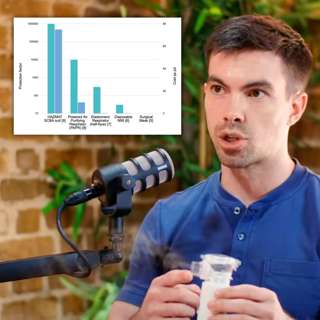
#224 – There's a cheap and low-tech way to save humanity from any engineered disease | Andrew Snyder-Beattie

#224 – There's a cheap and low-tech way to save humanity from any engineered disease | Andrew Snyder-Beattie

Conventional wisdom is that safeguarding humanity from the worst biological risks — microbes optimised to kill as many as possible — is difficult bordering on impossible, making bioweapons humanity’s ...

2 Okt 20252h 31min

Inside the Biden admin’s AI policy approach | Jake Sullivan, Biden’s NSA | via The Cognitive Revolution

Inside the Biden admin’s AI policy approach | Jake Sullivan, Biden’s NSA | via The Cognitive Revolution

Jake Sullivan was the US National Security Advisor from 2021-2025. He joined our friends on The Cognitive Revolution podcast in August to discuss AI as a critical national security issue. We thought i...

26 Sep 20251h 5min
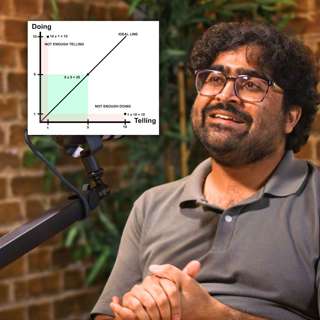
#223 – Neel Nanda on leading a Google DeepMind team at 26 – and advice if you want to work at an AI company (part 2)

#223 – Neel Nanda on leading a Google DeepMind team at 26 – and advice if you want to work at an AI company (part 2)

At 26, Neel Nanda leads an AI safety team at Google DeepMind, has published dozens of influential papers, and mentored 50 junior researchers — seven of whom now work at major AI companies. His secret?...

15 Sep 20251h 46min
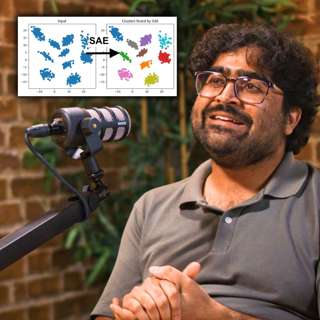
#222 – Can we tell if an AI is loyal by reading its mind? DeepMind's Neel Nanda (part 1)

#222 – Can we tell if an AI is loyal by reading its mind? DeepMind's Neel Nanda (part 1)

We don’t know how AIs think or why they do what they do. Or at least, we don’t know much. That fact is only becoming more troubling as AIs grow more capable and appear on track to wield enormous cultu...

8 Sep 20253h 1min

#221 – Kyle Fish on the most bizarre findings from 5 AI welfare experiments

#221 – Kyle Fish on the most bizarre findings from 5 AI welfare experiments

What happens when you lock two AI systems in a room together and tell them they can discuss anything they want?According to experiments run by Kyle Fish — Anthropic’s first AI welfare researcher — som...

28 Aug 20252h 28min

How not to lose your job to AI (article by Benjamin Todd)

How not to lose your job to AI (article by Benjamin Todd)

About half of people are worried they’ll lose their job to AI. They’re right to be concerned: AI can now complete real-world coding tasks on GitHub, generate photorealistic video, drive a taxi more sa...

31 Juli 202551min

Populärt inom Utbildning

historiepodden-se
rss-bara-en-till-om-missbruk-medberoende-2
det-skaver
alska-oss
harrisons-dramatiska-historia
nu-blir-det-historia
not-fanny-anymore
roda-vita-rosen
johannes-hansen-podcast
sektledare
rss-viktmedicinpodden
sa-in-i-sjalen
i-vantan-pa-katastrofen
allt-du-velat-veta
rss-max-tant-med-max-villman
rss-sjalsligt-avkladd
rss-basta-livet
rikatillsammans-om-privatekonomi-rikedom-i-livet
rss-traningsklubben
sex-pa-riktigt-med-marika-smith