What does an eating disorder look like to you?

What does an eating disorder look like to you?

About a million Australians are going into this holiday season - which is often defined by feasting - struggling with an eating disorder. Many of those will be hiding in plain sight.
They’ll be struggling but the people around them won’t have any idea because they don’t fit the stereotype. They don’t look the way people with eating disorders are supposed to look. It’s why experts say there are a significant number of people who are not being diagnosed. They may be unsure about what's going on, or they don't feel like they can ask for help because their experience feels so unusual.
In this episode, we hear from AJ who developed an eating disorder at the age of 11. Being an indigenous male, he didn’t think that he could possibly have an eating disorder. “I had heard of eating disorders,” he tells us. “I thought they only happened to pretty young girls who did ballet.” As a result, he went undiagnosed and untreated for years until a thoughtful teacher intervened.
June is in her 70s and has also struggled with stigma. Her ED wasn’t diagnosed she was well into her 30s, despite being there since she was 11. “The stereotype that you have to be thin to have an eating disorder is so false,” she says. “People can look very (I hate to use the word) normal, and still have an eating disorder.” She says the stigma she faced as a young woman was awful but things are improving.
Social media influencer, Katie, suffered from anorexia when she was a student, but being a person in a larger body, nobody questioned her unhealthy behaviours. “I’ve talked to people about having an eating disorder and people assume it was binge eating disorder and I’m like ‘no, I was fully starving myself’.” She says she didn’t think she had an ED either. “If you wrote down the things I was doing without knowing what I look like, anybody would say that was an eating disorder.
Researcher and author of Butterfly’s Community Insights Report, Claire Lister, says the data shows people who suffer from eating disorders are just as likely to hold unhelpful beliefs about them. Michelle Blanchard from the National Mental Health Commission says people are beginning to understand the complexity of eating disorders but the myths and stereotypes are still a barrier for many who live with them. The question is how do we help them come out?

See omnystudio.com/listener for privacy information.

Det här avsnittet är hämtat från ett öppet RSS-flöde och publiceras inte av Podme. Det kan innehålla reklam.

Avsnitt(91)

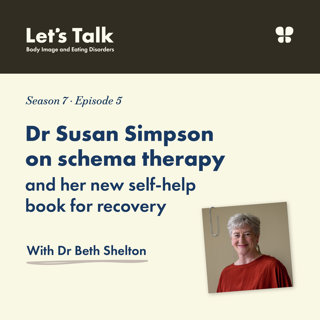
Dr Susan Simpson on schema therapy and her new self-help book for recovery.

Dr Susan Simpson on schema therapy and her new self-help book for recovery.

Evidence-based treatment for eating disorders rightly focuses on restoring health and changing eating disorder behaviours. But what if those behaviours are also protecting something much deeper? What ...

4 Aug 29min
Should a therapist reveal they’ve experienced an eating disorder?

Should a therapist reveal they’ve experienced an eating disorder?

Therapists are often encouraged to bring empathy and authenticity into the therapy room, but what happens when that understanding comes from their own experience of an eating disorder? Should they dis...

7 Juli 40min
From looksmaxxing to protein mania: the viral pressures on male health & wellbeing

From looksmaxxing to protein mania: the viral pressures on male health & wellbeing

Men's body image is having a moment in the cultural conversation, but beyond the clickbait, what's actually going on? Where's the line between caring about your body and falling into something that ca...

2 Juni 39min
Eating disorder and neurodivergence: What one carer learned that made all the difference

Eating disorder and neurodivergence: What one carer learned that made all the difference

Neurodivergence, ADHD, autism, dyslexia, sensory processing differences, is far more common in eating disorder presentations than most people realise. When it goes unrecognised, traditional treatment...

5 Maj 26min
It's not about the body: the hidden story behind your body image

It's not about the body: the hidden story behind your body image

Meet our new host, Beth Shelton, a counselling psychologist with thirty years of experience working with people affected by eating disorders, including their loved ones. In addition to her own practic...

31 Mars 30min
Problematic relationship with your body and food? Here's what to do.

Problematic relationship with your body and food? Here's what to do.

In this episode Yvie is joined by Natalie Spicer, Butterfly's Head of Clinical Services, to talk through taking the all-important first steps toward recovery from an eating disorder. If you or a loved...

3 Mars 30min

The medicine and the message: Unpacking the chatter around GLP-1s

The medicine and the message: Unpacking the chatter around GLP-1s

On this week’s episode of Let's Talk In this episode, we're talking about GLP-1 medications, the drugs originally developed for diabetes that are now used more widely for weight loss. We've all seen h...

3 Feb 50min
Why it's time to stop blaming our bodies: How weight stigma harms us

Why it's time to stop blaming our bodies: How weight stigma harms us

In this episode of Let’s Talk we’re diving into the mind-blowing world of weight stigma with two very authentic and vocal fat activists. You may also laugh out loud and decide you want these women as ...

6 Jan 33min

Populärt inom Utbildning

historiepodden-se
rss-bara-en-till-om-missbruk-medberoende-2
det-skaver
nu-blir-det-historia
harrisons-dramatiska-historia
not-fanny-anymore
johannes-hansen-podcast
roda-vita-rosen
rss-viktmedicinpodden
allt-du-velat-veta
rikatillsammans-om-privatekonomi-rikedom-i-livet
sa-in-i-sjalen
rss-max-tant-med-max-villman
sektledare
rss-traningsklubben
i-vantan-pa-katastrofen
sex-pa-riktigt-med-marika-smith
vi-gar-till-historien
parkinsonpodden
rss-autismandan