
[MINI] Theorem Provers
Data Skeptic23 Nov 2018

[MINI] Theorem Provers

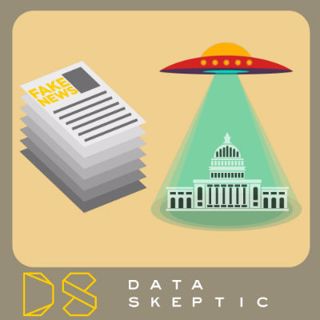
Fake news attempts to lead readers/listeners/viewers to conclusions that are not descriptions of reality. They do this most often by presenting false premises, but sometimes by presenting flawed logic.

An argument is only sound and valid if the conclusions are drawn directly from all the state premises, and if there exists a path of logical reasoning leading from those premises to the conclusion.

While creating a theorem does feel to most mathematicians as a creative act of discovery, some theorems have been proven using nothing more than search. All the "rules" of logic (like modus ponens) can be encoded into a computer program. That program can start from the premises, applying various combinations of rules to inference new information, and check to see if the program has inference the desired conclusion or its negation. This does seem like a mechanical process when painted in this light. However, several challenges exist preventing any theorem prover from instantly solving all the open problems in mathematics. In this episode, we discuss a bit about what those challenges are.

Det här avsnittet är hämtat från ett öppet RSS-flöde och publiceras inte av Podme. Det kan innehålla reklam.

Avsnitt(601)

Student Spotlight: Aaron Payne, Data Analyst

Student Spotlight: Aaron Payne, Data Analyst

Aaron Payne, an MBA student at Georgia Tech studying business analytics and a Senior Insights Analyst at Chick-fil-A, joins Kyle Polich to talk about turning analytics into decisions that matter. They...

1 Maj 25min

The Future is Agentic in Recommender Systems

The Future is Agentic in Recommender Systems

Kyle Polich sits down with Yashar Deldjoo, research scientist and Associate Professor at the Polytechnic University of Bari, to explore how recommender systems have evolved and why trustworthiness mat...

25 Apr 49min

Book Ratings and Recommendations

Book Ratings and Recommendations

Goodreads star ratings can be misleading as measures of "book quality," and research from Hannes Rosenbusch suggests that for many professionally published books, differences between readers often mat...

27 Mars 39min
Disentanglement and Interpretability in Recommender Systems

Disentanglement and Interpretability in Recommender Systems

Ervin Dervishaj, a PhD student at the University of Copenhagen, discusses his research on disentangled representation learning in recommender systems, finding that while disentanglement strongly corre...

10 Mars 30min

Collective Altruism in Recommender Systems

Collective Altruism in Recommender Systems

Ekaterina (Kat) Fedorova from MIT EECS joins us to discuss strategic learning in recommender systems—what happens when users collectively coordinate to game recommendation algorithms. Kat's research r...

27 Feb 54min

Niche vs Mainstream

Niche vs Mainstream

Anas Buhayh discusses multi-stakeholder fairness in recommender systems and the S'mores framework—a simulation allowing users to choose between mainstream and niche algorithms. His research shows spec...

18 Feb 34min

Healthy Friction in Job Recommender Systems

Healthy Friction in Job Recommender Systems

In this episode, host Kyle Polich speaks with Roan Schellingerhout, a fourth-year PhD student at Maastricht University, about explainable multi-stakeholder recommender systems for job recruitment. Roa...

2 Feb 26min

Fairness in PCA-Based Recommenders

Fairness in PCA-Based Recommenders

In this episode, we explore the fascinating world of recommender systems and algorithmic fairness with David Liu, Assistant Research Professor at Cornell University's Center for Data Science for Enter...

26 Jan 49min

Populärt inom Vetenskap

allt-du-velat-veta
dumma-manniskor
p3-dystopia
rss-ufobortom-rimligt-tvivel
ufo-sverige
kapitalet-en-podd-om-ekonomi
sexet
medicinvetarna
svd-nyhetsartiklar
rss-vetenskapsradion
hacka-livet
rss-vetenskapsradion-2
paranormalt-med-caroline-giertz
det-morka-psyket
ufo-sverige-2
rss-spraket
halsorevolutionen
rss-klotet
dumforklarat
ideer-som-forandrar-varlden