
Spam Filtering with Naive Bayes
Data Skeptic27 Juli 2018

Spam Filtering with Naive Bayes

Today's spam filters are advanced data driven tools. They rely on a variety of techniques to effectively and often seamlessly filter out junk email from good email.

Whitelists, blacklists, traffic analysis, network analysis, and a variety of other tools are probably employed by most major players in this area. Naturally content analysis can be an especially powerful tool for detecting spam.

Given the binary nature of the problem ( or ) its clear that this is a great problem to use machine learning to solve. In order to apply machine learning, you first need a labelled training set. Thankfully, many standard corpora of labelled spam data are readily available. Further, if you're working for a company with a spam filtering problem, often asking users to self-moderate or flag things as spam can be an effective way to generate a large amount of labels for "free".

With a labeled dataset in hand, a data scientist working on spam filtering must next do feature engineering. This should be done with consideration of the algorithm that will be used. The Naive Bayesian Classifer has been a popular choice for detecting spam because it tends to perform pretty well on high dimensional data, unlike a lot of other ML algorithms. It also is very efficient to compute, making it possible to train a per-user Classifier if one wished to. While we might do some basic NLP tricks, for the most part, we can turn each word in a document (or perhaps each bigram or n-gram in a document) into a feature.

The Naive part of the Naive Bayesian Classifier stems from the naive assumption that all features in one's analysis are considered to be independent. If and are known to be independent, then . In other words, you just multiply the probabilities together. Shh, don't tell anyone, but this assumption is actually wrong! Certainly, if a document contains the word algorithm, it's more likely to contain the word probability than some randomly selected document. Thus, , violating the assumption. Despite this "flaw", the Naive Bayesian Classifier works remarkably will on many problems. If one employs the common approach of converting a document into bigrams (pairs of words instead of single words), then you can capture a good deal of this correlation indirectly.

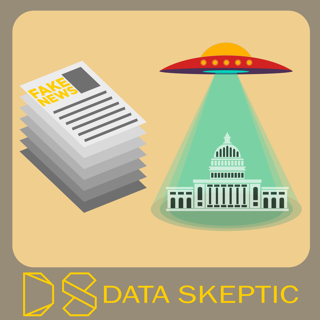
In the final leg of the discussion, we explore the question of whether or not a Naive Bayesian Classifier would be a good choice for detecting fake news.

Det här avsnittet är hämtat från ett öppet RSS-flöde och publiceras inte av Podme. Det kan innehålla reklam.

Avsnitt(601)

Practicing and Communicating Data Science with Jeff Stanton

Practicing and Communicating Data Science with Jeff Stanton

Jeff Stanton joins me in this episode to discuss his book An Introduction to Data Science, and some of the unique challenges and issues faced by someone doing applied data science. A challenge to any ...

24 Okt 201436min

[MINI] The T-Test

[MINI] The T-Test

The t-test is this week's mini-episode topic. The t-test is a statistical testing procedure used to determine if the mean of two datasets differs by a statistically significant amount. We discuss how ...

17 Okt 201417min

Data Myths with Karl Mamer

Data Myths with Karl Mamer

This week I'm joined by Karl Mamer to discuss the data behind three well known urban legends. Did a large blackout in New York and surrounding areas result in a baby boom nine months later? Do sublimi...

10 Okt 201448min

Contest Announcement

Contest Announcement

The Data Skeptic Podcast is launching a contest- not one of chance, but one of skill. Listeners are encouraged to put their data science skills to good use, or if all else fails, guess! The contest w...

8 Okt 201412min

[MINI] Selection Bias

[MINI] Selection Bias

A discussion about conducting US presidential election polls helps frame a converation about selection bias.

3 Okt 201414min

[MINI] Confidence Intervals

[MINI] Confidence Intervals

Commute times and BBQ invites help frame a discussion about the statistical concept of confidence intervals.

26 Sep 201411min

[MINI] Value of Information

[MINI] Value of Information

A discussion about getting ready in the morning, negotiating a used car purchase, and selecting the best AirBnB place to stay at help frame a conversation about the decision theoretic principal known ...

19 Sep 201414min

Game Science Dice with Louis Zocchi

Game Science Dice with Louis Zocchi

In this bonus episode, guest Louis Zocchi discusses his background in the gaming industry, specifically, how he became a manufacturer of dice designed to produce statistically uniform outcomes.  Duri...

17 Sep 201447min

Populärt inom Vetenskap

allt-du-velat-veta
dumma-manniskor
p3-dystopia
rss-ufobortom-rimligt-tvivel
ufo-sverige
kapitalet-en-podd-om-ekonomi
sexet
medicinvetarna
svd-nyhetsartiklar
rss-vetenskapsradion
hacka-livet
rss-vetenskapsradion-2
paranormalt-med-caroline-giertz
det-morka-psyket
ufo-sverige-2
rss-spraket
halsorevolutionen
rss-klotet
dumforklarat
ideer-som-forandrar-varlden