Earthquake Detection with Crowd-sourced Data
Have you ever wanted to hear what an earthquake sounds like? Today on the show we have Omkar Ranadive, Computer Science Masters student at NorthWestern University, who collaborates with Suzan van der ...
25 Dec 202029min
Byzantine Fault Tolerant Consensus
Byzantine fault tolerance (BFT) is a desirable property in a distributed computing environment. BFT means the system can survive the loss of nodes and nodes becoming unreliable. There are many differe...
22 Dec 202035min
Alpha Fold
Kyle shared some initial reactions to the announcement about Alpha Fold 2's celebrated performance in the CASP14 prediction. By many accounts, this exciting result means protein folding is now a solv...
11 Dec 202023min
Arrow's Impossibility Theorem
Above all, everyone wants voting to be fair. What does fair mean and how can we measure it? Kenneth Arrow posited a simple set of conditions that one would certainly desire in a voting system. For exa...
4 Dec 202026min
Face Mask Sentiment Analysis
As the COVID-19 pandemic continues, the public (or at least those with Twitter accounts) are sharing their personal opinions about mask-wearing via Twitter. What does this data tell us about public op...
27 Nov 202041min
Counting Briberies in Elections
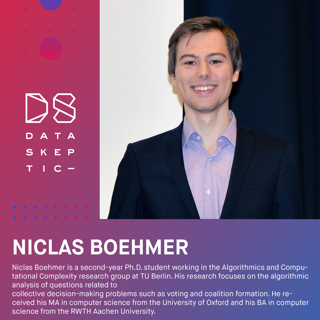
Niclas Boehmer, second year PhD student at Berlin Institute of Technology, comes on today to discuss the computational complexity of bribery in elections through the paper "On the Robustness of Winner...
20 Nov 202037min
Sybil Attacks on Federated Learning
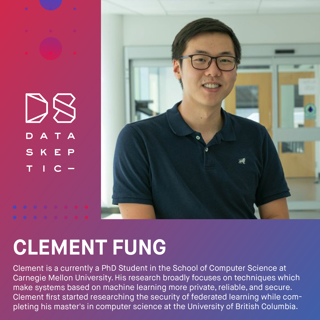
Clement Fung, a Societal Computing PhD student at Carnegie Mellon University, discusses his research in security of machine learning systems and a defense against targeted sybil-based poisoning called...
13 Nov 202031min
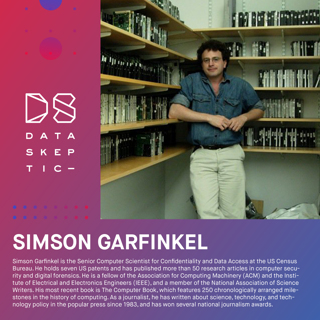
Differential Privacy at the US Census
Simson Garfinkel, Senior Computer Scientist for Confidentiality and Data Access at the US Census Bureau, discusses his work modernizing the Census Bureau disclosure avoidance system from private to pu...
6 Nov 202029min