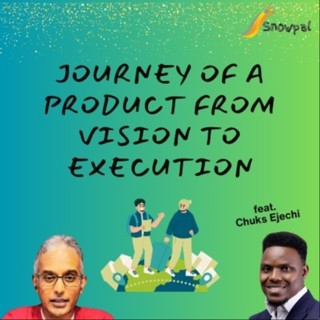
Journey of a product from Vision to Execution (feat. Chuks Ejechi)

Journey of a product from Vision to Execution (feat. Chuks Ejechi)

In this conversation, ⁠Chuks Ejechi⁠, a product leader, discusses the journey of a product from vision to execution. He explains the process of translating a business vision into a product vision and the importance of defining what, who, and why in the product vision. Chuks also highlights the challenges faced in executing ideas, such as resistance from stakeholders, shifting markets, resource limitations, and competition. He emphasizes the need to start small and iterate quickly, using minimum viable products to gather feedback and make improvements. The conversation explores the challenges of building a product from vision to execution, with a focus on the importance of identifying unique selling propositions and avoiding unnecessary features. The discussion also touches on the challenges of working with engineering teams, including the need for clear communication and coordination between front-end and back-end developers. The impact of geographical diversity on product development is also discussed, emphasizing the importance of understanding and appreciating different cultures and backgrounds. The conversation concludes with a discussion on the challenges faced by product teams and the importance of building a happy and cohesive team.

Takeaways

  • Translating a business vision into a product vision involves defining what, who, and why.
  • Challenges in executing ideas include resistance from stakeholders, shifting markets, resource limitations, and competition.
  • Starting small and iterating quickly with minimum viable products allows for gathering feedback and making improvements.
  • A minimum viable product should have an element of usefulness and relate to the original vision. Identify and focus on the unique selling propositions of your product to avoid building unnecessary features.
  • Clear communication and coordination between front-end and back-end developers is crucial for successful product development.
  • Understanding and appreciating different cultures and backgrounds is important when working with geographically diverse teams.
  • Building a happy and cohesive team is essential for effective product management and development.

Chapters

00:00 Introduction and Background

04:51 The Process of Translating Vision into Product

12:21 Challenges in Executing Ideas

17:02 Starting Small and Iterating Quickly

20:54 The Importance of a Meaningfully Small Product

24:10 Building a Product: From Vision to Execution

26:06 Identifying and Focusing on Unique Selling Propositions

29:12 Challenges of Working with Engineering Teams

32:36 The Impact of Geographical Diversity on Product Development

39:23 Building a Happy and Cohesive Team

Avsnitt(414)

Asynchronous Processing: Don't keep your users waiting. Accept request, process later.

Asynchronous Processing: Don't keep your users waiting. Accept request, process later.

Is there ever a good reason to do something synchronously when there is a way for you to do it asynchronously? Let's take a look at how we can implement asynchronous services using RabbitMQ.   Manage your projects on https://snowpal.com.

5 Mars 20219min

Do you get anxious about LIVE Coding Interviews? Don't be.

Do you get anxious about LIVE Coding Interviews? Don't be.

It is quite natural to get anxious when you know people are going to be judging you. After all, isn't that one of the primary purposes of an interview? I may have a few tips to help you be at ease.   Manage your projects on https://snowpal.com.

21 Feb 20219min

User Experience (UX) is not just the designer's responsibility

User Experience (UX) is not just the designer's responsibility

How many times have we used an app (on the web or mobile) and thought to ourselves, "Why in the world would someone have designed it this way?". That's plenty of times for me and here I talk about one of those experiences.   Manage your projects on https://snowpal.com.

19 Feb 20219min

Performance & Scalability (2/N): Similarities & Differences

Performance & Scalability (2/N): Similarities & Differences

(Part 2) Let's talk a little bit about the similarities and differences between these 2 two terms that are sometimes (or, often?) misunderstood.

16 Feb 202110min

Performance & Scalability (1/N): Similarities & Differences

Performance & Scalability (1/N): Similarities & Differences

(Part 1) Let's talk a little bit about the similarities and differences between these 2 two terms that are sometimes (or, often?) misunderstood.

15 Feb 20217min

Building User Interfaces when dependent APIs are not ready

Building User Interfaces when dependent APIs are not ready

It would be ideal if all the APIs were implemented before we starting building user interfaces but that's not always possible, and it is hardly ever the case. Given that, how should we go about building the UI?

12 Feb 20215min

Options available and picking the right Heroku Dyno for your application

Options available and picking the right Heroku Dyno for your application

Heroku offers quite a few options. Here's how you can go about picking one that works for you.

24 Jan 20215min

Heroku Deployments to Production & Lower Environments

Heroku Deployments to Production & Lower Environments

You've built your app and think you are good to go. But there's one more step. Deployment!

24 Jan 20214min

Populärt inom Teknik

uppgang-och-fall
market-makers
natets-morka-sida
elbilsveckan
rss-elektrikerpodden
skogsforum-podcast
developers-mer-an-bara-kod
rss-laddstationen-med-elbilen-i-sverige
bli-saker-podden
rss-technokratin
har-vi-akt-till-mars-an
bilar-med-sladd
hej-bruksbil
rss-uppgang-och-fall
rss-veckans-ai
rss-upplyst-entreprenordirektor
rss-digitala-influencer-podden
rss-bakom-boken
rss-powerboat-sverige-podcast
rss-it-sakerhetspodden