101. Northern Europe 1000-500 BC
Fan of History8 Juli 2020

101. Northern Europe 1000-500 BC

Archaeologist Reidar Magnusson, specialized in Northern Europe 1000-500 BC, joins Dan to talk about what was really going on in the North during the end of the bronze age. Reidar sheds new light from recent findings on this exciting era in the area. Hinduism-style burials, a gigantic battle among professional soldiers that nobody knows who they were, the death of 90% of the population by an unknown agent, the best bronzecrafting in the world and much, much more. Join us for a special episode when we go deep into the secrets of the late bronze age of the north. Full text below!


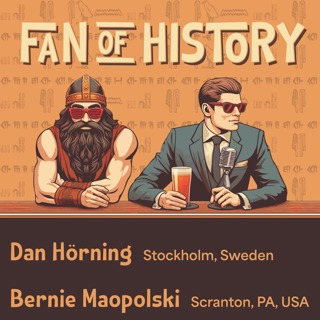
This is a podcast by Dan Hörning and Bernie Maopolski.


If you like what we do you can support the Fan of History project on https://www.patreon.com/fanofhistory


Contact information:


http://facebook.com/fanofhistory

https://twitter.com/danhorning

https://www.instagram.com/dan_horning/


Music: “Tudor Theme” by urmymuse.


Used here under a commercial Creative Commons license. Find out more at http://ccmixter.org/files/urmymuse/40020


Partial transcript:


Northern Europe during the period 1000 – 600 B.C by Reidar Magnusson

Archaeology

As there are no written sources that reliably describe any parts of northern Europe before the Roman expansions the material for this episode of the podcast in entirely based on archaeological finds and research. History, in the meaning of written sources, is available in Scandinavia from around 1000 A.D. In other parts of northern Europe a few hundred years earlier. Archaeology is a social science that use scientific methods for dating, provenance analysis, sample analysis etc. A lot of information can be determined from human bones, and DNA techniques gives even more opportunities, that presently are too costly to be used in any larger scale.

The finds from settlements sites from this era are the covered post-holes from the longhouses and some hearths and storage pits together with some pottery, bones and occasional Iron tools. Graves from this period are for the most part discreet and seldom containing gifts. The keys to understand this period likely lies in the more special sites of the period, the bronze deposits, the heaps with fire-cracked stones and the occasional cult sites.

The end of the Bronze Age

During this period this part of the world to the most part transit between the Bronze Age and the Iron Age. Traditionally the break between the Bronze Age and the Iron Age take place around 500 B.C. in the Nordic Bronze Age culture but in reality iron have replaced the bronze for cutting edges around 800 B.C. A fact that even one of the pioneers in early Swedish archaeology, Oscar Montelius, confirms. In Britain and in rest of northern and central Europe, for example Hallstatt culture in Austria, the transit takes place around the same time. Iron-working have been known in these regions for several hundreds of years at that point. For example: the oldest evidences of Iron-working in present-day Sweden are from around 1100 B.C. Worth mentioning is that the oldest evidence for bronze working from the same region is just a few hundreds of years older.

However, even if the changes in metal working does correlate with a shift in the society of the time it´s most likely not the cause of the change. And the introduction of iron does not diminish the use of Bronze in most cases. It´s relevant to question whether the transit from bronze to iron had any greater significance at all in a larger scale.

Settlement patterns

The society of the time had a strong maritime focus. All settlements where situated in the vicinity of waterway, but often not directly by the shores. Settlements where almost exclusively single household farms, with a few exceptions that are perhaps hamlets. One example of that is Apalle outside today’s Bålsta in Sweden, that is the largest excavated...

Hosted on Acast. See acast.com/privacy for more information.

Det här avsnittet är hämtat från ett öppet RSS-flöde och publiceras inte av Podme. Det kan innehålla reklam.

Avsnitt(227)

233. 500s BC The Americas part 3: Strangling walruses, farming deserts, and a North American slave trade

233. 500s BC The Americas part 3: Strangling walruses, farming deserts, and a North American slave trade

Our final episode on the America's in the 500s BC delivers all the details and fun you expect from a Fan of History episode. Before the Inuit. Before the Pueblo cities. Before the great trade networks...

18 Mars 41min

232. 500s BC – The Americas part 2: Mountains, Rainforest, and Sea

232. 500s BC – The Americas part 2: Mountains, Rainforest, and Sea

While Greece and Persia dominate the history books, entire worlds are developing across the Americas.In this episode we explore:• The Chavín network that connected the Andes through religion, pilgrima...

4 Mars 35min

231. 500s BC - The Americas Part 1 of 3: Before the Empires

231. 500s BC - The Americas Part 1 of 3: Before the Empires

Before the Maya kings. Before the Aztecs. Before the Inca.While the Mediterranean world reorganizes itself, two continents across the ocean are developing along very different lines.In this episode ar...

18 Feb 32min

What´s New In History: Frozen in Time: Norway’s Ancient Reindeer Trap

What´s New In History: Frozen in Time: Norway’s Ancient Reindeer Trap

New discoveries in Norway point to a large-scale, coordinated reindeer hunting operation from 1,500 years ago. But this isn’t just another dig—it’s personal. Bernie is joined by Thomas, a hunter and f...

11 Feb 37min

230. 500s BC part 13 - How a real Oarhole changed the history of Western Civilization

230. 500s BC part 13 - How a real Oarhole changed the history of Western Civilization

How do you ignite a decades-long East-West conflict? Sometimes all it takes is some meddlesome Greeks, a Persian Transformer, and a tight oarhole. In this episode, we revisit a pivotal moment in 500 B...

4 Feb 33min

What´s  New In History: Escaping Vesuvius — The Romans Who Lived

What´s New In History: Escaping Vesuvius — The Romans Who Lived

Most people think everyone died when Vesuvius erupted in AD 79. Pompeii and Herculaneum froze in time — but the story didn’t stop there. In this What’s New in History, we talk to Garry Stevens about t...

14 Jan 22min

229. 500s BC Part 12 When Coins Took Over the World Part 2

229. 500s BC Part 12 When Coins Took Over the World Part 2

Picking up where we left off, in part 2 of my conversation with Leo from Classical Numismatics, we go deeper—tracing the earliest coins across Rome, Persia, and beyond. If you think everyone used silv...

10 Dec 202538min

228. 500s BC part 11: When Coins Took Over the World

228. 500s BC part 11: When Coins Took Over the World

How did little metal disks became power, propaganda, and paychecks?Could you buy a round of drinks with a coin in 500BC?Well that depends! Some places maybe yes and some places maybe a goat would be b...

26 Nov 202537min
Populärt inom Samhälle & Kultur

podme-dokumentar
en-mork-historia
p3-dokumentar
svenska-fall
gynning-berg
aftonbladet-krim
skaringer-nessvold
creepypodden-med-jack-werner
hor-har
killradet
aftonbladet-daily
kod-katastrof
flashback-forever
p3-historia
vad-blir-det-for-mord
mardromsgasten
rss-mer-an-bara-morsa
dialogiskt
historiska-brott
rss-nemo-moter-en-van