Podcast #258: REBOA

Podcast #258: REBOA

Author: Dylan Luyten, M.D.

Educational Pearls

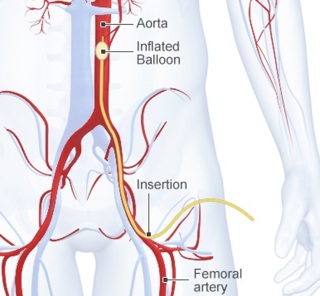
  • Resuscitative Endovascular Balloon Occlusion of the Aorta (REBOA).
  • Exsanguination is a major cause of mortality in trauma
  • One temporizing technique to buy time to definitive hemorrhage control is to occlude the aorta thereby shunting blood away from pelvis and lower extremities, increasing cardiac afterload to increase myocardial and brain perfusion.
  • Rather than perform a thoracotomy to cross clamp aorta, a REBOA catheter may be introduced into the aorta via the common femoral artery and a balloon inflated in the descending aorta to occlude it.
  • The indications for REBOA include PEA arrest of brief duration attributable to exsanguination for sub-diaphragmatic source in a young, healthy patient, or severe hypovolemic shock or those in an agonal state due to non-compressible hemorrhage not responding to volume and in whom obstructive cause of shock has been ruled out.
  • Contraindicated in prolonged arrest, suspected proximal aortic injury, advanced age/comorbidities.
  • Controversies and evidence:

    • High quality evidence is lacking - as it is for much of what we do and even consider standard of care in trauma. It has not been shown to improve survival, which is hard to demonstrate.

    • Role in remote settings vs trauma centers unclear.

    • Further refinements of indication for use are likely to occur with time and experience.

  • Summarize - REBOA is a promising relatively new technology that may have potential to improve outcomes in the sickest of trauma patients.

Reference: https://lifeinthefastlane.com/ccc/resuscitative-endovascular-balloon-occlusion-aorta-reboa/

Avsnitt(1146)

Podcast 627: Oxygen Like It's Hot

Podcast 627: Oxygen Like It's Hot

Contributor: Aaron Lessen, MD Educational Pearls: High flow nasal cannula (HFNC) has become more utilized with COVID pandemic Multiple studies have shown this method improves both oxygenation and ven...

4 Jan 20213min

Pharmacy Phriday #6: Tik Tok Benadryl Challenge and Diphenhydramine Toxicity

Pharmacy Phriday #6: Tik Tok Benadryl Challenge and Diphenhydramine Toxicity

Contributor: Ruben Marrero-Vasquez, PharmD Educational Pearls: ACEP and FDA have both issued warnings about the viral Tik Tok Benadryl (diphenhydramine) challenge where individuals voluntarily overdo...

1 Jan 20216min

Mental Health Monthly #6: Suicide Assessment

Mental Health Monthly #6: Suicide Assessment

EMM is excited to welcome back the hosts of Millennial Mental Health Channel podcast to explain the key points of a robust suicide assessment in the ED. Dr. Justin Romano is a third year psychiatry re...

30 Dec 202016min
Podcast 626: Updated Gonorrhea Treatment

Podcast 626: Updated Gonorrhea Treatment

Educational Pearls: The CDC has made new formal recommendations for treating Gonorrhea due to increasing resistance to Rocephin and Azithromycin. New recommendations: Confirmed gonorrhea: Ceftriaxo...

29 Dec 20204min

Podcast 625: High Altitude Cerebral Edema (HACE)

Podcast 625: High Altitude Cerebral Edema (HACE)

Contributor: Tom Seibert, MD Educational Pearls: High altitude cerebral edema (HACE) is the end stage of acute mountain sickness and is diagnosed when patients develop neurologic dysfunction, ataxia,...

28 Dec 20202min

Podcast 624: Timing and Tips on Sepsis

Podcast 624: Timing and Tips on Sepsis

Contributor: Don Stader, MD Educational Pearls: Time can be an important factor in outcomes regarding sepsis including mortality Emphasis has grown on early administration of antibiotics and IV fluid...

22 Dec 20203min
Podcast 623: Acute Mountain Sickness

Podcast 623: Acute Mountain Sickness

Contributor: Tom Seibert, MD Educational Pearls: Acute Mountain sickness (AMS) can cause headache along with fatigue, nausea, vomiting, insomnia Typically occurs above 6500 feet (not 65,000) in eleva...

21 Dec 20204min

Podcast 622: High Altitude Pulmonary Edema (HAPE)

Podcast 622: High Altitude Pulmonary Edema (HAPE)

Contributor: Thomas Seibert, MD Educational Pearls: High Altitude Pulmonary Edema (HAPE) typically occurs 2-4 days after arriving at elevation Symptoms include: Fatigue Dyspnea Cough Treatment in...

15 Dec 20204min

Populärt inom Vetenskap

p3-dystopia
dumma-manniskor
svd-nyhetsartiklar
allt-du-velat-veta
det-morka-psyket
kapitalet-en-podd-om-ekonomi
pojkmottagningen
sexet
rss-ufo-bortom-rimligt-tvivel
rss-vetenskapsradion-2
rss-vetenskapsradion
dumforklarat
halsorevolutionen
rss-broccolipodden-en-podcast-som-inte-handlar-om-broccoli
medicinvetarna
rss-experimentet
bildningspodden
vetenskapsradion
hacka-livet
intergalaktiskt