
COVID-19 Digest: Do NSAIDs Make COVID-19 More Severe? (Recorded 3/30/20, 18:00 MST)

COVID-19 Digest: Do NSAIDs Make COVID-19 More Severe? (Recorded 3/30/20, 18:00 MST)

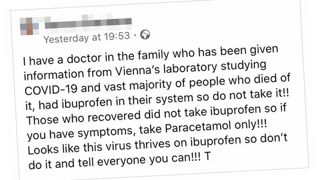
In the past two weeks, warnings, questions, and misinformation concerning COVID-19 and NSAID use have been spreading...no pun intended..virally. The pace of this evolving pandemic and the equally quick pace of the news and social media news cycle have meant that information and misinformation travel equally fast. Today we bring to you the story of how a letter in The Lancet led to a world of confusion.

Host: Elizabeth Esty, MD

Research By: Elizabeth Esty & Nathan Novotny

Sound Editing By: Stephen Bahmani

Time Stamps:

0:00 - COVID-19 Statistics

2:55 - The Lancet Letter: What Started the Rumor

4:10 - ACE Inhibitors & ARB's

5:00 - What The Lancet Letter Got Wrong

6:25 - Treatment of HTN and DM in China vs. the U.S.

9:13 - Do ACE Inhibitors Actually Increase ACE-2 Expression?

11:00 - The French Ministry of Health and Their Warning About NSAIDs

14:09 - Misinformation in the Age of COVID-19

15:09 - Potential Harms of Tylenol Use

16:11 - The Need for High-Quality Science to Overcome COVID-19

References:

  1. Fang L, Karakiulakis G, Roth M. Are patients with hypertension and diabetes mellitus at increased risk for COVID-19 infection? The Lancet Respiratory Medicine. March 2020:S2213260020301168. doi:10.1016/S2213-2600(20)30116-8
  2. Kane S. Ibuprofen - Drug Usage Statistics, ClinCalc DrugStats Database. ClinCalc DrugStats Database. https://clincalc.com/DrugStats/Drugs/Ibuprofen. Published December 23, 2019. Accessed March 30, 2020.
  3. Hoffmann M, Kleine-Weber H, Schroeder S, et al. SARS-CoV-2 Cell Entry Depends on ACE2 and TMPRSS2 and Is Blocked by a Clinically Proven Protease Inhibitor. Cell. March 2020. doi:10.1016/j.cell.2020.02.052
  4. Lu J, Lu Y, Wang X, et al. Prevalence, awareness, treatment, and control of hypertension in China: data from 1·7 million adults in a population-based screening study (China PEACE Million Persons Project). The Lancet. 2017;390(10112):2549-2558. doi:10.1016/S0140-6736(17)32478-9
  5. Wang Zengwu, Chen Zuo, Zhang Linfeng, et al. Status of Hypertension in China. Circulation. 2018;137(22):2344-2356. doi:10.1161/CIRCULATIONAHA.117.032380
  6. Hu C, Jia W. Diabetes in China: Epidemiology and Genetic Risk Factors and Their Clinical Utility in Personalized Medication. Diabetes. 2018;67(1):3-11. doi:10.2337/dbi17-0013
  7. Yuan H, Li X, Wan G, et al. Type 2 diabetes epidemic in East Asia: a 35-year systematic trend analysis. Oncotarget. 2018;9(6). doi:10.18632/oncotarget.22961
  8. Woo KS, Nicholls MG. High prevalence of persistent cough with angiotensin converting enzyme inhibitors in Chinese. Br J Clin Pharmacol. 1995;40(2):141-144.
  9. Chen X, Hu W, Ling J, et al. Hypertension and Diabetes Delay the Viral Clearance in COVID-19 Patients. medRxiv. March 2020:2020.03.22.20040774. doi:10.1101/2020.03.22.20040774
  10. Perico L, Benigni A, Remuzzi G. Should COVID-19 Concern Nephrologists? Why and to What Extent? The Emerging Impasse of Angiotensin Blockade. NEF. March 2020:1-9. doi:10.1159/000507305
  11. Qiao Y, Shin J-I, Chen TK, et al. Association Between Renin-Angiotensin System Blockade Discontinuation and All-Cause Mortality Among Persons With Low Estimated Glomerular Filtration Rate. JAMA Intern Med. March 2020. doi:10.1001/jamainternmed.2020.0193
  12. The Local. UPDATE - Coronavirus: French health minister and WHO issue warning over taking anti-inflammatories. https://www.thelocal.fr/20200314/coronavirus-french-health-minister-issues-warning-over-anti-flammatories. Published March 14, 2020. Accessed March 30, 2020.
  13. ScienceAlert. Updated: WHO Now Doesn't Recommend Avoiding Ibuprofen For COVID-19 Symptoms. https://www.sciencealert.com/who-recommends-to-avoid-taking-ibuprofen-for-covid-19-symptoms. Accessed March 30, 2020.
  14. European Medicines Agency. Coronavirus disease (COVID-19). https://www.ema.europa.eu/en/human-regulatory/overview/public-health-threats/coronavirus-disease-covid-19#advice-on-using-non-steroidal-anti-inflammatory-medicines-such-as-ibuprofen--section. Published March 18, 2020.
  15. U.S. Food and Drug Administration. FDA advises patients on use of non-steroidal anti-inflammatory drugs (NSAIDs) for COVID-19. https://www.fda.gov/drugs/drug-safety-and-availability/fda-advises-patients-use-non-steroidal-anti-inflammatory-drugs-nsaids-covid-19. Published March 19, 2020.
  16. BBC Reality Check team and BBC Monitoring. Coronavirus and ibuprofen: Separating fact from fiction. BBC News. https://www.bbc.com/news/51929628. Published March 17, 2020.
  17. Mosbergen D. Tylenol Overdose Risk Is Staggering; Acetaminophen Safeguards Remain Insufficient: Report. HuffPost. https://www.huffpost.com/entry/tylenol-overdose_n_3976991. Published September 24, 2013.

Avsnitt(1145)

Episode 905: Oseltamivir (Tamiflu) for Influenza

Episode 905: Oseltamivir (Tamiflu) for Influenza

Contributor: Aaron Lessem MD Educational Pearls:  Oseltamivir (Tamiflu) is an antiviral medication used commonly to treat influenza Trials show that the medication reduces the duration of illness ...

27 Maj 20242min

Episode 904: Cardiovascular Risks of Epinephrine

Episode 904: Cardiovascular Risks of Epinephrine

Contributor: Aaron Lessen MD Educational Pearls: Epinephrine is essential in the treatment of anaphylaxis, but is epinephrine dangerous from a cardiovascular perspective? A 2024 study in the Journal o...

20 Maj 20242min

Episode 903: Treating Precipitated Opioid Withdrawal

Episode 903: Treating Precipitated Opioid Withdrawal

Contributor: Aaron Lessen MD Educational Pearls: Opioid overdoses that are reversed with naloxone (Narcan), a mu-opioid antagonist, can precipitate acute withdrawal in some patients Treatment of o...

13 Maj 20242min

Episode 902: Liver Failure and Cirrhosis

Episode 902: Liver Failure and Cirrhosis

Contributor: Travis Barlock MD Educational Pearls: How do you differentiate between compensated and decompensated cirrhosis? Use the acronym VIBE to look for signs of being decompensated. V-Volume ...

6 Maj 20243min

Episode 901: Underdosing in Status Epilepticus

Episode 901: Underdosing in Status Epilepticus

Contributor: Aaron Lessen MD Educational Pearls: Lorazepam (Ativan) is dosed at 0.1 mg/kg up to a maximum of 4 mg in status epilepticus Some ED protocols only give 2 mg initially The maximum r...

29 Apr 20242min

Episode 900: Ketamine Dosing

Episode 900: Ketamine Dosing

Contributor: Travis Barlock MD Educational Pearls: Ketamine is an NMDA receptor antagonist with a wide variety of uses in the emergency department. To dose ketamine remember the numbers 0.3, 1, and 3....

22 Apr 20242min

Episode 899: Thrombolytic Contraindications

Episode 899: Thrombolytic Contraindications

Contributor: Travis Barlock MD Educational Pearls: Thrombolytic therapy (tPA or TNK) is often used in the ED for strokes Use of anticoagulants with INR > 1.7 or  PT >15 Warfarin will reliably i...

15 Apr 20243min

Episode 898: Takotsubo Cardiomyopathy

Episode 898: Takotsubo Cardiomyopathy

Contributor: Ricky Dhaliwal, MD Educational Pearls: Takotsubo cardiomyopathy, also known as "broken heart syndrome," is a temporary heart condition that can mimic the symptoms of a heart attack, inc...

10 Apr 20243min

Populärt inom Vetenskap

p3-dystopia
dumma-manniskor
svd-nyhetsartiklar
allt-du-velat-veta
kapitalet-en-podd-om-ekonomi
det-morka-psyket
pojkmottagningen
dumforklarat
rss-vetenskapsradion
rss-vetenskapsradion-2
sexet
halsorevolutionen
rss-ufo-bortom-rimligt-tvivel
rss-experimentet
rss-broccolipodden-en-podcast-som-inte-handlar-om-broccoli
rss-spraket
medicinvetarna
bildningspodden
vetenskapsradion
rss-lara-fran-larda-en-fackbok-och-en-forfattare