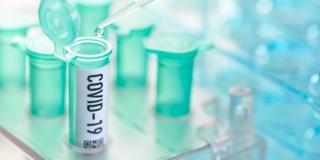

Podcast 557:  COVID-19 Lab Trends

Podcast 557: COVID-19 Lab Trends

Contributor: Don Stader, MD

Educational Pearls:

  • COVID-19 is diagnosed with a nasopharyngeal swab (q-tip). This unfortunately can be painful, but if the swab doesn't go deep into the nasal cavity the sample can be inadequate leading to false negatives (missed infections).
  • The sensitivity of the COVID-19 RT PCR test is low, ranging from 66-80% in various studies. Another study has shown 23% of patients who initially tested negative but had COVID-19 symptoms will test positive when re-tested. So test highly suspicious patients twice.

  • COVID has shown to have an effect on CBC. White blood cell counts are often normal (no leukocytosis), but there is often lymphopenia, or low lymphocytes, and thrombocytopenia. Interestingly, low platelets have appeared to have prognostic value in that lower platelets often indicate worse patient outcomes.
  • Coagulation studies are showing very elevated D-Dimers which has sparked the debate as to whether COVID-19 causes a hypercoagulable state. The increased incidence of MI/heart attacks and strokes in COVID patients supports this argument.
  • While D-Dimers can help point towards a diagnosis of pulmonary embolism, in the setting of highly likely COVID-19 infections, getting a CTA looking for a PE is probably unnecessary unless there's also suspicion for PE.
  • C-reactive protein (CRP) and procalcitonin are two common inflammatory markers. A CRP can help indicate how sick a patient is and procalcitonin can help determine if the infection is bacterial or viral in nature.
  • CRP levels are often elevated in COVID patients, and studies are showing a high CRP is linked to worse patient outcomes.
  • Elevations in procalcitonin can be used to see if there's a concomitant bacterial infection, meaning patients need antibiotics in addition to supportive care for the COVID-19.
  • Flu season is coming to a close, but data has shown a 5-10% co-infection rate of COVID-19 with influenza. As expected patient outcomes have been worse in those with both infections.

References

1) Farkas, Josh. "COVID-19." EMCrit Project, 21 Apr. 2020, emcrit.org/ibcc/covid19/#labs.

2) Guan W. et al. Clinical Characteristics of Coronavirus Disease 2019 in China. February 28, 2020, updated on March 6, 2020, at NEJM.org. DOI: 10.1056/NEJMoa2002032

3)Young BE, Ong SWX, Kalimuddin S, et al. Epidemiologic Features and Clinical Course of Patients Infected With SARS-CoV-2 in Singapore. JAMA. 2020;323(15):1488–1494. doi:10.1001/jama.2020.3204

4) Wang M. et al. Clinical diagnosis of 8274 samples with 2019-novel coronavirus in Wuhan. medRxiv 2020.02.12.20022327; doi: https://doi.org/10.1101/2020.02.12.20022327

Summarized by Jackson Roos, MS4 | Edited by Erik Verzemnieks, MD

Avsnitt(1145)

Carepoint Journal Club: Trauma Discussion

Carepoint Journal Club: Trauma Discussion

Carepoint Journal Club is a quarterly series with discussions about a medical topic, brought to you by Carepoint's Emergency Physicians.

22 Dec 202545min

Episode 987: Cough Suppressants

Episode 987: Cough Suppressants

Contributor: Meghan Hurley, MD Educational Pearls:  OTC Medications Dextromethorphan (DM) Most common OTC cough suppressant Minimal efficacy: Little evidence that it shortens the duration or severit...

15 Dec 20257min

Episode 986: Lateral Canthotomy in Emergency Settings

Episode 986: Lateral Canthotomy in Emergency Settings

Contributor: Taylor Lynch, MD Educational Pearls: What is orbital compartment syndrome, and how is it assessed in the emergency room? Orbital compartment syndrome (OCS) is an emergent ophthalmic cond...

8 Dec 20254min

Episode 985: Amiodarone vs. Lidocaine

Episode 985: Amiodarone vs. Lidocaine

Contributor: Aaron Lessen, MD Educational Pearls: How do amiodarone and lidocaine work on the heart? Amiodarone Blocks potassium channels (Class III effect). Also blocks sodium and calcium channels....

8 Dec 20252min

Episode 984: Fish Hooks

Episode 984: Fish Hooks

Contributor: Megan Hurley, MD Educational Pearls: Assess first: confirm the hook isn't near vital structures. Automatic subspecialty consult for eye involvement or proximity to carotid artery, radial...

24 Nov 20254min

Episode 983: Head-of-Bed Position in Large Vessel Occlusion Strokes

Episode 983: Head-of-Bed Position in Large Vessel Occlusion Strokes

Contributor: Aaron Lessen MD Educational Pearls:  Recent prospective randomized clinical trial assessed optimal head-of-bed positioning in patients with LVO 0º vs. 30º elevation Objective was to det...

18 Nov 20252min

Episode 982: Epistaxis Management

Episode 982: Epistaxis Management

Contributor: Meghan Hurley, MD Educational Pearls: 1. Initial Assessment Start with a physical examination: Determine if the bleed is anterior or posterior. Perform a primary survey: assess ai...

10 Nov 20256min

Episode 981: Electrical Burns

Episode 981: Electrical Burns

Contributor: Travis Barlock, MD Educational Pearls: Quick Statistics on Electrical Burns: Electrical burns compose roughly 2 to 9% of all burns that come into emergency departments. The majority of p...

3 Nov 20253min

Populärt inom Vetenskap

p3-dystopia
dumma-manniskor
svd-nyhetsartiklar
allt-du-velat-veta
kapitalet-en-podd-om-ekonomi
det-morka-psyket
pojkmottagningen
dumforklarat
rss-vetenskapsradion-2
rss-vetenskapsradion
sexet
halsorevolutionen
rss-ufo-bortom-rimligt-tvivel
rss-spraket
rss-experimentet
vetenskapsradion
rss-broccolipodden-en-podcast-som-inte-handlar-om-broccoli
medicinvetarna
bildningspodden
4health-med-anna-sparre