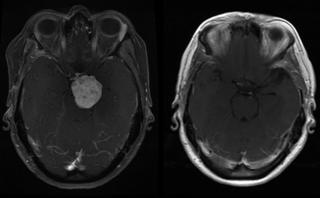

Podcast 582:  Gadolinium - The Contrast of MRI

Podcast 582: Gadolinium - The Contrast of MRI

Contributor: Michael Hunt, MD

Educational Pearls:

  • Contrast agents are commonly used for X-rays and CT's to better characterize disease, but contrast doesn't work with MRI. That's where the element Gadolinium comes into play.
  • Gadolinium, element 64, is ferromagnetic (attracted to iron) below 68 degrees and above that temperature it's paramagnetic which makes it useful in MRI (Magnetic Resonance Imaging).
  • Gadolinium is toxic alone, but when paired with chelators it can be used in humans and allows for better characterization of tumors or abnormal tissue on MRI.
  • It helps identify this abnormal tissue because when MRI causes polarization of our body's cells, the gadolinium, which has the maximum number of unpaired electrons in its orbital shells, alters the rate of decay in abnormal tissue highlighting abnormalities on imaging.
  • Gadolinium can also be used in the treatment of cancers because it collects in the cells of abnormal tissue, allowing for more targeted therapies.
  • In people exposed to gadolinium, the anaphylaxis rate is low, below 1/1000, and in rare cases there are reports of kidney injury and nephrogenic systemic fibrosis which is why it's not recommended in renal failure patients.

References

1)Ibrahim MA, Hazhirkarzar B, Dublin AB. Magnetic Resonance Imaging (MRI) Gadolinium. [Updated 2020 Mar 9]. In: StatPearls [Internet]. Treasure Island (FL): StatPearls Publishing; 2020 Jan-. Available from: https://www.ncbi.nlm.nih.gov/books/NBK482487/

2)Pasquini L, Napolitano A, Visconti E, et al. Gadolinium-Based Contrast Agent-Related Toxicities [published correction appears in CNS Drugs. 2018 May 15;:]. CNS Drugs. 2018;32(3):229-240. doi:10.1007/s40263-018-0500-1

Summarized by Jackson Roos, MS4 | Edited by Erik Verzemnieks, MD

Avsnitt(1145)

Episode 897: Adrenal Crisis

Episode 897: Adrenal Crisis

Contributor: Ricky Dhaliwal MD Educational Pearls: Primary adrenal insufficiency (most common risk factor for adrenal crises) An autoimmune condition commonly known as Addison's Disease Defects...

1 Apr 20244min

Podcast 896: Cancer-Related Emergencies

Podcast 896: Cancer-Related Emergencies

Contributor: Travis Barlock, MD Educational Pearls: Cancer-related emergencies can be sorted into a few buckets: Infection Cancer itself and the treatments (chemotherapy/radiation) can be immunos...

25 Mars 20242min

Episode 895: Indications for Exogenous Albumin

Episode 895: Indications for Exogenous Albumin

Contributor: Travis Barlock MD Educational Pearls: There are three indications for IV albumin in the ED Spontaneous bacterial peritonitis (SBP) Patients with SBP develop renal failure from volu...

18 Mars 20242min

Episode 894: DKA and HHS

Episode 894: DKA and HHS

Contributor: Ricky Dhaliwal, MD Educational Pearls: What are DKA and HHS? DKA (Diabetic Ketoacidosis) and HHS (Hyperosmolar Hyperglycemic State) are both acute hyperglycemic states. DKA More com...

11 Mars 20247min

Episode 893: Home Treatments for Button Battery Ingestion

Episode 893: Home Treatments for Button Battery Ingestion

Contributor: Aaron Lessen MD Educational Pearls: Button batteries cause alkaline corrosion and erosion of the esophagus when swallowed Children swallow button batteries, which create a medical eme...

4 Mars 20242min

Episode 892: Tourniquets

Episode 892: Tourniquets

Contributor: Ricky Dhaliwal, MD Educational Pearls: What can you do to control bleeding in a penetrating wound? Apply direct pinpoint pressure on the wound as well as proximal to the wound. Build ...

27 Feb 20245min
Pharmacy Phriday #11: Riddles, Medical Jargon, NNT, and Time Travel

Pharmacy Phriday #11: Riddles, Medical Jargon, NNT, and Time Travel

Contributors: Kali Olson PharmD, Travis Barlock MD, Jeffrey Olson MS2 Summary: In this episode of Pharmacy Phriday, Dr. Kali Olson joins Dr. Travis Barlock and Jeffrey Olson in studio to discuss a var...

23 Feb 202443min

Episode 891: Hypothermia

Episode 891: Hypothermia

Contributor: Taylor Lynch MD Educational Pearls Hypothermia is defined as a core body temperature less than 35 degrees Celsius or less than 95 degrees Fahrenheit  Mild Hypothermia: 32-35 degrees C...

19 Feb 20244min

Populärt inom Vetenskap

p3-dystopia
dumma-manniskor
svd-nyhetsartiklar
allt-du-velat-veta
kapitalet-en-podd-om-ekonomi
det-morka-psyket
dumforklarat
pojkmottagningen
rss-vetenskapsradion-2
rss-vetenskapsradion
rss-ufo-bortom-rimligt-tvivel
sexet
halsorevolutionen
rss-spraket
medicinvetarna
rss-experimentet
vetenskapsradion
paranormalt-med-caroline-giertz
4health-med-anna-sparre
rss-tidslinjen-podcast