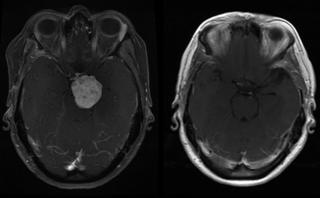

Podcast 582:  Gadolinium - The Contrast of MRI

Podcast 582: Gadolinium - The Contrast of MRI

Contributor: Michael Hunt, MD

Educational Pearls:

  • Contrast agents are commonly used for X-rays and CT's to better characterize disease, but contrast doesn't work with MRI. That's where the element Gadolinium comes into play.
  • Gadolinium, element 64, is ferromagnetic (attracted to iron) below 68 degrees and above that temperature it's paramagnetic which makes it useful in MRI (Magnetic Resonance Imaging).
  • Gadolinium is toxic alone, but when paired with chelators it can be used in humans and allows for better characterization of tumors or abnormal tissue on MRI.
  • It helps identify this abnormal tissue because when MRI causes polarization of our body's cells, the gadolinium, which has the maximum number of unpaired electrons in its orbital shells, alters the rate of decay in abnormal tissue highlighting abnormalities on imaging.
  • Gadolinium can also be used in the treatment of cancers because it collects in the cells of abnormal tissue, allowing for more targeted therapies.
  • In people exposed to gadolinium, the anaphylaxis rate is low, below 1/1000, and in rare cases there are reports of kidney injury and nephrogenic systemic fibrosis which is why it's not recommended in renal failure patients.

References

1)Ibrahim MA, Hazhirkarzar B, Dublin AB. Magnetic Resonance Imaging (MRI) Gadolinium. [Updated 2020 Mar 9]. In: StatPearls [Internet]. Treasure Island (FL): StatPearls Publishing; 2020 Jan-. Available from: https://www.ncbi.nlm.nih.gov/books/NBK482487/

2)Pasquini L, Napolitano A, Visconti E, et al. Gadolinium-Based Contrast Agent-Related Toxicities [published correction appears in CNS Drugs. 2018 May 15;:]. CNS Drugs. 2018;32(3):229-240. doi:10.1007/s40263-018-0500-1

Summarized by Jackson Roos, MS4 | Edited by Erik Verzemnieks, MD

Avsnitt(1145)

Podcast 738: Acute Mesenteric Ischemia

Podcast 738: Acute Mesenteric Ischemia

Contributor: Ian Gillman, PA-C Educational Pearls: Acute mesenteric ischemia is a condition where bowel loses blood supply from an acute occlusion of the mesenteric arteries A frequent sign is abdomi...

14 Dec 20212min

Podcast 737: TBI Outcomes

Podcast 737: TBI Outcomes

Contributor: Aaron Lessen, MD Educational Pearls: Study evaluating patient outcomes after traumatic brain injury (TBI) over 1 year Trial followed patients with severe TBI (GCS 3-8) and moderate TBI (...

13 Dec 20212min

Podcast 736: Seasonal Affective Disorder

Podcast 736: Seasonal Affective Disorder

Contributor: Adam Barkin, MD Educational Pearls: Seasonal Affective Disorder (SAD) a form of seasonal depression which can result in trouble sleeping, concentration difficulties, changes in appetite,...

7 Dec 20213min

Podcast 735: End Tidal CO2 and BiPAP

Podcast 735: End Tidal CO2 and BiPAP

Contributor: Aaron Lessen, MD Educational Pearls: End tidal CO2 is accurate to 1-4 mmHg in intubated patient but use with those on positive pressure ventilation like BiPAP is unclear Study looked at ...

6 Dec 20212min

Podcast 734: Push Dose Antibiotics

Podcast 734: Push Dose Antibiotics

Contributor: Aaron Lessen, MD Educational Pearls: Recent study at a hospital in Chicago with a shortage of normal saline decided to push IV ceftriaxone rather than the typical infusion of the antibio...

1 Dec 20212min

Podcast 733: Nitric Oxide for COVID

Podcast 733: Nitric Oxide for COVID

Contributor: Nick Hatch, MD Educational Pearls: Inhaled nitric oxide or Flolan may be considered in COVID Flolan is a prostaglandin can be inhaled or given IV These medications are classically us...

30 Nov 20215min

Podcast 732: Organophosphate Toxicity

Podcast 732: Organophosphate Toxicity

Educational Pearls: Organophosphates affect the cholinergic system by inhibiting acetylcholinesterase affecting muscarinic and nicotinic receptors Symptoms include lacrimation, salivation, bronchocon...

23 Nov 20215min

Podcast 731: Fluid Resuscitation in Burns

Podcast 731: Fluid Resuscitation in Burns

Contributor: Chris Holmes, MD Educational Pearls: Parkland Formula: 4 mL x [Total Body Surface Area Burned (%)] x [body weight (kg)] given in 24 hours 50% given over 8 hours and 50% given over the ...

22 Nov 20214min

Populärt inom Vetenskap

p3-dystopia
dumma-manniskor
svd-nyhetsartiklar
allt-du-velat-veta
kapitalet-en-podd-om-ekonomi
det-morka-psyket
pojkmottagningen
dumforklarat
rss-vetenskapsradion
rss-vetenskapsradion-2
sexet
halsorevolutionen
rss-ufo-bortom-rimligt-tvivel
rss-experimentet
rss-broccolipodden-en-podcast-som-inte-handlar-om-broccoli
rss-spraket
medicinvetarna
bildningspodden
vetenskapsradion
rss-lara-fran-larda-en-fackbok-och-en-forfattare