
Podcast 582:  Gadolinium - The Contrast of MRI

Podcast 582: Gadolinium - The Contrast of MRI

Contributor: Michael Hunt, MD

Educational Pearls:

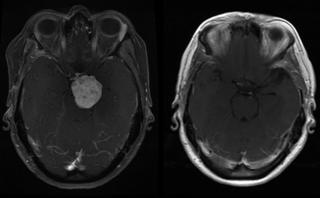
  • Contrast agents are commonly used for X-rays and CT's to better characterize disease, but contrast doesn't work with MRI. That's where the element Gadolinium comes into play.
  • Gadolinium, element 64, is ferromagnetic (attracted to iron) below 68 degrees and above that temperature it's paramagnetic which makes it useful in MRI (Magnetic Resonance Imaging).
  • Gadolinium is toxic alone, but when paired with chelators it can be used in humans and allows for better characterization of tumors or abnormal tissue on MRI.
  • It helps identify this abnormal tissue because when MRI causes polarization of our body's cells, the gadolinium, which has the maximum number of unpaired electrons in its orbital shells, alters the rate of decay in abnormal tissue highlighting abnormalities on imaging.
  • Gadolinium can also be used in the treatment of cancers because it collects in the cells of abnormal tissue, allowing for more targeted therapies.
  • In people exposed to gadolinium, the anaphylaxis rate is low, below 1/1000, and in rare cases there are reports of kidney injury and nephrogenic systemic fibrosis which is why it's not recommended in renal failure patients.

References

1)Ibrahim MA, Hazhirkarzar B, Dublin AB. Magnetic Resonance Imaging (MRI) Gadolinium. [Updated 2020 Mar 9]. In: StatPearls [Internet]. Treasure Island (FL): StatPearls Publishing; 2020 Jan-. Available from: https://www.ncbi.nlm.nih.gov/books/NBK482487/

2)Pasquini L, Napolitano A, Visconti E, et al. Gadolinium-Based Contrast Agent-Related Toxicities [published correction appears in CNS Drugs. 2018 May 15;:]. CNS Drugs. 2018;32(3):229-240. doi:10.1007/s40263-018-0500-1

Summarized by Jackson Roos, MS4 | Edited by Erik Verzemnieks, MD

Avsnitt(1145)

Emergency Medicine Cases with Dr. Barlock

Emergency Medicine Cases with Dr. Barlock

Contributors: Travis Barlock MD, Jeffrey Olson MS4 Feel free to use the cases below for your own practice. All of the scenarios are completely made up and designed to hit several teaching points. Case...

9 Sep 202553min

Episode 973: Meningitis Retention Syndrome

Episode 973: Meningitis Retention Syndrome

Contributor: Travis Barlock MD Educational Pearls: Meningitis retention syndrome is a relatively novel and rare clinical condition Aseptic meningitis + acute urinary retention One study reports an i...

8 Sep 20252min

Episode 972: Hepatic Encephalopathy

Episode 972: Hepatic Encephalopathy

Contributor: Alec Coston, MD Educational Pearls: Hepatic encephalopathy (HE) is defined as a disruption in brain function that results from impaired liver function or portosystemic shunting. Manifes...

3 Sep 20253min

Episode 971: Calcium Pretreatment for Diltiazem in AFib with RVR

Episode 971: Calcium Pretreatment for Diltiazem in AFib with RVR

Contributor: Taylor Lynch, MD Educational Pearls: What is atrial fibrillation with rapid ventricular response (AFib with RVR) and how does it differ from atrial fibrillation (AFib)? AFib is an abnorm...

25 Aug 20252min

Episode 970: Fever Management

Episode 970: Fever Management

Contributor: Aaron Lessen, MD Educational Pearls: Recorded March 2025 What is the best treatment for a fever? Tylenol? Ibuprofen? Combined? Alternating the two? The journal Pediatrics aimed to answer...

22 Aug 20252min

Episode 969: Shoulder Reduction

Episode 969: Shoulder Reduction

Contributor: Aaron Lessen, MD Educational Pearls: There are many techniques for reducing a shoulder dislocation A recent study discussed a new variation of closed reduction technique: wrist-clamping ...

11 Aug 20252min

Episode 968: Heavy Metals

Episode 968: Heavy Metals

Contributor: Megan Hurley MD Educational Pearls: Acute toxicity of heavy metals: Gastrointestinal upset is the most common presentation Chronic toxicity of heavy metals: Symptoms depend on the meta...

4 Aug 20252min

Episode 967: Dilutional Hyponatremia

Episode 967: Dilutional Hyponatremia

Contributor: Taylor Lynch, MD Educational Pearls: Dilutional Hyponatremia: Occurs when there is an excess of free water relative to sodium in the body. Causes a falsely low sodium concentration witho...

28 Juli 20252min

Populärt inom Vetenskap

svd-nyhetsartiklar
p3-dystopia
dumma-manniskor
pojkmottagningen
allt-du-velat-veta
det-morka-psyket
kapitalet-en-podd-om-ekonomi
rss-experimentet
dumforklarat
rss-vetenskapsradion-2
halsorevolutionen
rss-ufo-bortom-rimligt-tvivel
medicinvetarna
rss-vetenskapsradion
paranormalt-med-caroline-giertz
bildningspodden
rss-spraket
sexet
vetenskapsradion
4health-med-anna-sparre