Podcast 582:  Gadolinium - The Contrast of MRI

Podcast 582: Gadolinium - The Contrast of MRI

Contributor: Michael Hunt, MD

Educational Pearls:

  • Contrast agents are commonly used for X-rays and CT's to better characterize disease, but contrast doesn't work with MRI. That's where the element Gadolinium comes into play.
  • Gadolinium, element 64, is ferromagnetic (attracted to iron) below 68 degrees and above that temperature it's paramagnetic which makes it useful in MRI (Magnetic Resonance Imaging).
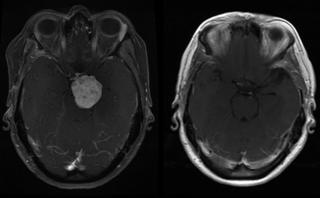
  • Gadolinium is toxic alone, but when paired with chelators it can be used in humans and allows for better characterization of tumors or abnormal tissue on MRI.
  • It helps identify this abnormal tissue because when MRI causes polarization of our body's cells, the gadolinium, which has the maximum number of unpaired electrons in its orbital shells, alters the rate of decay in abnormal tissue highlighting abnormalities on imaging.
  • Gadolinium can also be used in the treatment of cancers because it collects in the cells of abnormal tissue, allowing for more targeted therapies.
  • In people exposed to gadolinium, the anaphylaxis rate is low, below 1/1000, and in rare cases there are reports of kidney injury and nephrogenic systemic fibrosis which is why it's not recommended in renal failure patients.

References

1)Ibrahim MA, Hazhirkarzar B, Dublin AB. Magnetic Resonance Imaging (MRI) Gadolinium. [Updated 2020 Mar 9]. In: StatPearls [Internet]. Treasure Island (FL): StatPearls Publishing; 2020 Jan-. Available from: https://www.ncbi.nlm.nih.gov/books/NBK482487/

2)Pasquini L, Napolitano A, Visconti E, et al. Gadolinium-Based Contrast Agent-Related Toxicities [published correction appears in CNS Drugs. 2018 May 15;:]. CNS Drugs. 2018;32(3):229-240. doi:10.1007/s40263-018-0500-1

Summarized by Jackson Roos, MS4 | Edited by Erik Verzemnieks, MD

Avsnitt(1146)

Mental Health Monthly #3: Maintaining Mental Health and Wellness for Healthcare Professionals

Mental Health Monthly #3: Maintaining Mental Health and Wellness for Healthcare Professionals

In this timely installment of Mental Health Monthly, mental health expert Lexi Eliades shares useful tips for identifying burnout and mental health decline as well as ways to maintain mental wellness ...

6 Maj 202010min
Podcast 559: Metabolic Acidosis

Podcast 559: Metabolic Acidosis

Contributor: Dylan Luyten, MD Educational Pearls Acidosis can be caused by a respiratory, metabolic, or mixed source A respiratory acidosis will have a low serum pH and elevated bicarbonate if it's c...

5 Maj 20203min

Podcast 558:  Rapid ARDS Review

Podcast 558: Rapid ARDS Review

Contributor: Don Stader, MD Educational Pearls: Acute respiratory distress syndrome (ARDS) is a catch all term for when lung injury leads to fluid collection in the air spaces of the lungs  Ventila...

4 Maj 20204min
COVID-19 Digest: Strokes in Young People with COVID

COVID-19 Digest: Strokes in Young People with COVID

Last week we looked at neurologic presentations of COVID-19; this week we'll look more closely at strokes in young people with COVID. A letter published 2 days ago in the NEJM with lead author Thomas ...

1 Maj 20208min

Podcast 557:  COVID-19 Lab Trends

Podcast 557: COVID-19 Lab Trends

Contributor: Don Stader, MD Educational Pearls: COVID-19 is diagnosed with a nasopharyngeal swab (q-tip). This unfortunately can be painful, but if the swab doesn't go deep into the nasal cavity th...

29 Apr 20207min
Podcast 556:  CSF - What is it good for?

Podcast 556: CSF - What is it good for?

Contributor: Eric Miller, MD Educational Pearls: A cell count is performed on tubes 1 and 4 to account for changes that may occur from blood entering the first sample from the needle insertion Tube 2...

28 Apr 20206min

Podcast 555:  Anticoagulation vs. Antiplatelet

Podcast 555: Anticoagulation vs. Antiplatelet

Contributor: Don Stader, MD Educational Pearls: When do we give antiplatelet drugs or anti-coagulation drugs? Arterial issues get antiplatelet therapy Venous issues, or slow flow states, get antico...

27 Apr 20203min
COVID-19 Digest: Neurological Manifestations of COVID-19

COVID-19 Digest: Neurological Manifestations of COVID-19

Accumulating clinical evidence suggests that many patients with COVID have neurological symptoms and that some may even present with neurologic manifestations of the disease. Most COVID patients have ...

23 Apr 202014min

Populärt inom Vetenskap

dumma-manniskor
svd-nyhetsartiklar
p3-dystopia
kapitalet-en-podd-om-ekonomi
allt-du-velat-veta
rss-ufo-bortom-rimligt-tvivel
det-morka-psyket
rss-vetenskapsradion
sexet
medicinvetarna
rss-vetenskapsradion-2
rss-experimentet
pojkmottagningen
dumforklarat
hacka-livet
rss-spraket
bildningspodden
rss-broccolipodden-en-podcast-som-inte-handlar-om-broccoli
rss-lara-fran-larda-en-fackbok-och-en-forfattare
intergalaktiskt