Podcast 582:  Gadolinium - The Contrast of MRI

Podcast 582: Gadolinium - The Contrast of MRI

Contributor: Michael Hunt, MD

Educational Pearls:

  • Contrast agents are commonly used for X-rays and CT's to better characterize disease, but contrast doesn't work with MRI. That's where the element Gadolinium comes into play.
  • Gadolinium, element 64, is ferromagnetic (attracted to iron) below 68 degrees and above that temperature it's paramagnetic which makes it useful in MRI (Magnetic Resonance Imaging).
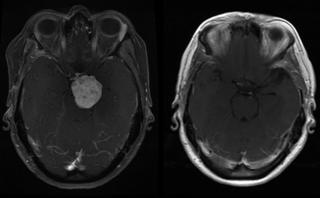
  • Gadolinium is toxic alone, but when paired with chelators it can be used in humans and allows for better characterization of tumors or abnormal tissue on MRI.
  • It helps identify this abnormal tissue because when MRI causes polarization of our body's cells, the gadolinium, which has the maximum number of unpaired electrons in its orbital shells, alters the rate of decay in abnormal tissue highlighting abnormalities on imaging.
  • Gadolinium can also be used in the treatment of cancers because it collects in the cells of abnormal tissue, allowing for more targeted therapies.
  • In people exposed to gadolinium, the anaphylaxis rate is low, below 1/1000, and in rare cases there are reports of kidney injury and nephrogenic systemic fibrosis which is why it's not recommended in renal failure patients.

References

1)Ibrahim MA, Hazhirkarzar B, Dublin AB. Magnetic Resonance Imaging (MRI) Gadolinium. [Updated 2020 Mar 9]. In: StatPearls [Internet]. Treasure Island (FL): StatPearls Publishing; 2020 Jan-. Available from: https://www.ncbi.nlm.nih.gov/books/NBK482487/

2)Pasquini L, Napolitano A, Visconti E, et al. Gadolinium-Based Contrast Agent-Related Toxicities [published correction appears in CNS Drugs. 2018 May 15;:]. CNS Drugs. 2018;32(3):229-240. doi:10.1007/s40263-018-0500-1

Summarized by Jackson Roos, MS4 | Edited by Erik Verzemnieks, MD

Avsnitt(1146)

Podcast # 481: Medical Errors and Cognitive Bias

Podcast # 481: Medical Errors and Cognitive Bias

Contributor: Peter Bakes, MD Educational Pearls: While there are many different types of medical error, one of the most common errors in emergency medicine is failure to diagnose Systematic error in ...

21 Juni 20196min

Podcast # 480: Inhalant Abuse

Podcast # 480: Inhalant Abuse

Author: Sam Killian, MD Educational Pearls: Abuse occurs by breathing in volatile substances such as solvents, glues, paints, butane, and propane Inhalants are generally depressants Estimated that 10...

19 Juni 20194min

Podcast # 479: Clots and Pregnancy

Podcast # 479: Clots and Pregnancy

Author: Nick Hatch, MD Educational Pearls: Pregnancy is a hypercoagulable state, which predisposes women to venous thromboembolism, but also elevates levels of circulating d-dimer A recent study eva...

17 Juni 20193min

Podcast # 478: Psychedelics and Depression

Podcast # 478: Psychedelics and Depression

Author: Chris Holmes, MD Educational Pearls: Hallucinogenic drugs have been in use since ancient times for both medical and recreational purposes Ayahausca is an ancient psychedelic with origins in B...

14 Juni 20193min

Podcast # 477: Postpolypectomy Electrocoagulation Syndrome

Podcast # 477: Postpolypectomy Electrocoagulation Syndrome

Author: Nick Hatch, MD Educational Pearls: Postpolypectomy electrocoagulation syndrome (PES) is a rare complication of polypectomy and electrocautery during colonoscopy Occurs when cautery causes tr...

12 Juni 20193min

Podcast # 476: Evidence for Patient Satisfaction

Podcast # 476: Evidence for Patient Satisfaction

Author: Dylan Luyten, MD Educational Pearls: Actual wait times are weakly correlated to patient satisfaction but the difference between perceived/expected wait times and actual wait times is strongly...

5 Juni 20194min

Podcast # 475: Orthostatic Vital Signs and Syncope

Podcast # 475: Orthostatic Vital Signs and Syncope

Author: Michael Hunt, MD Educational Pearls: A recent study evaluated the relationship between abnormal orthostatic vital signs and serious outcomes within 30 days in patients over 60 presenting to t...

2 Juni 20192min

Podcast # 474: Obesity Hypoventilation Syndrome

Podcast # 474: Obesity Hypoventilation Syndrome

Author: Peter Bakes, MD Educational Pearls: The differential diagnosis for pedal edema includes issues in the heart, kidney, and liver Obesity hypoventilation syndrome (OHS) is an important and commo...

29 Maj 20199min

Populärt inom Vetenskap

p3-dystopia
dumma-manniskor
svd-nyhetsartiklar
allt-du-velat-veta
kapitalet-en-podd-om-ekonomi
det-morka-psyket
rss-ufo-bortom-rimligt-tvivel
sexet
rss-vetenskapsradion
pojkmottagningen
rss-vetenskapsradion-2
dumforklarat
rss-broccolipodden-en-podcast-som-inte-handlar-om-broccoli
halsorevolutionen
rss-spraket
bildningspodden
hacka-livet
rss-experimentet
medicinvetarna
rss-lara-fran-larda-en-fackbok-och-en-forfattare