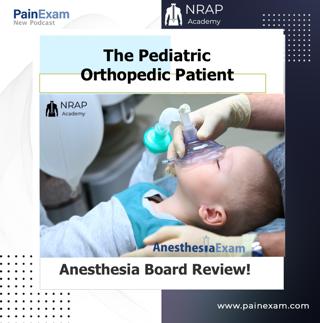
Pediatric Anesthesia Considerations in the  Orthopedic Patient

Pediatric Anesthesia Considerations in the Orthopedic Patient

Introduction: Providing anesthesia for pediatric orthopedic patients poses unique challenges for anesthesiologists. The approach must consider the psychological development of the child and the prevalence of respiratory infections. Pain management, management of concomitant diseases, and risk reduction for adverse events are crucial aspects of anesthetic care. This blog post will review the perioperative concerns specific to pediatric orthopedic procedures, discuss pain control methods used, and highlight anesthetic considerations for certain surgeries.

Listen to Audio via a Free Preview to our AnesthesiaExam Advanced Board Review Course or stay updated via our newsletter below

Claim CME Credit

Select Pediatric Perioperative Concerns:

  1. Upper Respiratory Tract Infections (URI): Pediatric patients presenting for orthopedic surgery with current or recent URIs pose a challenge for anesthesiologists and surgeons. Children commonly experience URIs with symptoms like a runny nose, cough, and fever. While the viral infection may reside in the nasopharynx, the lower respiratory tract remains sensitive for up to 6 weeks after URI symptoms have resolved. This increased sensitivity puts patients at risk for perioperative complications like laryngospasm, bronchospasm, and oxygen desaturation. Delaying surgery for 6 weeks after URI resolution is often impractical, as another URI is likely to occur. For elective surgery, severe symptoms and complications warrant postponing surgery, but clear nasal discharge in an otherwise healthy patient may proceed with elective surgery. Clinical decision-making becomes challenging for cases falling between these extremes. Factors such as patient age, comorbidities, prior cancellations, surgery complexity, and urgency are considered when deciding whether to postpone surgery. If elective surgery is delayed, most clinicians would wait 2 to 4 weeks after URI symptom resolution.
  2. Anxiety in the Pediatric Patient: Pediatric patients undergoing orthopedic surgery often experience varying levels of anxiety and distress. Preoperative stressors can include unfamiliar environments, procedures, hunger, fear of pain, and separation from parents. Certain risk factors contribute to preoperative anxiety, such as ages 1 to 5 years, shy temperament, prior negative medical experiences, high cognitive levels, and parental anxiety. Unaddressed anxiety can lead to postoperative behavioral changes, including generalized anxiety, separation anxiety, aggression, and nighttime crying. It can also result in higher pain scores and increased pain medication requirements after surgery. Strategies to mitigate preoperative anxiety include presurgical preparation programs involving site visits, videos, books, and child-life interventions. Allowing parental presence during anesthesia induction can help alleviate separation anxiety. Pharmacologic interventions like oral midazolam can improve compliance and reduce negative behavioral changes in the short term.

Anesthetic Management for Orthopedic Procedures:

  1. Anesthetic Considerations for Select Pediatric Orthopedic Surgeries: Scoliosis Surgery: Anesthetic concerns during scoliosis surgery include optimizing neuromonitoring signals, managing blood loss, preventing positioning-related injuries, and minimizing the risk of postoperative visual loss.

  2. Pain Management: Pain control for pediatric orthopedic patients involves a multimodal pharmacologic approach to minimize opioid requirements. This approach includes non-opioid analgesics, local anesthetics, and regional anesthesia techniques. Regional anesthesia, such as peripheral nerve blocks and caudal anesthesia, is particularly valuable for postoperative pain control. Recent studies have confirmed the safety of regional anesthesia in the pediatric population.

Pediatric orthopedic surgeries present unique challenges for anesthesiologists. Effective management of preoperative anxiety, careful consideration of upper respiratory tract infections, and appropriate pain control strategies are essential for successful outcomes. Anesthesiologists must tailor their approach to the specific needs of pediatric patients undergoing orthopedic procedures to ensure their safety and well-being.

Reference

Wu JP. Pediatric Anesthesia Concerns and Management for Orthopedic Procedures. Pediatr Clin North Am. 2020 Feb;67(1):71-84. doi: 10.1016/j.pcl.2019.09.006. PMID: 31779838; PMCID: PMC7172179.

Anesthesiology Board Review Newsletter

Subscribe for Discounts, Free Videos, Course Calendar & More! * indicates required Email Address * Ultrasound Block Course applicable in Pediatric Anesthesia for Orthopedic Procedures includes:
  • Certificate of Completion
  • Ultrasound Guided Interventional Pain Atlas
  • Continuing Medical Education Credit
  • Online access to Webinar (additional CME Credit)

Regional Anesthesia:

Lower Extremity Nerve Blocks for

Upper Extremity Anesthesia for Fractures and Reductions

Truncal and Fascial Plane Blockade

and much more!

Caudal Epidural and Spine demonstrations available as well.

Register Now!

Or Email DRosenblum@rmcpain.com to arrange a private workshop with your Department.

NRAP Academy: Ultrasound Guided Regional Anesthesia and Interventional Pain Workshops

Subscribe for Discounts, Free Videos, Course Calendar & More! * indicates required Email Address *

Det här avsnittet är hämtat från ett öppet RSS-flöde och publiceras inte av Podme. Det kan innehålla reklam.

Avsnitt(98)

Occipital Neuralgia and Compression Fractures for the Boards

Occipital Neuralgia and Compression Fractures for the Boards

PainExam Podcast Show Notes Compression Fractures, Vertebroplasty, Kyphoplasty & Occipital Neuralgia for the ABA Pain Medicine Boards In this episode of the PainExam Podcast, Dr. David Rosenblum revie...

29 Maj 14min
CRPS & Intrathecal Pain Pumps for the Anesthesia Boards

CRPS & Intrathecal Pain Pumps for the Anesthesia Boards

🎙️ PainExam Podcast Show Notes CRPS & Intrathecal Pain Pumps — High-Yield ABA Pain Board Review 🔥 Episode Overview In this episode of the PainExam Podcast, David Rosenblum reviews two essential ABA...

12 Maj 12min
Corticosteroids and Contrast for Pain Procedures: Anesthesia Board Prep Pearls!

Corticosteroids and Contrast for Pain Procedures: Anesthesia Board Prep Pearls!

🎙️ PainExam Podcast Show Notes Corticosteroids & Contrast Agents in Pain Management + Evidence-Based Steroid Selection 🔥 Episode Overview In this high-yield episode of the PainExam Podcast, David ...

29 Apr 16min
Facet Mediated Pain for the Anesthesia Boards

Facet Mediated Pain for the Anesthesia Boards

🎙️ AnesthesiaExam Podcast & Video Show Notes Spine Pain, Facet Syndromes, and Interventional Concepts for the Anesthesia Boards 🔥 Episode Overview In this episode of the AnesthesiaExam Podcast, Dav...

16 Apr 8min
Phantom Limb Pain and SI Joint Dysfunction for the Anesthesia & Pain Boards

Phantom Limb Pain and SI Joint Dysfunction for the Anesthesia & Pain Boards

🎙️ PainExam Podcast Show Notes Phantom Limb Pain & Sacroiliac Joint Dysfunction — High-Yield Pain Board Review 🔥 Episode Overview In this episode of the PainExam Podcast, David Rosenblum delivers ...

25 Mars 8min

What is Red Light Therapy?

What is Red Light Therapy?

PainExam Podcast Show Notes Red Light Therapy (Photobiomodulation) for Pain Evidence, Mechanisms, and Clinical Applications Host: Dr. David Rosenblum Red light therapy, also known as photobiomodulatio...

4 Mars 11min

What you need to know about Regenerative Pain Medicine- ASIPP Regenerative Med Talk

What you need to know about Regenerative Pain Medicine- ASIPP Regenerative Med Talk

Dr. Rosenblum from NRAP Academy presented a webinar on the integration of regenerative medicine into pain practices, highlighting its benefits and applications. He discussed the evolution of treating ...

12 Feb 17min

Meralgia Paresethetica for the Anesthesia Boards- NRAPpain.org

Meralgia Paresethetica for the Anesthesia Boards- NRAPpain.org

Meralgia Paresthetica Education and the Anesthesiology Boards This podcast episode from the NRAP Academy features Dr. David Rosenblum discussing Meralgia Paresthetica, a mononeuropathy affecting the l...

14 Jan 7min

Populärt inom Utbildning

historiepodden-se
rss-bara-en-till-om-missbruk-medberoende-2
det-skaver
harrisons-dramatiska-historia
nu-blir-det-historia
johannes-hansen-podcast
not-fanny-anymore
roda-vita-rosen
sektledare
allt-du-velat-veta
sa-in-i-sjalen
rss-foraldramotet-bring-lagercrantz
rss-viktmedicinpodden
rikatillsammans-om-privatekonomi-rikedom-i-livet
rss-om-vi-ska-vara-arliga
rss-max-tant-med-max-villman
i-vantan-pa-katastrofen
rss-traningsklubben
rss-sjalsligt-avkladd
rss-relationsrevolutionen