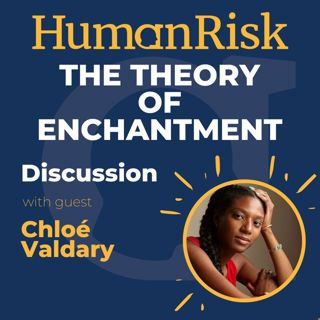
Chloé Valdary on The Theory of Enchantment

Chloé Valdary on The Theory of Enchantment

How can watching Disney movies, help create more inclusive environments? The answer is in the word Enchantment.

On this episode, I'm speaking to Chloé Valdary, the founder of an organisation called The Theory of Enchantment, to explore her unique approach to diversity, equity, and inclusion (DE&I) training. If you're someone for whom DE&I conjures up negative thoughts, then you're going to want to hear this. Because Chloé's approach is nothing like traditional DE&I.

This episode is the third in a mini-series looking at the subject — you'll find links to the other episodes below.

In a fascinating discussion, Chloé shares how her program blends philosophy, psychology, and culture to create environments of belonging and compassion. Together, we examine why many traditional DEI programs fall short and how her methodology seeks to address deeper human dynamics in workplaces.

We discuss the power of enchantment—a term Chloé uses to describe the balance between light and shadow in every individual—and how recognizing this balance allows us to foster more meaningful connections.

With references to popular culture, including Disney films like Beauty and the Beast, Chloé offers a compelling case for why empathy and self-reflection are essential tools in any organization’s toolkit.

You'll hear how The Theory of Enchantment can be used to address conflict, enhance collaboration, and ultimately create more innovative and inclusive spaces. Whether you’re a leader, manager, or simply curious about human behavior, this conversation offers practical insights that go beyond the traditional DEI framework.

Guest Biography
Chloé Valdary is the founder of Theory of Enchantment, an innovative approach to diversity, equity, and inclusion that blends philosophy, psychology, and popular culture to help organizations foster belonging.

Since its founding in 2018, Theory of Enchantment has been deployed in various organizations to build trust, compassion, and connection among employees.With a background in international studies and a concentration in conflict and diplomacy, Chloé has a unique perspective on building inclusive environments.

She draws on sources ranging from Carl Jung to Disney films to guide her transformative work. Chloé is also a writer and cultural critic, exploring how love and compassion can serve as the foundation for solving societal challenges.

Timestamped AI-generated Summary of Key Points
[00:00:00] Introduction to the episode and overview of the mini-series on diversity and inclusion.
[00:01:00] Background on previous episodes and why traditional DEI approaches need rethinking.
[00:02:00] Introduction of Chloé Valdary and the Theory of Enchantment.
[00:03:00] What "enchantment" means in the context of DEI training.
[00:04:00] Exploring the balance between light and shadow in human behavior.
[00:06:00] How popular culture, like Disney films, reflects deeper human truths.
[00:09:00] Using self-reflection to build trust and navigate conflict in the workplace.
[00:11:00] How diversity leads to innovation through self-understanding.
[00:15:00] The need to address insecurities and biases to build inclusive teams.
[00:18:00] Criticizing to uplift and empower, not to tear down.
[00:22:00] How recognizing insecurities can resolve conflict and build trust.
[00:25:00] The importance of creating space for emotional vulnerability at work.
[00:30:00] Theory of Enchantment’s practical application in organizations.
[00:33:00] Using design thinking to develop tailored DEI solutions.
[00:36:00] The three core principles of Theory of Enchantment. [00:42:00] Historical examples of reconciliation and conflict resolution.
[00:49:00] Chloé’s background and inspiration for the Theory of Enchantment.
[01:03:00] Closing thoughts and how to learn more about Chloé’s work.

Relevant Links:

The Theory of Enchantment - https://www.theoryofenchantment.com/

The Atlantic article 'Can Chloé Valdary sell skecptics on DEI?' - https://www.theatlantic.com/ideas/archive/2021/01/can-chloe-valdary-sell-skeptics-dei/617875/

The previous episodes of the mini-series:

Chloé Valdary, Morgan Hamel & Peter Stein on De-Polarized Diversity, Equity & Inclusion - https://www.humanriskpodcast.com/chloevaldary-morganhamel-peterstein-on-diversity-equity-inclusion/

Morgan Hamel on Moral Polarization - https://www.humanriskpodcast.com/morgan-hamel-on-moral-polarization/

Det här avsnittet är hämtat från ett öppet RSS-flöde och publiceras inte av Podme. Det kan innehålla reklam.

Avsnitt(368)

Nick & Gio Gallo on Compliance 3.0

Nick & Gio Gallo on Compliance 3.0

How can Compliance feel less burdensome & more aligned with the businesses it is there to protect? In this episode, I return to exploring how Compliance, a 'brand' I hate but forms a cornerstone of m...

20 Jan 202157min

Dr Magda Osman on Unconscious Bias - what is it & can we train people to not display it?

Dr Magda Osman on Unconscious Bias - what is it & can we train people to not display it?

What is Unconscious Bias? It's a term we've been hearing a lot recently and you might even have been sent on training to help you understand and manage it. That's what I began exploring with Dr Magda...

15 Jan 20211h 3min

Andra Popa on how Art & Design can inspire Compliance

Andra Popa on how Art & Design can inspire Compliance

What can Compliance learn from Art & Design? They're not normally things we associate together. But my guest on this episode, Andra Popa has a background in art. She then became a Lawyer and finally...

8 Jan 202153min

Gerald Ashley & Rory Sutherland on Prosilience

Gerald Ashley & Rory Sutherland on Prosilience

What is Prosilience, and how can organisations ensure their people provide it? That’s where the discussion between my guests on this episode, Gerald Ashley and Rory Sutherland, begins. Where it goes ...

28 Dec 202041min

Rory Sutherland & Gerald Ashley on Networks

Rory Sutherland & Gerald Ashley on Networks

How do networks influence our decision-making?As the Human Risk podcast approached its 100th episode, I thought I’d invite back two guests whose previous appearances have been amongst the most downloa...

26 Dec 202045min

Mark Heywood on Human Risk In The Creative Industries

Mark Heywood on Human Risk In The Creative Industries

On the face of it, the creative industry ought to be very good at adapting it's thinking. After all, people who can think creatively, ought to be able to adapt the way they do things. But, as we've ...

22 Dec 202057min

Jim Oates on how a No Surprises approach can help manage risk

Jim Oates on how a No Surprises approach can help manage risk

When things go wrong in companies, it's usually accompanied by a sense of surprise on the part of senior management. Given we know that employing people will result in some form of Human Risk, wouldn...

21 Dec 20201h 3min

Trisha Ferguson on the psychology & design of Airline Safety Cards

Trisha Ferguson on the psychology & design of Airline Safety Cards

How can we prevent poor decision-making at a time of stress, when human action can make a real difference? That's what my guest on this episode, Trisha Ferguson, helps to deliver. She's the CEO of In...

17 Dec 20201h 8min

Populärt inom Vetenskap

allt-du-velat-veta
p3-dystopia
dumma-manniskor
rss-ufobortom-rimligt-tvivel
kapitalet-en-podd-om-ekonomi
ufo-sverige
svd-nyhetsartiklar
rss-spraket
paranormalt-med-caroline-giertz
hacka-livet
medicinvetarna
dumforklarat
rss-vetenskapsradion
det-morka-psyket
ufo-sverige-2
sexet
rss-tidsmaskinen
halsorevolutionen
rss-tidslinjen-podcast
rss-vetenskapsradion-2