
How To Build Your Own Auth

How To Build Your Own Auth

In this episode of Syntax, Scott and Wes talk about building your own authentication — diving deep into JWT, sessions, tokens, cookies, local storage, CSRF, and how it all works! Prismic - Sponsor Prismic is a Headless CMS that makes it easy to build website pages as a set of components. Break pages into sections of components using React, Vue, or whatever you like. Make corresponding Slices in Prismic. Start building pages dynamically in minutes. Get started at prismic.io/syntax. LogRocket - Sponsor LogRocket lets you replay what users do on your site, helping you reproduce bugs and fix issues faster. It’s an exception tracker, a session re-player and a performance monitor. Get 14 days free at logrocket.com/syntax. Hasura - Sponsor With Hasura, you can get a fully managed, production-ready GraphQL API as a service to help you build modern apps faster. You can get started for free in 30 seconds, or if you want to try out the Standard tier for zero cost, use the code “TryHasura” at this link: hasura.info. We’ve also got an amazing selection of GraphQL tutorials at hasura.io/learn. Show Notes 01:51 - Overview Level Up uses a JWT & secure cookie-based authentication and tracks sessions via a db table. Accounts.js 05:13 - JWT Base 64 encoded (not encrypted) token that contains data. We have both accessTokens and refreshTokens. JWT has three parts: Header What kind of algo was used Payload Data about the user Email Username UserID refreshToken, authToken, sessionId Signature This ensures that no one monkeyed with the above parts. If you change your email in the payload, the signature is not invalid, because in order to generate the signature, it uses the header and payload as part of it. accessToken A short lived JWT that contains the sessionToken, userId and expires after 90min. refreshToken A long lived JWT that contains just the sessionToken and doesn’t expire. JWT can be decoded and read, but you have to encode them with your secret. JWT can be stored anywhere, there are two main places: 20:26 - Cookies We use httpOnly, secure cookies to store the accessToken and the refreshToken. The accessToken is a session cookie and is removed whenever the browser is closed. The refreshToken is valid for 100 days but is also re-created and revalidated for 100 more days each time the accessToken is generated. Because these are httpOnly cookies, they cannot be accessed by JavaScript in the client and can only be set and removed on the server. Note: Safari has stricter rules than others for same domain cookies (e.g. localhost won’t work). 34:26 - Sessions Sessions are when a user logs in on a device. If you open a phone and log in and a computer and log in, those will create two different sessions. A session contains information about the user’s connection (like their IP) but it also contains the userId which allows us to create new accessTokens from a valid session. Sessions can be valid or invalid. This allows us to log anyone out by setting their session to valid: false. Sessions also have sessionToken which are generated on authentication or create account. 38:10 - CORS Cross-origin-resource-sharing Can be super tricky to get working cross-domain You usually have to actually visit the website for the cookie to be set, even with lax cors 46:06 - CSRF 48:47 - Authentication process bcrypt.js 52:13 - Helper Packages NextAuth.js is super easy Passport.js auth0 Links Caddy Fastify ××× SIIIIICK ××× PIIIICKS ××× Scott: reMarkable 2 Wes: Opration Odessa Shameless Plugs Scott: Node Fundamentals Authentication - Sign up for the year and save 25%! Wes: Advanced React - Use the coupon code ‘Syntax’ for $10 off! Tweet us your tasty treats! Scott’s Instagram LevelUpTutorials Instagram Wes’ Instagram Wes’ Twitter Wes’ Facebook Scott’s Twitter Make sure to include @SyntaxFM in your tweets

Det här avsnittet är hämtat från ett öppet RSS-flöde och publiceras inte av Podme. Det kan innehålla reklam.

Avsnitt(1050)

1050 - Everyone Is Hacking Their TV

1050 - Everyone Is Hacking Their TV

Wes, Scott, and CJ run through the week’s biggest web dev news: everyone’s hacking their TVs, VoidZero open-sourced its Void framework with Cloudflare deploys, OpenCode got hacked, and Anthropic built...

26 Okt 1h 19min

1049: WTF is a Software Factory?

1049: WTF is a Software Factory?

Scott and Wes talk with Adam Jacob about software factories: what they actually are, why they’re unique to each team, and how to build trust in agent-generated code. They dig into Swamp Club, black bo...

21 Okt 57min
1048: Deno Is Dead

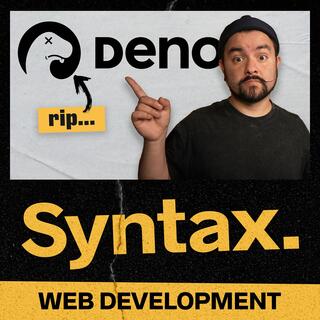
1048: Deno Is Dead

Deno is shutting down and the team is heading to Cloudflare — Scott, Wes, and CJ break down what that means for the runtime, JSR, and workerd. Plus OpenCode 2.0 on durable objects, TanStack Start 1.0,...

19 Okt 1h 40min
1047: Adobe has a big problem

1047: Adobe has a big problem

Someone just clean-room ported seven Adobe apps to Rust, and Wes is shocked at how good it is. Scott and Wes break down what it gets right, what’s still missing, and why copying software is easy but i...

14 Okt 35min
1046: The Pi Updates are insane

1046: The Pi Updates are insane

Scott, Wes, and CJ break down the latest Pi updates, including durable long-running agents, Codemode, and MCP support, then debate whether pull requests are dead in favor of issues. Plus Supabase pick...

12 Okt 1h 40min
1045: Who can actually max out 5 AI subscriptions?

1045: Who can actually max out 5 AI subscriptions?

Scott and Wes answer listener questions about what replaced blogging, what to do while your AI agent works, and who should pay for token costs. They also cover keeping agents from going off the rails,...

7 Okt 52min
1044: Ruby on Rails is Dead

1044: Ruby on Rails is Dead

Scott, Wes, and CJ ask whether Ruby on Rails is really dead (and whether Rust is just Rails you don't have to read), then dig into Meta's new Muse agent, which is free, comes with its own VM, and is a...

5 Okt 1h 20min
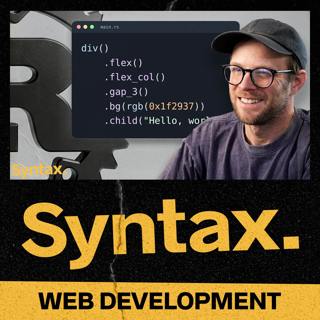
1043: I’m Using GPUI For Everything

1043: I’m Using GPUI For Everything

Scott and Wes ditch Electron and Tauri for GPUI, the GPU accelerated Rust UI framework from the Zed team. They get into its React-like API, styling that feels a lot like Tailwind, GPUI Kit components,...

30 Sep 32min

Populärt inom Politik & nyheter

svenska-fall
fordomspodden
aftonbladet-krim
motiv
p3-krim
rss-krimstad
flashback-forever
rss-sparra-in-isa-tilda
aftonbladet-daily
rss-expressen-dok
rss-sanning-konsekvens
rss-krimreportrarna
svd-ledarredaktionen
rss-vad-fan-hande
kungligt
omni-podd
rss-flodet
spar
rss-frandfors-horna
olyckan-inifran