

How To Build Your Own Auth

How To Build Your Own Auth

In this episode of Syntax, Scott and Wes talk about building your own authentication — diving deep into JWT, sessions, tokens, cookies, local storage, CSRF, and how it all works! Prismic - Sponsor Prismic is a Headless CMS that makes it easy to build website pages as a set of components. Break pages into sections of components using React, Vue, or whatever you like. Make corresponding Slices in Prismic. Start building pages dynamically in minutes. Get started at prismic.io/syntax. LogRocket - Sponsor LogRocket lets you replay what users do on your site, helping you reproduce bugs and fix issues faster. It’s an exception tracker, a session re-player and a performance monitor. Get 14 days free at logrocket.com/syntax. Hasura - Sponsor With Hasura, you can get a fully managed, production-ready GraphQL API as a service to help you build modern apps faster. You can get started for free in 30 seconds, or if you want to try out the Standard tier for zero cost, use the code “TryHasura” at this link: hasura.info. We’ve also got an amazing selection of GraphQL tutorials at hasura.io/learn. Show Notes 01:51 - Overview Level Up uses a JWT & secure cookie-based authentication and tracks sessions via a db table. Accounts.js 05:13 - JWT Base 64 encoded (not encrypted) token that contains data. We have both accessTokens and refreshTokens. JWT has three parts: Header What kind of algo was used Payload Data about the user Email Username UserID refreshToken, authToken, sessionId Signature This ensures that no one monkeyed with the above parts. If you change your email in the payload, the signature is not invalid, because in order to generate the signature, it uses the header and payload as part of it. accessToken A short lived JWT that contains the sessionToken, userId and expires after 90min. refreshToken A long lived JWT that contains just the sessionToken and doesn’t expire. JWT can be decoded and read, but you have to encode them with your secret. JWT can be stored anywhere, there are two main places: 20:26 - Cookies We use httpOnly, secure cookies to store the accessToken and the refreshToken. The accessToken is a session cookie and is removed whenever the browser is closed. The refreshToken is valid for 100 days but is also re-created and revalidated for 100 more days each time the accessToken is generated. Because these are httpOnly cookies, they cannot be accessed by JavaScript in the client and can only be set and removed on the server. Note: Safari has stricter rules than others for same domain cookies (e.g. localhost won’t work). 34:26 - Sessions Sessions are when a user logs in on a device. If you open a phone and log in and a computer and log in, those will create two different sessions. A session contains information about the user’s connection (like their IP) but it also contains the userId which allows us to create new accessTokens from a valid session. Sessions can be valid or invalid. This allows us to log anyone out by setting their session to valid: false. Sessions also have sessionToken which are generated on authentication or create account. 38:10 - CORS Cross-origin-resource-sharing Can be super tricky to get working cross-domain You usually have to actually visit the website for the cookie to be set, even with lax cors 46:06 - CSRF 48:47 - Authentication process bcrypt.js 52:13 - Helper Packages NextAuth.js is super easy Passport.js auth0 Links Caddy Fastify ××× SIIIIICK ××× PIIIICKS ××× Scott: reMarkable 2 Wes: Opration Odessa Shameless Plugs Scott: Node Fundamentals Authentication - Sign up for the year and save 25%! Wes: Advanced React - Use the coupon code ‘Syntax’ for $10 off! Tweet us your tasty treats! Scott’s Instagram LevelUpTutorials Instagram Wes’ Instagram Wes’ Twitter Wes’ Facebook Scott’s Twitter Make sure to include @SyntaxFM in your tweets

Avsnitt(990)

990: Vite Is Taking Over (Vite+)

990: Vite Is Taking Over (Vite+)

Wes, Scott, and CJ talk about Vite+, a unified JavaScript toolchain that combines linting, formatting, task running, monorepos, and more. They break down its evolution, open-source shift, performance ...

25 Mars 33min
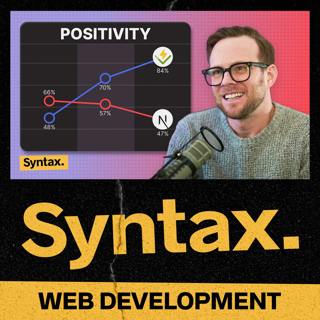
989: State of JS 2025

989: State of JS 2025

Scott and Wes dig into the latest State of JS survey results, breaking down which JavaScript libraries, frameworks, and tools are rising, falling, or holding steady in the ever-shifting JS ecosystem. ...

23 Mars 1h 4min

988: Cloudflare’s Next.js Slop Fork

988: Cloudflare’s Next.js Slop Fork

Wes and Scott talk with Steve Faulkner about vinext, a Vite-powered Next.js fork. They dive into AI coding workflows, agent browsers, code quality, and what modern dev tooling looks like in an AI-firs...

18 Mars 47min

987: Remote Coding Agents

987: Remote Coding Agents

Scott and Wes break down the world of remote coding agents — what they are, why you’d want one, and all the different ways you can run them, from Cursor Cloud and Claude Code to an old laptop sitting ...

16 Mars 47min

986: Does Code Quality Matter Anymore?

986: Does Code Quality Matter Anymore?

In this potluck episode, Wes and Scott answer your questions about popover navigation patterns, the Vibrate API on iOS, whether code quality still matters in the AI era, Wes’s evolving Obsidian second...

11 Mars 58min
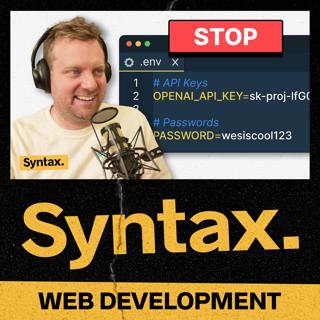
985: Stop putting secrets in .env

985: Stop putting secrets in .env

Scott and Wes are joined by Phil Miller and Theo Ephraim to talk about Varlock, a new approach to environment variables that adds schemas, validation, and security to the humble .env file. They dig in...

9 Mars 47min

984: How to Make a DOM Library Render Anything w/ Paolo Ricciuti

984: How to Make a DOM Library Render Anything w/ Paolo Ricciuti

Wes and Scott talk with Paolo Ricciuti about Svelte custom renderers and how Svelte actually talks to the DOM. They dig into compiler internals, CSS handling, native bridges, and the realities of main...

4 Mars 49min

983: Why I Chose Electron Over Native (And I’d Do It Again)

983: Why I Chose Electron Over Native (And I’d Do It Again)

Wes and Scott talk about building v_framer, Scott’s custom multi-source video recording app, and why Electron beat Tauri and native APIs for the job. They dig into MKV vs WebM, crash-proof recording, ...

2 Mars 37min

Populärt inom Politik & nyheter

svenska-fall
p3-krim
aftonbladet-krim
spar
fordomspodden
rss-krimstad
flashback-forever
rss-sanning-konsekvens
motiv
aftonbladet-daily
krimmagasinet
rss-krimreportrarna
rss-frandfors-horna
rss-vad-fan-hande
politiken
grans
rss-flodet
sydsvenskan-dok
dagens-eko
rss-aftonbladet-krim