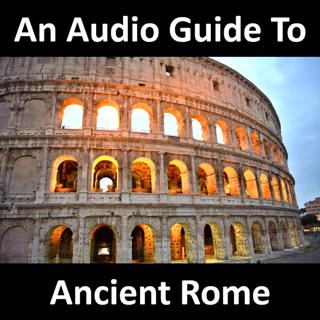
34: The Mausoleum of Augustus

34: The Mausoleum of Augustus

Augustus started building the mausoleum following his victory over Anthony and Cleopatra in 31 BCE at the naval battle on the west coast of Greece close to the promontory of Actium – his success brought an end to the civil war and meant that Egypt transitioned to be a Roman province. Augustus’ cremated ashes wouldn’t be placed inside for another 45 years however he would see it serve as the tomb for several imperial family members and close friends during his lifetime. Today this imperial burial site is surrounded by a combination of somewhat brutal architecture from the 1930s, a church hospital and a modern museum dedicated to Augustus’ transplanted and reconstructed Ara Pacis. However, when first completed the Mausoleum would have dominated the landscape as it was tall, strategically positioned in a large open area and visible from a long distance, it was also placed close by the Via Flaminia and the Tiber – both major access routes for Rome.

Considering the historical significance of the building, the Mausoleum has suffered (and continues to receive) a surprising level of neglect. At the time of this recording in October 2020 there is still no visitor access despite millions of dollars and multi-year efforts to renovate and re-open the site. That said, given the adjacency of Ara Pacis museum, if you’re already there, it is worth taking a few minutes to look across to the final resting place of the first and perhaps greatest Roman Emperor.

What remains is principally the central core and foundation structure of a huge circular tomb. The design of the upper tiers is the subject of speculation as there are no remaining original external walls and no contemporary evidence in coins, sketches or sufficiently detailed descriptions to allow a confident reconstruction. That said, we do have one account by Strabo a Greek geographer and historian who lived in Asia Minor during the transitional period of the Roman Republic into the Roman Empire. Writing about the Campus Martius (Field of Mars) shortly after Augustus’ death he says:

For this reason, in the belief that this place was holiest of all, the Romans have erected in it the tombs of their most illustrious men and women. The most noteworthy is what is called the Mausoleum, a great mound near the river on a lofty foundation of white marble, thickly covered with ever-green trees to the very summit. Now on top is a bronze image of Augustus Caesar; beneath the mound are the tombs of himself and his kinsmen and intimates; behind the mound is a large sacred precinct with wonderful promenades; and in the center of the Campus is the wall (this too of white marble) round his crematorium; the wall is surrounded by a circular iron fence and the space within the wall is planted with black poplars.
The circular mausoleum had a diameter of 300 feet (roughly 89meters) with its entrance to the south – which faces towards the rear of the Chiesa di San Rocco all’Augusteo. The entrance way led into a roughly 40m wide series of concentric walls that themselves formed three circular corridors. Each of these corridors had a barrel vault and they surrounded a spiral staircase in the middle of the mausoleum that wound its way up 30meters to the sepulcher where we imagine the ashes of the deceased were placed. Directly above this area was the pinnacle structure that supported the large statue of Augustus mentioned by Strabo.

In front of the entrance were two bronze plaques attached to pilasters on either side of the main doors. These contained the text of the Res Gestae a personal account of Augustus’ accomplishments.

If you are visiting the site then consider going to the outside wall of the Ara Pacis museum to the side that faces the Mausoleum. There you will find a complete copy of this latin text which goes into detail of Augustus’ political career; the offices and political honors that he held.

Sometime before the fourth century the entrance to the Mausoleum gained two plain obelisks of red Aswan granite. These are gone from the site and are now positioned in the Piazza del Quirinale and in front of Basilica di Santa Maria Maggiore. In the Middle Ages, the Mausoleum was converted into a fortress and later a site for formal gardens.

In the Eighteenth Century, the area inside the upper terrace was used for bullfights, then for circus and theatrical performances, and in the Twentieth Century, before restoration began it was used as a venue for concerts. Plans to re-open the site remain unclear given the slow progress of the renovation – the latest target date of spring 2020 has clearly not been met.

Image: "Rome. Mausoleum of Augustus." by Sergey Sosnovskiy is licensed under CC BY-SA 2.0

Det här avsnittet är hämtat från ett öppet RSS-flöde och publiceras inte av Podme. Det kan innehålla reklam.

Avsnitt(36)

28: Trajan's Column

28: Trajan's Column

Trajan’s Column is a monument to Emperor Trajan’s victory in the wars with Dacia that took place between the years 101 and 106.  It was part of a sequence of constructions built by or dedicated to Tra...

25 Feb 20218min

35: The Column of Marcus Aurelius

35: The Column of Marcus Aurelius

This monument celebrates Marcus Aurelius’ two successful military campaigns against tribes north of the Danube in what is modern day Germany.  The first campaign ran from the year 172-173 and was wage...

17 Okt 202011min

33: The Theater of Marcellus

33: The Theater of Marcellus

The Theater was named after Emperor Augustus’ nephew Marcus Claudius Marcellus however the building was originally commissioned by Julius Caesar who bought and cleared the land in a space to the south...

3 Okt 202010min

32: The Pyramid of Cestius

32: The Pyramid of Cestius

The Pyramid of Cestius was built during the reign of the emperor Augustus, probably between 18 and 12 BCE. It’s surface is white Carrara marble and the tip is exactly 100 Roman feet (30 meters) high. ...

26 Sep 20207min

12: The Temple of Vesta

12: The Temple of Vesta

The Temple of Vesta was integrated into the adjacent House and Sanctuary of the Vestal Virgins. The only remains of the temple itself are a modest mound of concrete however there is a reconstruction o...

20 Sep 20204min

13: Temple of Divus Romulus

13: Temple of Divus Romulus

The Temple of Divus Romulus is recognizable as a tall round building on the North side of the Via Sacra. From the name you can be forgiven for thinking that this temple is dedicated to Romulus the leg...

20 Sep 20205min

14: Temple of Antoninus and Faustina

14: Temple of Antoninus and Faustina

The Temple of Antoninus and Faustina is easily recognized by the six columns that dominate its front – these are topped by an entablature that carries the dedication to “Divo Antonino et Divae Faustin...

20 Sep 20205min
Populärt inom Utbildning

historiepodden-se
rss-bara-en-till-om-missbruk-medberoende-2
det-skaver
harrisons-dramatiska-historia
roda-vita-rosen
nu-blir-det-historia
johannes-hansen-podcast
allt-du-velat-veta
sektledare
rss-viktmedicinpodden
i-vantan-pa-katastrofen
rss-foraldramotet-bring-lagercrantz
rss-basta-livet
not-fanny-anymore
rss-max-tant-med-max-villman
rss-relationsrevolutionen
sex-pa-riktigt-med-marika-smith
sa-in-i-sjalen
rss-sjalsligt-avkladd
rikatillsammans-om-privatekonomi-rikedom-i-livet