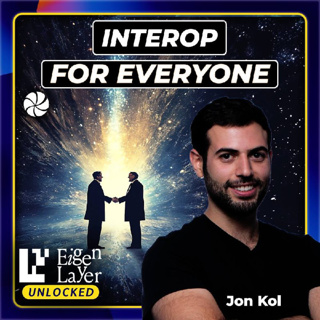


Modular March EP 19: The Power of Fuel Network's Rollup OS
Another episode with an Ethereum scaling OG, Nick Dodson, who pioneered the original idea of optimistic rollups before they were the norm. Nick is actually also working on an innovative concept called fast finality optimistic rollups, which we are going to line up another episode for. The team behind Fuel has been working tirelessly for several years to bring their vision to life, and we getting very close to mainnet. In this presentation, we explore the “Rollup OS” of Fuel, powered by the Fuel Virtual Machine (FuelVM), which is notable for its integration of the UTXO model extended for sophisticated transactions including smart contracts. We discussed this in-depth, seeing as the UTXO model has gotten a bit of a bad rap (shoutout Cardano). The Fuel VM also utilizes a hybrid proving model, combining the strengths of optimistic rollups and zk proofs to ensure the integrity and efficiency of transactions. We went onto discuss the "rollup trilemma" and the ways in which Nick is striving to achieve optimal performance, sustainability, and interoperability without compromising on any single front. We pushed back on some of the design choices around Fuel’s customized programming language, Sway, and why this is the choice they made. Nick gave us a quick demo of a very cool compiler tool as well, some sweet alpha there. Get ready for the modular expansion, its happening quickly.
8 Apr 202446min
Modular March EP 18: Unveiling Blobstream and Celestia's Node Architecture
The core innovation of data availability in the modular landscape revolves around minimalism. Due to the minimal smart contract execution capabilities of altDA chains, they can focus solely on providing a specialized service of data verification & publishing. In addition to the design of minimal blocks, these chains are able to perform a unique task of Data Availability Sampling (DAS) which is a revolutionary innovation for blockchain scaling. In today’s presentation, we sit down with John Adler, an Ethereum OG and creator of optimistic rollups. We take a deep, technical dive through the various node types (full, light, and partial) in Celestia’s architecture. After that, we took a second to digest and summarize and then dove right into Blobstream, another cornerstone of Celestia's approach. Blobstream acts as a one-way relay for data attestations between Celestia and other blockchains and recently has been deployed in testnet on Base and Arbitrum Orbit. We also touched on the development of Succint’s Blobstream X, and their zk version of Blobstream. Finally, we asked some rapid fire questions about Celestia’s design and John’s perspectives on the modular space at large. Enjoy!
5 Apr 202455min
Modular March EP 17: Modularity is a Meme with Scroll
Not sure we need to write too much about this one! We mostly laughed and had a good time while understanding the definitions of some key terms in the space. Togruhl, one of the early Ethereum contributors and Scroll co-founders, gave us a presentation on his mental models for modular and monolithic design structures. What was particularly interesting was the idea which Togruhl posed about the convergence of these two ideologies into nearly the same place. Monolithic chains will modularize. Modular chains will enshrine more functionality. We also asked if he thinks Celestia is more of a competitor for Ethereum than Solana. Togruhl then posed the question “Is Celestia really modular?” which was kind of mindblowing. Big definitions guy over here. We think you’ll really enjoy this one and we had a bunch of great takeaways which were driven by out of the box thinking.
4 Apr 202446min
Wormhole Token Launch: Everything You Need to Know
Finally! Wormhole $W token is here. After a three year journey of shipping filled of ups and downs, Wormhole has announced they are taking the path to decentralizing their community. If you've been navigating the onchain world, you've probably heard the buzz about Wormhole's token, $W (and hopefully qualified for the airdrop). Wormhole has long stood as a critical infrastructure in the blockchain world, offering a bridge that seamlessly connects over 30 chains across five different runtimes. At its core, $W aims to fortify the bridge between diverse blockchain ecosystems, rewarding those who've journeyed with Wormhole over the years. We discussed the reward distribution mechanism of the historic users of Wormhole and specific NFT communities like MadLads. We also talked about the emphasis on cross-chain governance and the general tokenomics of $W. From exploring incentives for governance participants to contemplating novel uses within the Wormhole ecosystem, Robinson and the Wormhole team have their sights set on targets for this year. Congrats to everyone who qualified, and hope you enjoy this!
3 Apr 202444min
Modular March EP 16: Where Eclipse & SVM Fit in The Modular Thesis
Typically, you wouldn’t think of Solana having a strong footing in the modular thesis. After all, the design choices they have elegantly pioneered (credit where credit is due) revolve around scaling a single state machine. This simply won’t scale to billions of users, and they will need to modularize. However, the extremely performant and extensible Solana Virtual Machine (SVM) is an effective tool to build an extremely fast rollup atop Ethereum. We can all be friends here, right? Welcome to today's Modular March presentation, where we take our first dive as a team into the fascinating world of Eclipse and its modular approach to blockchain scalability and security. For those who've been around the block(chain), you know the drill: scalability often comes at the cost of complexity or security. Yet, Eclipse offers high throughput without the mess of state fragmentation via their flexible architecture. They're mixing the best of both worlds - Solana's speed and Ethereum's security, with a splash of Celestia for that decentralized data layer cherry on top. We enjoyed this presentation with Sydney while also trying to understand where the tradeoffs or weaknesses in this design lie. We found some edge-cases but what was most interesting was the application possibilities as a result of using the SVM. We had some solid takeaways, you’ll enjoy this.
2 Apr 202442min
Modular March EP 15: Where Espresso Fits In The Modular Thesis
We really enjoyed this presentation. While we’ve had multiple shared sequencers talks on Modular March, each one has been far different. Today’s deep dive is around the game theory and incentive designs behind creating a rollup ecosystem which feels completely seamless and interoperable. At its core, Espresso leverages a two part system to enforce how transactions are ordered and finalized across rollups via its sequencer. This system mirrors Ethereum's, but with a twist, aiming to streamline interactions between different rollups and thereby improve user experience significantly. We discussed the based sequencing approach, their auction & lottery mechanism, and where Espresso fits in the broader modular thesis. While we are bullish on Espresso (and Ellie is amazing), we didn’t let their vision go untouched so to speak. There were areas where we pushed back around the incentive designs and whether or not this would actually work in practice. We also tried to understand why potentially making things more complex is really the solution for scaling the modular L2 landscape. Also, if Espresso is another chain with trust assumptions, what tradeoffs does that bring for rollup operators? Finally the big question…Will rollup operators really want to use Espresso if it could cause a big revenue reduction? Ellie flipped that narrative on its head, ever so graciously. She helped us understand how Espresso works under the hood and answered our questions. We were impressed and left feeling extremely optimistic on shared sequencing. Happy April Fools Day (no jokes here, yet!) & let’s have a great week!
1 Apr 202448min
The Avail Unification Vision Unpacked
We’ve heard of the fragmentation problem many times in Modular March, and we’ve came to learn of a variety of solutions like shared sequencing, intents-based interop, and more. Today, in less than 10 minutes, we hear the vision from Avail’s head of product Dan Mills live from Modular Day in ETHDenver. Created in 2020 as part of Polygon, Avail emerged in response to Ethereum's shift toward a rollup-centric architecture, identifying a critical need for enhanced data availability in support of data-hungry rollups. Avail's foundational product, AvailDA, addresses this need by providing scalable, raw block space without necessitating base layer execution features (aka a specialized, modular blockchain). Through the use of validity proofs and KZG polynomial commitments, AvailDA ensures that light clients can trust the data's integrity through efficient random sampling. However, Dan thought past first order consequences and like many of us now realize, there will be thousands of chains. To counter this, Avail is introducing Nexus, a unification layer based on aggregating proofs from various chains to guarantee the accuracy of execution and state transitions. We also dive into Avail Fusion, the eventual security layer and third part of the Avail Trinity. Stay up to speed on the biggest upcoming modular project launch, Avail, in less than 10 minutes with Andy.
31 Mars 202414min
Monolithic Vs. Modular Short Debate with Aptos Co-Founder Avery Ching
If you are modular-pilled this will be a refreshing short chat. If you want to understand the counterargument to building in a modularized fashion, you’ll enjoy this. Andy sat down with Avery Chang, co-founder of Aptos to discuss his perspective on the modular thesis and understand why he is building Aptos in a more integrated fashion. Avery shared his perspective on the intricate dance between modularity and monolithic architectures in blockchain design, and why Aptos leans into the latter with the elegance of a ‘finely tuned sports car’ as a reference. Avery addressed concerns regarding centralization and scalability, explaining that a unified stack simplifies development and security processes. He highlighted the strength of Aptos's community, with over 400 developers contributing to its codebase, underscoring the project's potential for decentralization and scalability. The conversation also delved into Aptos's adoption of the Move VM, which Avery advocates for its ability to reduce the risks associated with smart contract development and introduce formal verification to the ecosystem. Sometimes we can be stuck in tunnel vision with our steadfast beliefs of modularity. It’s good to hear the other side. We’re still modularity enthusiasts, don’t you worry.
30 Mars 20245min