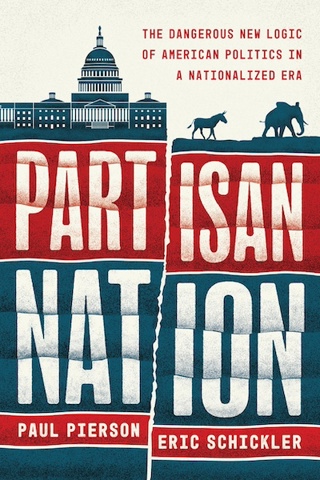

Partisan Nation: The Dangerous New Logic of American Politics in a Nationalized Era
Matrix Podcast10 Nov 2024

Partisan Nation: The Dangerous New Logic of American Politics in a Nationalized Era

Recorded on October 9, 2024, this video features an Authors Meet Critics panel on the book Partisan Nation: The Dangerous New Logic of American Politics in a Nationalized Era, by Paul Pierson, the John Gross Distinguished Professor of Political Science at UC Berkeley, and Eric Schickler, the Jeffrey & Ashley McDermott Professor of Political Science and co-director of the Institute of Governmental Studies at UC Berkeley.

The authors were joined in conversation by Francis Fukuyama, the Olivier Nomellini Senior Fellow at Stanford University's Freeman Spogli Institute for International Studies (FSI) and a faculty member of FSI's Center on Democracy, Development and the Rule of Law (CDDRL), and Didi Kuo, a Center Fellow at the Freeman Spogli Institute for International Studies (FSI) at Stanford University. Mark Danner, Professor at the UC Berkeley School of Journalism, moderated.

The Social Science Matrix Authors Meet Critics event series features lively discussions about recently published books authored by social scientists at UC Berkeley. For each event, the author discusses the key arguments of their book with fellow scholars. These events are free and open to the public.

About Partisan Nation

The ground beneath American political institutions has moved, with national politics subsuming and transforming the local. As a result, American democracy is in trouble. In this paradigm-shifting book, political scientists Paul Pierson and Eric Schickler bring a sharp new perspective to today's challenges. Attentive to the different coalitions, interests, and incentives that define the Democratic and Republican parties, they show how contemporary polarization emerged in a rapidly nationalizing country and how it differs from polarization in past eras.

In earlier periods, three key features of the political landscape—state parties, interest groups, and media—varied locally and reinforced the nation's stark regional diversity. But this began to change in the 1960s as the two parties assumed clearer ideological identities and the power of the national government expanded, raising the stakes of conflict. Together with technological and economic change, these developments have reconfigured state parties, interest groups, and media in self-reinforcing ways. The result is that today's polarization is self-perpetuating—and intensifying.

Partisan Nation offers a powerful caution. As a result of this polarization, America's political system is distinctly and acutely vulnerable to an authoritarian movement emerging in the contemporary Republican Party, which has both the motive and the means to exploit America's unusual Constitutional design. Combining the precision and acuity characteristic of their earlier work, Pierson and Schickler explain what these developments mean for American governance and democracy.

Watch the video on YouTube.

A transcript of this event is available at https://matrix.berkeley.edu/research-article/partisan-nation.

Det här avsnittet är hämtat från ett öppet RSS-flöde och publiceras inte av Podme. Det kan innehålla reklam.

Avsnitt(111)

Benjamin Recht: "The Irrational Decision: How We Gave Computers the Power to Choose for Us"

Benjamin Recht: "The Irrational Decision: How We Gave Computers the Power to Choose for Us"

Recorded on May 5, 2026, this video features a talk by Benjamin Recht, Professor of Electrical Engineering and Computer Sciences at UC Berkeley, focused on his book, The Irrational Decision: How We G...

14 Maj 1h 21min

Incommunicable: Toward Communicative Justice in Health and Medicine

Incommunicable: Toward Communicative Justice in Health and Medicine

Recorded on April 9, 2026, this Authors Meet Critics panel features the book Incommunicable: Toward Communicative Justice in Health and Medicine, by Charles Briggs, the Alan Dundes Distinguished Profe...

23 Apr 1h 12min
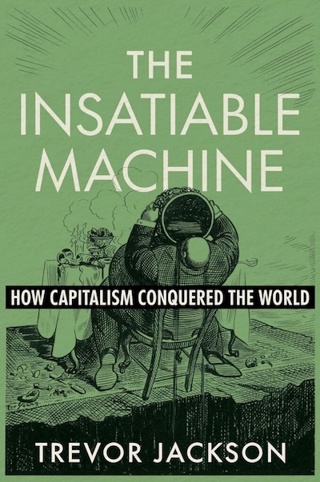
Authors Meet Critics: Trevor Jackson, "The Insatiable Machine: How Capitalism Conquered the World"

Authors Meet Critics: Trevor Jackson, "The Insatiable Machine: How Capitalism Conquered the World"

On April 7, 2026, Social Science Matrix hosted an Authors Meet Critics panel on the book The Insatiable Machine: How Capitalism Conquered the World, by Trevor Jackson, Associate Professor of History a...

23 Apr 1h 21min
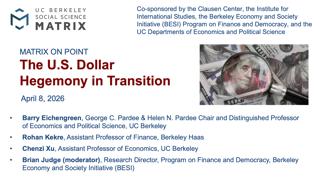
Matrix on Point: The U.S. Dollar Hegemony in Transition

Matrix on Point: The U.S. Dollar Hegemony in Transition

The global dominance of the U.S. dollar has long shaped international trade, financial markets, and geopolitical power. Amid shifting global dynamics and the rapid development of stablecoins and other...

23 Apr 1h

Julien Migozzi: "Algorithms of Distinction: Class, Credit Scores, and Property in South Africa"

Julien Migozzi: "Algorithms of Distinction: Class, Credit Scores, and Property in South Africa"

Recorded on March 18, 2026, this podcast features a lecture by Julien Migozzi, an economic geographer and Assistant Professor in Development Studies at the University of Cambridge. Dr Migozzi's lectur...

1 Apr 43min

California Spotlight: Higher Education Under Attack

California Spotlight: Higher Education Under Attack

Higher education is facing mounting pressures, from political intervention and financial challenges to attacks on academic freedom. These tensions are visible in the University of California system, w...

3 Mars 1h 6min

Matrix Teach-In: Ula Taylor, "The Making of Frances M. Beal's Black Feminist House"

Matrix Teach-In: Ula Taylor, "The Making of Frances M. Beal's Black Feminist House"

Recorded on February 19, 2026, this video presents a lecture by Ula Taylor, Professor and Chair of the Department of African American Studies & African Diaspora Studies. The talk centered on Professor...

3 Mars 42min

Matrix on Point: Corruption in America

Matrix on Point: Corruption in America

Corruption is a persistent challenge in America, shaping institutions, influencing policy, and eroding public trust. Understanding its roots, mechanisms, and consequences is essential for assessing th...

3 Mars 1h

Populärt inom Vetenskap

p3-dystopia
dumma-manniskor
allt-du-velat-veta
kapitalet-en-podd-om-ekonomi
rss-vetenskapsradion
rss-ufobortom-rimligt-tvivel
svd-nyhetsartiklar
rss-spraket
paranormalt-med-caroline-giertz
medicinvetarna
rss-vetenskapsradion-2
halsorevolutionen
det-morka-psyket
sexet
rss-odla
dumforklarat
rss-broccolipodden-en-podcast-som-inte-handlar-om-broccoli
vetenskapsradion
hacka-livet
kvalificerat-hemligt-poddradio